Earthworks Bring to Light Elaborate Ancient Burial in…
The unusually elaborate pithos burial dates…

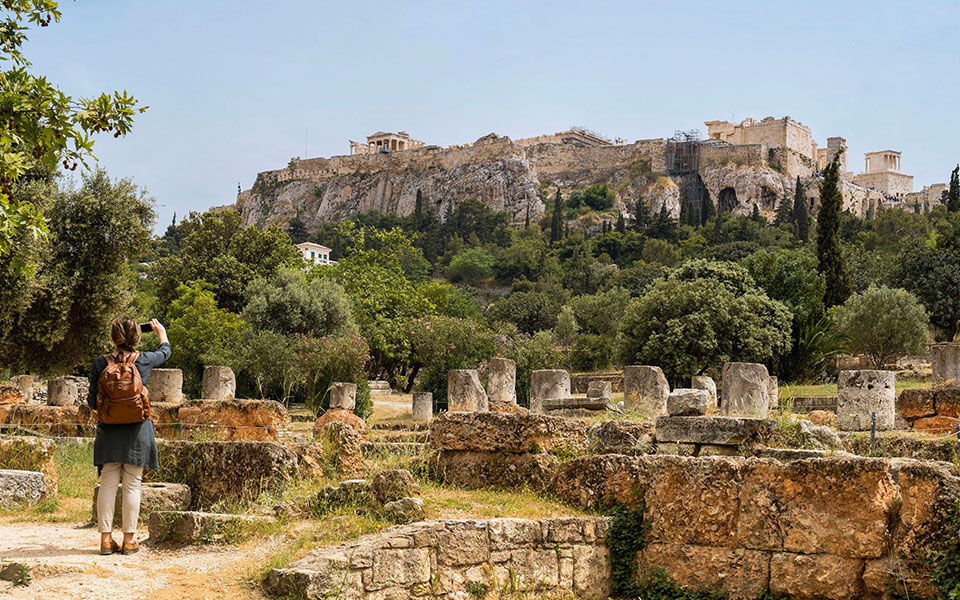
Ancient Agora, Athens
© Perikles Merakos
From prehistoric citadels to hillside sanctuaries, Greece’s archaeological sites have long enchanted travelers. Now, a new nationwide survey confirms that these ancient landmarks are doing more than inspiring awe – they’re also delivering high levels of visitor satisfaction and contributing meaningfully to modern Greek life.
The study, “Upgrading the Services Provided at Archaeological Sites and Their Impact on Society as a Whole,” carried out by the research firm PULSE for the Greek Ministry of Culture, takes a close look at how the public perceives both the value and the day-to-day experience of visiting the country’s monuments. The results paint a vivid picture of cultural heritage as a cornerstone of social well-being and economic vitality.
One of the survey’s central findings is the significant impact archaeological sites have on quality of life. Fifty-four percent of respondents said these cultural spaces contribute “quite a lot to very much” to their everyday experience – a figure that rises to 77 percent when moderate contributions are included. The economic implications appear even more striking: 73 percent of participants believe heritage sites contribute strongly to national development, and 90 percent see the overall benefit as “moderate to very high.”
“The entire Greek society recognizes the importance of archaeological sites in the economic development of our country, regardless of whether someone is a regular or occasional visitor,” noted George Arapoglou, General Manager of PULSE, during the survey’s presentation.
Rather than looking only at broad societal value, the survey also drills into the experience of visiting the sites themselves – and here, too, the news is positive. Respondents reported noticeable improvements in cleanliness, access, and operating hours, signaling a steady upgrade in basic services.
Ticket pricing, a perennial concern for tourists and residents alike, received encouraging feedback. While 31 percent of visitors rated entry fees highly, a much larger 65 percent gave them “medium or above” evaluations, suggesting that updated pricing policies and expanded free-entry days are striking the right balance.
Perhaps the strongest individual performance indicator relates to staff. Fifty-six percent of respondents awarded high marks for staff knowledge and the overall quality of information offered, with 77 percent rating these aspects “medium to high.” Among regular visitors – often the most demanding audience – 61 percent gave high ratings for staff behavior, and 84 percent offered “medium to high” evaluations. This consistency points to a clear upward trajectory in human-centered services.
Reflecting on these results, Culture Minister Lina Mendoni highlighted heritage’s dual role: “Culture, in addition to being a social good, is also an economic sector; the coexistence of economic and sustainable management is completely compatible and in the best interests of society,” she said.
The improvements captured by the survey are backed by significant, ongoing investment. Since 2019, the Culture Ministry has completed over 850 projects worth more than 1.3 billion euros. These initiatives emphasize sustainability and balanced regional development, ensuring that upgrades extend far beyond Greece’s most famous sites.
Enhanced visitor facilities, revitalized urban and historic centers, redesigned exhibitions, and an expanding suite of digital tools – including AR, VR, and e-ticketing – are reshaping the way people encounter the country’s past.
Taken together, the findings reveal a dynamic heritage landscape: one where ancient monuments continue to inspire, while modern management ensures they remain accessible, engaging, and deeply valued by both residents and visitors.
Source: GTP News
The unusually elaborate pithos burial dates…

The approved expansion integrates historic architecture,…
Reconstructing the lost polychromy and meaning…