Minoan Palaces of Crete Join UNESCO’s World Heritage…
Six iconic sites of Europe’s first…

© Shutterstock
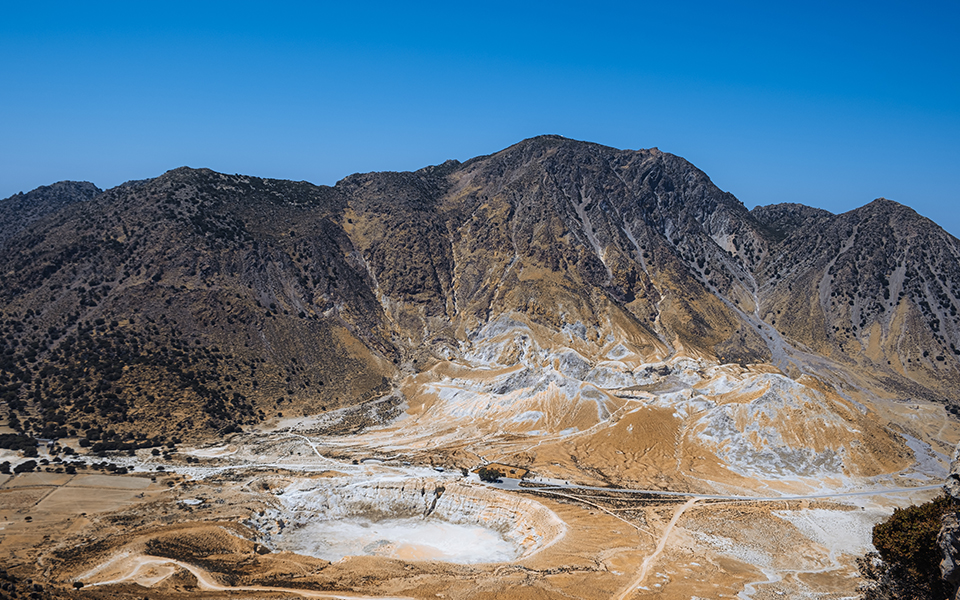
The small volcanic island of Nisyros has officially been admitted to the UNESCO Global Geoparks Network, placing it among the world’s most treasured landscapes where geological and cultural heritage meet sustainable development. The decision was made earlier this month during the 10th session of the UNESCO Global Geoparks Council, hosted in Chile, marking the culmination of a multi-year effort by local authorities and university partners.
“This international recognition represents a landmark moment for our island,” said Christofis Koroneos, Mayor of Nisyros. “It highlights not only the unique natural and cultural wealth of Nisyros, but also the significance of the surrounding islets of Pergousa, Pachia, Kondeliousa, and Strongyli, as well as the marine area between them, which form an integral part of the Geopark.”
The island’s candidacy began in November 2021, with the support of researchers from the National and Kapodistrian University of Athens and the International Hellenic University. After several years of evaluation, including a final review in early 2025, Nisyros’ application was endorsed by the Global Geoparks Council. The proposal now moves to UNESCO’s Executive Board for final ratification in 2026, but membership is considered secure.
Mayor Koroneos underscored both the pride and the responsibility of the designation: “This is an opportunity to ensure that the natural beauty and geological heritage of our island will remain intact, while at the same time creating sustainable development prospects for the local community.”
With Nisyros’ inclusion, Greece strengthens its position on the global stage, joining 11 other new applications this year from China, France, Ireland, Japan, Malaysia, Portugal, Russia, Tunisia, and Uruguay. Once endorsed, the network will expand to 241 sites in over 50 countries.
Nisyros now joins a distinguished – and steadily growing – family of Greek UNESCO Global Geoparks. In the north Aegean, Lesvos preserves a petrified forest of 20-million-year-old trees. On the mainland, the Vikos–Aoos Geopark embraces the world-famous Vikos Gorge and the Zagori stone villages, recently added to UNESCO’s World Heritage List. Further south, the Mt. Chelmos–Vouraikos National Park in the Peloponnese showcases a dramatic mountain range that was once an ancient seabed.
Crete offers two contrasting landscapes: Psiloritis, where myths place the birth of Zeus, and Sitia, a rugged region of wild coastlines, wetlands, and Europe’s largest native palm forest at Vai. In the Ionian Sea, the Kefalonia–Ithaki Geopark tells its own tale of seismic upheaval, with sinkholes, caves, and sheer limestone cliffs.
Together with Nisyros, these seven Geoparks highlight Greece’s extraordinary geological diversity – from volcanic craters and fossilized forests to soaring mountains and deep gorges. They are not just places to admire from afar, but destinations to hike, explore, and experience first-hand.
Six iconic sites of Europe’s first…
In Lesvos, Dimitris Kouvdis preserves ancient…
The UK newspaper explores 16 serene…

The Zagori region in northwest Greece,…