The Digital Rebirth of Greece’s Tatoi Collections
A groundbreaking digital archive opens over…

© Hellenic Ministry of Culture and Sports
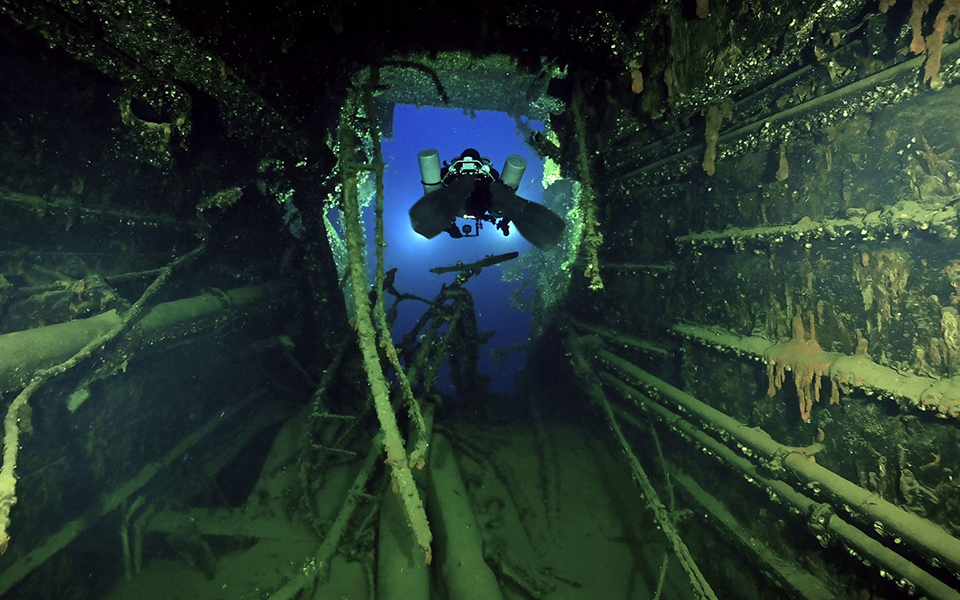
On November 16, 1916, the HMHS Britannic – requisitioned by the British Admiralty and converted into a hospital ship during the First World War – struck a German mine while sailing off the coast of Kea, en route to the Allied hospital station on Lemnos. Within an hour, the giant vessel had sunk beneath the waves.
Of the 1,065 people on board, 30 perished when two lifeboats were pulled into the ship’s massive propellers. The Britannic, one of the largest ocean liners of its era, was the sister ship of the ill-fated Titanic.
This May (6–13, 2025), for the first time, a research program officially approved by Greece’s Ministry of Culture oversaw the recovery of selected objects from the wreck, lying at a depth of more than 120m. The operation was carried out under the supervision and guidance of the Ministry’s Ephorate of Underwater Antiquities.
An 11-member team of specialist deep-sea divers carried out the retrieval using advanced closed-circuit rebreathers. The mission was organized by British amateur historian Simon Mills, founder of the “Britannic Foundation,” with diving safety and logistics coordinated by I. Tzavelakos, Evan Kovacs, and Richie Kohler. A three-member team from the Department of Underwater Antiquities was present throughout the project: archaeological diver Dionysios Evangelistis, conservator Chrysa Fouseki, and underwater technician Louis Mersenier. Their role was to supervise and coordinate the work, receive the finds, and carry out initial conservation procedures.
Not all targeted items could be raised due to their fragile condition or inaccessibility. Conditions at the wreck site proved especially challenging, with strong currents, great depths, and poor visibility. Those objects that were retrieved were carefully brought to the surface in lift bags, placed in protective containers, and immediately cleaned of marine growth. During the project, the finds were securely housed at facilities provided by the Kea Police Department, before being transferred to the conservation laboratories of the Department of Underwater Antiquities in Athens, where work is ongoing.
According to the Ministry of Culture, the most significant artifacts include the ship’s lookout bell, the port navigation light, a pair of binoculars, ceramic tiles from the onboard Turkish bath, and various personal items from first- and second-class passengers.
These objects will go on permanent display at the new National Museum of Underwater Antiquities in Piraeus, currently under construction. They will be displayed in the section dedicated to the First World War, where the Britannic will serve as a centerpiece exhibit.
The Ministry of Culture expressed its gratitude to the diving team, as well as the Municipality of Kea, the Hellenic Coast Guard, and the Kea Police Department, for their support in ensuring the mission’s success.
Source: kathimerini.gr
A groundbreaking digital archive opens over…
Recent research at the site of…
The Acropolis Museum unveils its pioneering…
Greece's Ministry of Culture has approved…