Earthworks Bring to Light Elaborate Ancient Burial in…
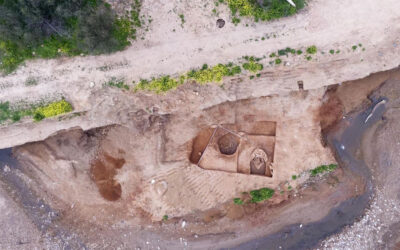
The unusually elaborate pithos burial dates…

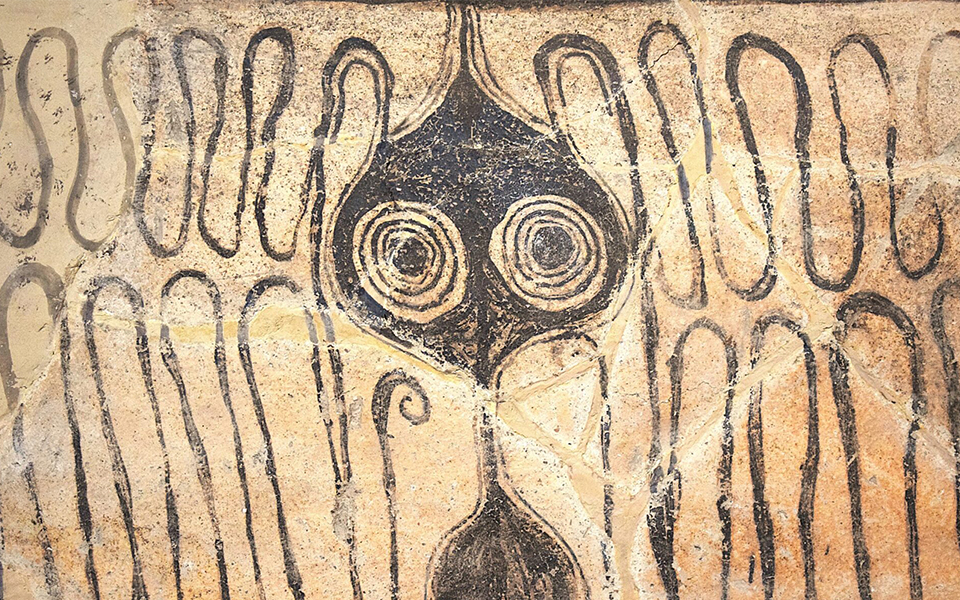
Detail from the decoration of the Minoan chest-shaped larnax (Photographic Archive of the Hellenic National Archaeological Museum)
© Hellenic Ministry of Culture – Hellenic Organization of Cultural Resources Development (H.O.C.RE.D.)
From late October to January 26, visitors to the National Archaeological Museum in Athens can encounter a rare and evocative sight: four Minoan artifacts adorned with painted octopuses, now brought to light for the first time as part of the museum’s acclaimed series “The Unseen Museum.”
Since its launch, The Unseen Museum has invited the public to discover the “secret life” of the museum’s storerooms, where thousands of ancient artifacts – too fragile, obscure, or numerous to display – are kept safe from the spotlight. Each temporary presentation focuses on a small group of objects united by a common theme, offering a deeper look into the forgotten corners of Greek antiquity.
This season’s installment, titled “Minoan Octopi,” showcases a clay larnax (coffin) and three stirrup jars dating from the 13th and 12th centuries BC. All four come from Crete and once served as funerary offerings or “vessels of death,” accompanying the deceased into the afterlife. Their surfaces are covered with large painted octopuses that stretch their tentacles across the clay, wrapping tightly around the forms of the vessels in a design both beautiful and weirdly unsettling.
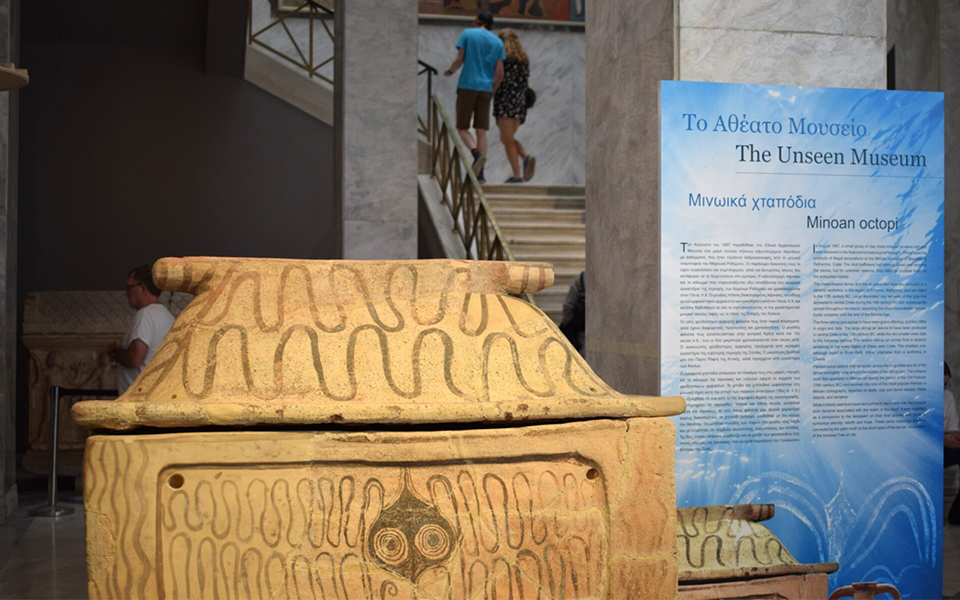
“Minoan octopi” (Photographic Archive of the Hellenic National Archaeological Museum)
© Hellenic Ministry of Culture – Hellenic Organization of Cultural Resources Development (H.O.C.RE.D.)
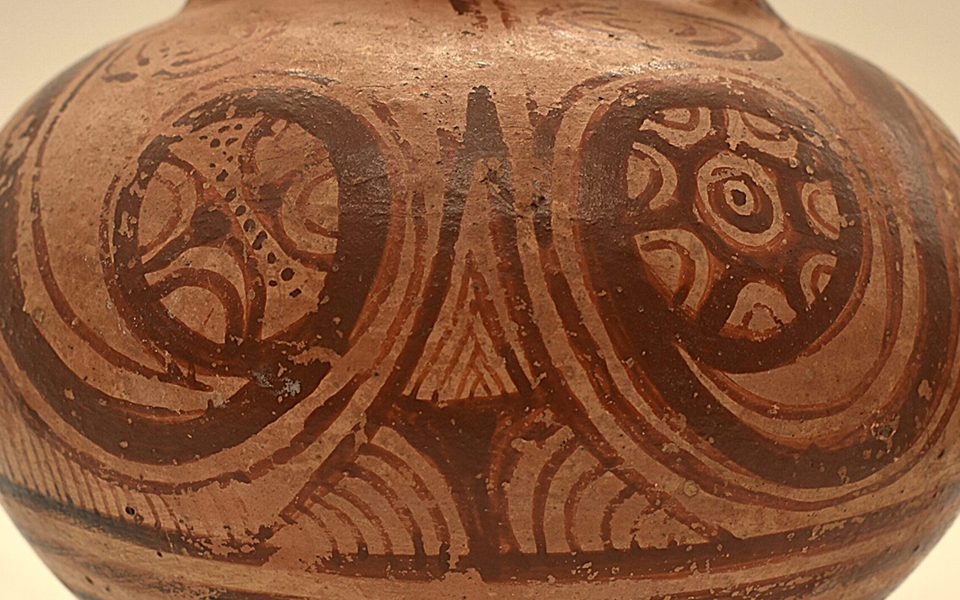
Detail from the decoration of the Minoan stirrup jar. (Photographic Archive of the Hellenic National Archaeological Museum)
© Hellenic Ministry of Culture – Hellenic Organization of Cultural Resources Development (H.O.C.RE.D.)
In Minoan art, the octopus was more than a decorative motif. Renowned for their skills as seafarers and maritime traders, the Minoans drew much of their inspiration from the surrounding sea, which was both a source of life and a realm of danger and mystery. Archaeologists believe the octopus held deep symbolic power – perhaps linked to death and rebirth, or to the eternal ebb and flow of existence. The twisting, enveloping tentacles may have represented the pull of the underworld or the cyclical rhythms of nature, echoing the Minoans’ intimate relationship with the Aegean.
Displayed in Hall 34 (“The Altar Hall”) on the ground floor, the exhibition runs until January 26, 2026. On select Wednesdays and Sundays throughout November and December, museum archaeologists will meet visitors in the gallery to discuss Minoan art, the enigmatic octopus motif in Aegean prehistory, and the sea’s place in Minoan conceptions of death. These short, informal talks (in Greek) take place at 13:00 and are included with general admission; participation is limited and early arrival is advised.
Tickets can be purchased online or at the museum entrance, with participation in the presentations available on a first-come, first-served basis.
From November 16, 2025, to March 31, 2026, the museum is open Wed-Mon, 08:30-15:30, and Tue, 13:00-20:00. Admission is 12 euros.
Through initiatives like The Unseen Museum, the Hellenic National Archaeological Museum continues to reveal the hidden treasures of its vast collections – objects that, until recently, lay in silence beneath the surface. The “Minoan Octopi” invite us to look closer, to see not only the beauty of Minoan art but the deep symbolic currents that once flowed through it.
For details on the exhibition and bookings, visit the National Archaeological Museum’s events page.
For more on the museum’s collections and must-see exhibits, click here.
The unusually elaborate pithos burial dates…
The approved expansion integrates historic architecture,…
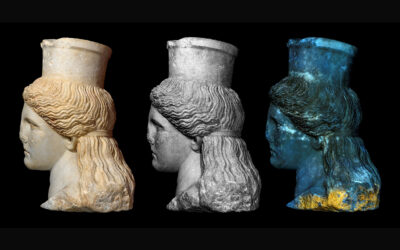
Reconstructing the lost polychromy and meaning…
A nationwide survey highlights improved services,…