Earthworks Bring to Light Elaborate Ancient Burial in…
The unusually elaborate pithos burial dates…

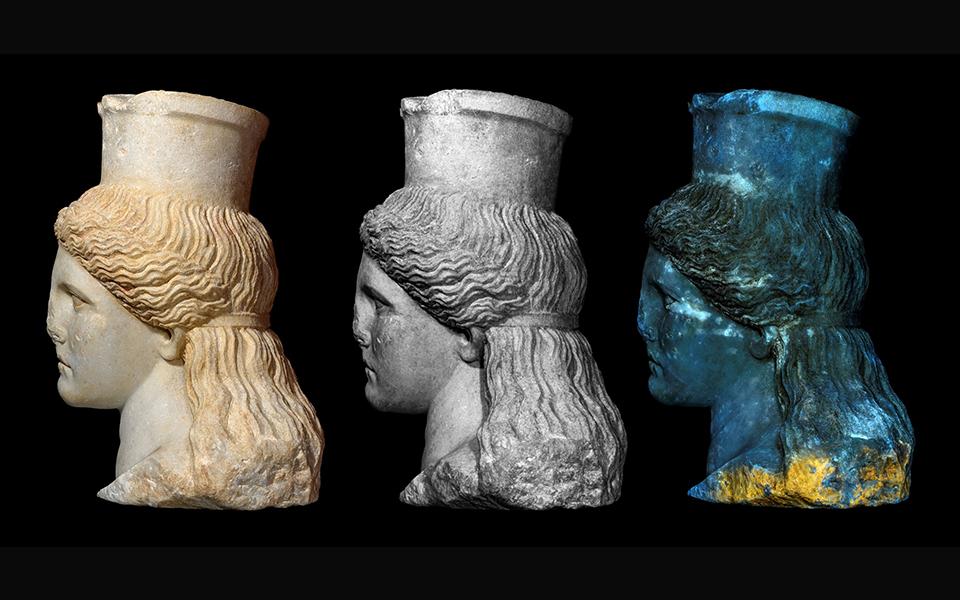
The head of the eastern Sphinx of the Kasta Tumulus, photographed in the visible spectrum (left) and under ultraviolet radiation (right).
© Christos Simatos
The AmphiPoly research project sets out to study, document and bring to light the original chromatic richness of the funerary monument at Kasta Tumulus in Amphipolis. The project, led by the National Hellenic Research Foundation (NHRF) and the “Demokritos” National Centre for Scientific Research, has been formalized through a program agreement with the Ministry of Culture.
The project’s central aim is the scientifically grounded reconstruction of the monument’s original decorative appearance – including its polychromy and iconography across all chronological phases – which today is difficult to read or even enigmatic. Through this process, the research seeks to enable a more comprehensive assessment of the significance, function and dating of the Kasta Tumulus.
Discovered in 2014 in northern Macedonia, the Kasta Tumulus stands among the most important archaeological finds in Greece in recent decades. Dating to the late 4th century BC, the funerary complex astonished scholars with its scale, architectural ambition, and sculptural richness, from the Sphinxes guarding its entrance and the monumental Lion of Amphipolis to the celebrated mosaic depicting the Abduction of Persephone. Though questions surrounding its original occupants remain unresolved, Kasta has profoundly reshaped our view of the era following the death of Alexander the Great.
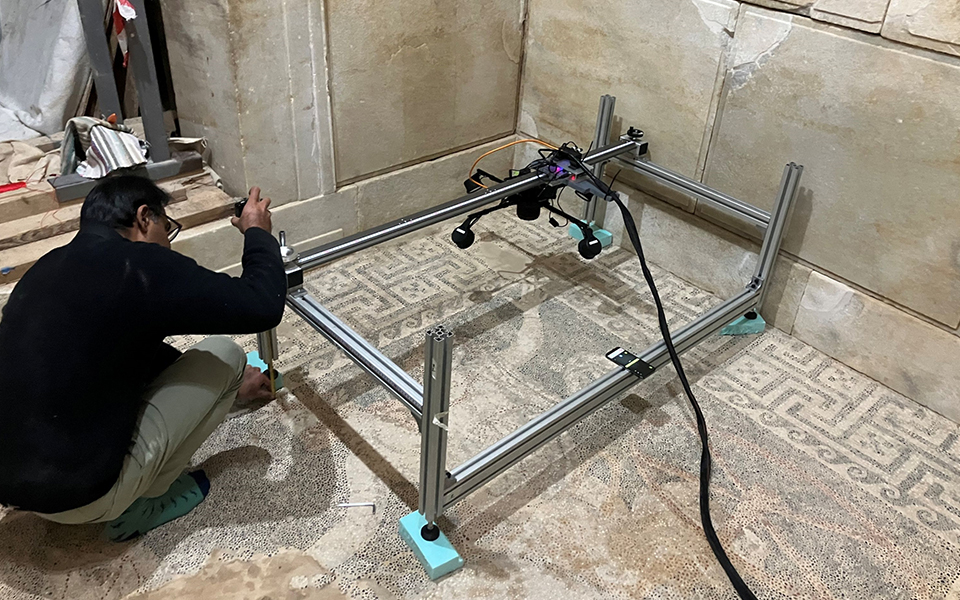
A researcher records the Persephone Abduction mosaic at the Kasta Tumulus in Amphipolis using photogrammetry. The polychromy of the monument’s decoration will be studied and digitally showcased by the National Hellenic Research Foundation and the “Demokritos” National Centre for Scientific Research, as part of a project commissioned by the Ministry of Culture.
© Gabriel Coleman / INTIME NEWS / Δελτίο τύπου / POOL
AmphiPoly envisions an immersive museum experience that will allow visitors to explore the tumulus virtually, navigating its spaces and examining its architectural and decorative features through interactive digital applications. The project will produce high-resolution digital models and virtual-reality films for museum use, alongside physical replicas of key elements of the monument’s decoration, including the Sphinxes’ façade, the Lion of Amphipolis, and the Persephone mosaic.
To achieve this, measurements will be carried out by the laboratories of the “Demokritos” National Centre for Scientific Research in collaboration with international research institutions such as Madrid-based Factum Arte. The project will also draw on advanced 3D scanning technologies and digital visualization tools, integrating archaeometric data with historical and archaeological evidence.
The digital completion and restoration process will also involve visual artists working with artificial intelligence, applying scientific data to reconstruct altered, lost, or barely legible iconographic elements—among them the mosaic and the marble friezes of the tomb.
In addition, contemporary funerary paintings from ancient Macedonia sharing related iconography, style and technique will be examined through comparative spectroscopic analyses and ultra-high-resolution imaging. Among them is the wall painting of the Abduction of Persephone from Tomb I at Aigai, widely believed to have served as the model for the mosaic of the Kasta Tumulus.
According to an official statement by the Ministry of Culture, the project will also make use of dating analyses based on samples of osteological material and mortars taken from the interior of the tomb.
The AmphiPoly research project runs in parallel with, and complements, the conservation and enhancement works at the Kasta Tumulus currently being implemented by the Ministry of Culture. Scheduled for completion by the end of 2027, these works include the restoration and presentation of sections of the monument’s perimeter wall, the reinstallation of a two-leaf marble door discovered fragmented in the tomb’s final chamber, and the construction of a museum and exhibition space where visitors will be introduced to the site through digital applications and selected finds from the tumulus.
With a budget of €660,000 provided by the Ministry of Culture, AmphiPoly is expected to be completed within 14 months.
This article was previously published in Greek at kathimerini.gr.
The unusually elaborate pithos burial dates…
The approved expansion integrates historic architecture,…
A nationwide survey highlights improved services,…
Four mysterious Bronze Age artifacts from…