Greece’s Ancient Ruins as Accidental Arks of Biodiversity
New research reveals that Greece’s most...

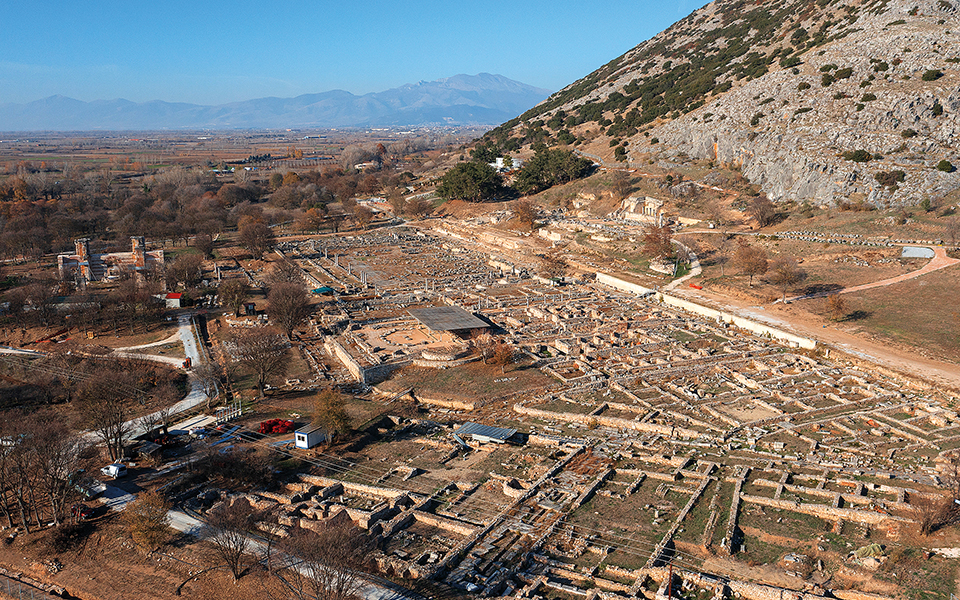
The ruins of Philippi stretch out at the foot of the Acropolis. Only about 25-30% of the walled city’s total area has been excavated.
© Konstantinos Tsakalidis
Just two kilometers from the ruins of Philippi, near the modern town of Krinides, lies the prehistoric settlement of Dikili Tash. Its name (“standing stone” in Turkish) refers to a Roman funerary monument that has marked the site for centuries.
“The earliest habitation dates from the 6th millennium BC, and the remains reveal a substantial Neolithic settlement,” says archaeologist Dimitra Malamidou, director of the Ephorate of Antiquities of Serres and co-director of the excavations. “With the exception of a lake near the settlement that was drained in the 1930s to provide land for refugees, the site offers a remarkably intact historical landscape. Findings show that, in addition to animal husbandry and agriculture, the inhabitants also relied on hunting and fishing. From the 5th millennium BC, winemaking expertise gradually developed.”
Research into viticulture and cultivation is led by Soultana-Maria Valamoti, Professor of Prehistoric Archaeology. “Excavations between 2008 and 2013 (co-funded by National Geographic) unearthed a house that had been destroyed by fire around 4300 BC,” she explains. “Inside, we found thousands of charred grape seeds and pomace (pressed grape skins), as well as fragments of a large vessel. Chemical analysis on the fragments revealed traces of grape must mixed with pomace. In other houses, vessels used for drinking wine were discovered.”

© Stavros Kalafatis

© Stavros Kalafatis
This constitutes the earliest evidence of winemaking in Europe – if not the world. Dikili Tash was continuously inhabited until around 1200 BC, and only intermittently from the Archaic period through Ottoman times. “The Roman funerary monument that gave the site its name was erected along the Via Egnatia,” explains archaeologist Michalis Lychounas, head of the Department of Byzantine and Post-Byzantine Antiquities of the Ephorate of Kavala. “Its presence led researchers to the site of the first round of excavations, begun in 1920 by the French School at Athens, which took place at the same time as those at Philippi.”
In 2020, the Dikili Tash archaeological research mission received the Grand Prize for Archaeology from the Del Duca Foundation of the French Academy, recognizing its contribution to international research. “Our aim is to make the site accessible to the public, with the installation of a protective shelter covering the Neolithic structures. At the same time, a small exhibition space for the finds is being planned,” notes Malamidou. Funding is currently being sought for the implementation of these projects.

© Stavros Kalafatis
We do not know whether Philippi itself has prehistoric origins. “There are references to a Thracian settlement established to exploit the gold of Mount Pangaion,” says Tassos Tantsis, Associate Professor of Byzantine Archaeology at the Aristotle University of Thessaloniki. “We do know that settlers from Thasos, with the support of the Athenians, founded Krenides, named for the area’s abundant springs. In 356 BC, the Thracians attempted to drive them out, and the Thasians sought the help of Philip II. He expelled the Thracians, but also seized the city, fortified it, and renamed it Philippi.”
“The plural form of the name suggests that it was likely a unification of several settlements across the plain,” says Lychounas. “The city was founded at the foothills, where the ground is stable, as the plain itself was marshy. Nearby quarries provided easy access to building materials, and an acropolis was established at the summit. The fortifications and the first phase of the construction of the theater date to Philip’s reign. During the Roman period, the theater was converted into an arena.”
By the mid-2nd century BC, Macedonia had come under Roman control. “The construction of the Via Egnatia further strengthened Philippi’s importance,” notes Lychounas. “Philippi is one of the few cities that predate the construction of the road, which passed alongside – not through – the city; the main axis of the archaeological site is mistakenly referred to as the Via Egnatia,” stresses Tantsis.

In the photo series Opsometha eis Philippous, Stavros Kalafatis captures the historic site and its surrounding landscape. The project began as a commission from the Municipality of Kavala in 2017 and was completed with the publication of a same-titled volume (Agra Editions) in 2019. A selection of the photographs was presented in 2022 at the Bernier/Eliades Gallery in Athens and Brussels.
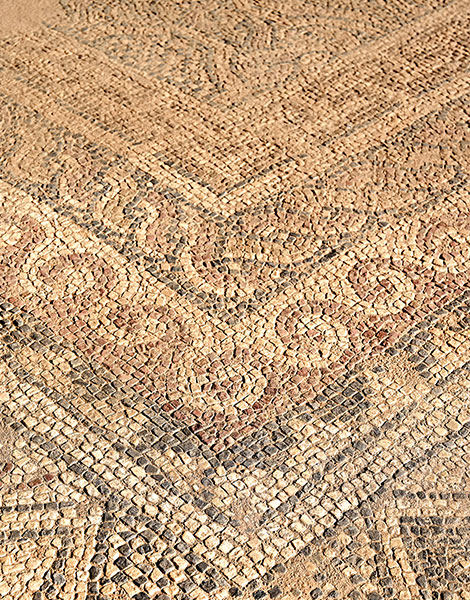
The mosaics discovered in the Octagon complex helped date the earliest church in Philippi to the 4th century.
© Konstantinos Tsakalidis
It was here that the future of the Roman state would be sealed. In 43 BC, civil war broke out between supporters of the Res Publica and those favoring monarchy. Leading the former were Brutus and Cassius, architects of Julius Caesar’s assassination; leading the latter were Octavian, Caesar’s adopted son and heir, and Mark Antony. In 42 BC, nearly 200,000 soldiers clashed on the plain before Philippi. The defeat – and subsequent suicides – of Brutus and Cassius marked the end of the Roman Republic.
Philippi acquired great symbolic importance, and the victors chose to settle Roman veterans there. After Octavian defeated the combined fleet of Mark Antony and Cleopatra at the Battle of Actium (31 BC) and became the first Roman emperor, he went on to establish an even more extensive colony at Philippi and the surrounding plain; for a time, Latin speakers predominated.
“He is considered the second founder of Philippi,” says Lychounas. “The city became a colonia augusta, and its public space was organized along Roman lines. It was home to Thracians, Greeks, and Romans, as well as a small Jewish community. Some inscriptions preserve Thracian names, while one refers to a synagogue.” At the heart of Roman Philippi stood the Forum, the city’s principal monument, housing its public buildings and serving as the center of civic and commercial life.
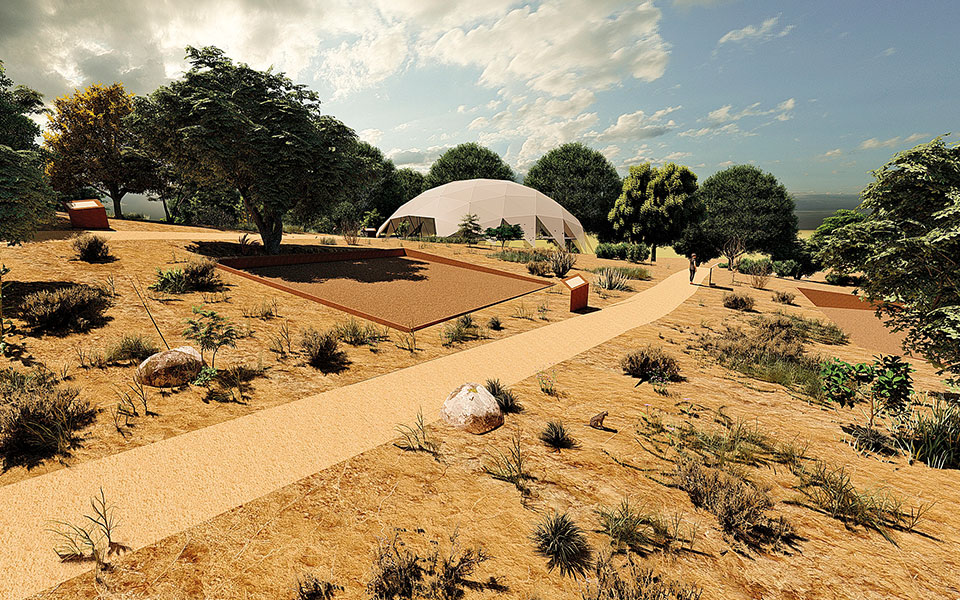
The aim of the Dikili Tash archaeological mission is to make the site accessible, with the installation of a protective shelter that will cover the Neolithic structures.
© Archive of the Dikili Tash research program
“The Apostle Paul visited cities with established Jewish communities,” explains Tantsis. Being monotheistic, Jews were far more receptive to the message of the new religion. Around AD 49-50, Paul landed in Neapolis and, following the Via Egnatia, made his way to Philippi. He converted the first Christians on European soil from among the city’s Jewish population. According to tradition, the first person he baptized in Philippi was Lydia, a Tyrian dye merchant from Thyatira in Asia Minor. More converts followed, and Paul’s activity soon drew the attention of the authorities. It is said that he was flogged, tried, and imprisoned. After his release, he maintained contact with the community, as reflected in his Epistle to the Philippians.
When Christianity was recognized as the official religion of the Roman Empire in AD 380, Philippi’s association with Paul transformed it into a place of pilgrimage. “The city evolved into an early Christian center of basilicas,” says Lychounas, “and its language gradually shifted toward Greek in the late 3rd to early 4th century.”

© Konstantinos Tsakalidis
“In the 7th century, powerful earthquakes reduced the basilicas to ruins, while repeated raids forced inhabitants to retreat to the Acropolis. The city passed to the Ottomans around 1390, and its population moved to the lower slopes. Centuries later, the refugees that arrived during the population exchange formed a renewed connection to the site through its association with Paul.”
“Today, only a small portion of Philippi – around 25 to 30 percent of the walled city – has been excavated,” Tantsis emphasizes. “Aside from the theater, excavations have not revealed the pre-Roman layers. What we see today is a city of Late Antiquity, shaped by its strong Christian character,” adds Lychounas. “The basilicas share architectural elements with those in Constantinople, offering valuable insight into the transition from the ancient to the medieval visual language.” Tantsis attributes both their number and grandeur to the city’s role in the spread of Christianity. “They were most likely pilgrimage monuments marking Paul’s ordeal – his arrest, flogging, trial, and imprisonment.”

Basilica B underwent an unfortunate intervention, with additions that stand in stark contrast to the building’s original core.
© Konstantinos Tsakalidis
The first excavations began in 1920 by the French School at Athens. After 1950, the Aristotle University of Thessaloniki took over, restoring the theater and launching the Philippi Festival. The excavations continue to this day, notes Tantsis, a member of the academic team overseeing the work.
In 2016, the archaeological site of Philippi was inscribed on the UNESCO World Heritage List. The decision highlights the city’s urban and architectural development as a “little Rome,” the importance of its basilicas for early Christian architecture, and the integrity of its natural landscape. From the slope of the Acropolis, visitors can see the ruins of the Forum and Basilica B set against the backdrop of Mount Pangaion.
The basilicas are arranged around the Forum. To the north, on the slope of the Acropolis, lie the remains of the so-called “Basilica A,” the largest in Philippi. Lychounas describes its architecture as one of dominance: “Built on a terrace, two stories high and monumental in scale, it was visible from afar and proclaimed the city’s new Christian identity. Dating to the 5th or 6th century, it was an ambitious and costly structure, constructed with large quantities of Proconnesian marble.”

A luxurious 5th- or 6th-century structure, Basilica A features monolithic piers made of Proconnesian marble.
© Nicholas Mastoras

The theatre is the principal monument of the Hellenistic period excavated at Philippi.
© Konstantinos Tsakalidis
The ruins of Basilica B, south of the Forum, form the most recognizable image of Philippi. The only remains visible before excavations began, they marked the location of the city and appeared in travelers’ engravings. “It is considered a structure where experimental architectural solutions were tested, much like Hagia Irene in Constantinople,” says Tantsis.
Lychounas describes it as a major and luxurious project of the Justinianic period: “The marble decoration was crafted by artisans who also worked on Hagia Sophia. There are two theories regarding Basilica B: either it was never completed, or it collapsed shortly after its completion. It quickly developed structural problems, as evidenced by the later addition of buttresses.”
Today, its appearance is both striking – and controversial. The structure is encircled by recently constructed walls that contrast sharply with the original remains. “Unfortunately, Basilica B underwent a problematic intervention,” Tantsis explains. Following an earthquake in Lemnos in 2014, its piers were affected, and walls and arches were rebuilt to a certain height to ensure stability. These additions alter the building’s authentic form and remain unintegrated. The landscape of Philippi, long defined by Basilica B since the time of early travelers, has changed.”

The Baptistery of Lydia marks the spot on the Zygaktis River where Saint Paul is believed to have baptized Saint Lydia.
© Giannis Giannelos
“What we see today is entirely artificial,” Lychounas argues. The reconstruction, based on a 2018 study, raises broader concerns about restoration practices. He describes a shift toward creating archaeological “Disneylands” to increase visitor numbers, calling it an “instrumentalization of cultural heritage.” He also notes that the study was never submitted to UNESCO, despite this being a requirement.
Elsewhere on the site, new discoveries continue to emerge. Southeast of the Forum, in the complex known as the “Octagon,” mosaics have been uncovered and are now displayed under a protective shelter. “They help date the earliest church at the site to the 4th century, making it one of the oldest in Europe,” says Tantsis. The complex includes a cross-shaped baptistery.
In the area east of the Octagon – once a district of houses and shops – ongoing excavations are revealing new finds. “At the intersection of the two main streets, a fountain adorned with statues was uncovered in 2022,” he notes. “Among the discoveries were a statue of Heracles and a head likely depicting Apollo.”
With much of Philippi still buried, the site holds many more secrets waiting to be revealed. Safeguarding and promoting this unique monumental complex remain a major responsibility for the Greek state; one it owes both to its citizens and to the international community, to which it made a commitment in 2016.
New research reveals that Greece’s most...
Here’s how to get better at...

Experienced restoration specialists have completed the...
New excavations shed light on an...