Athens: A Guide to the City’s Holiday Festivities
From Christmas markets to New Year’s...


Sketch for the restoration of the Church of Aghios Dimitrios Loumbardiaris, 1954-1957.
© Photos from the exhibition “Dimitris Pikionis: An Aeasthetic topography” - Benaki Museum
Dimitris Pikionis was an architect, but in truth he was much more: a thinker, a philosopher and a traveler moving effortlessly between art, science, tradition and modernity. A student of Konstantinos Parthenis and an admirer of Cézanne, Klee, and Rodin, Pikionis brought together European avant-garde ideas with a distinctly Greek sensibility, creating works that seem to breathe with the landscape and its history. His architecture isn’t confined to structures; it is a dialogue with nature, a celebration of memory and folk tradition. In his work, 20th-century Greece became a stage where art, nature and the human spirit coexisted in rare harmony.
Pikionis was born in 1887 in Piraeus. His family roots in Chios and the wider Aegean shaped his deep affinity for Greek tradition: his interest in vernacular architecture, his devotion to island simplicity, his emphasis on natural materials and the intimate relationship between built space and landscape. These origins, combined with an education that exposed him to the intellectual currents of Europe, helped form his distinctive architectural identity.

The Church of Aghios Dimitrios Loumbardiaris, restored by Pikionis in 1954-1957, with the Filopappou Monument in the distance.
© Photos from the exhibition “Dimitris Pikionis: An Aeasthetic topography” - Benaki Museum

Pikionis at Delphi.
© Photos from the exhibition “Dimitris Pikionis: An Aeasthetic topography” - Benaki Museum
Although architecture would become his life’s calling, Pikionis loved the visual arts, too. While studying engineering at the Athens Polytechnic, he met Konstantinos Parthenis, becoming that artist’s very first student. After receiving his degree in civil engineering, he continued his studies in Germany, where he discovered the European avant-garde. His time in Munich and Paris deepened his understanding of modern European stylistic movements, albeit without ever disconnecting him from Greek traditions.
Returning to Greece in 1912, he entered a country marked by the hardships of the Balkan Wars, yet alive with a growing desire for creative renewal. Pikionis soon joined a select circle of thinkers who brought elements of the European avant-garde to Greece. Although he was a contemporary of pioneering 20th-century architects such as Walter Gropius, Le Corbusier, and Mies van der Rohe, Pikionis developed his own distinctive approach that fused a vernacular tradition with abstraction, shaping an architectural language that was both modern and unmistakably Greek.

The ascent towards the Acropolis, laid out in 1954-1957.
© Photos from the exhibition “Dimitris Pikionis: An Aeasthetic topography” - Benaki Museum
Folk art, which he saw as vibrant, authentic and a true expression of the Balkan spirit, was a fundamental source of inspiration for him. In the small courtyards, the low-slung houses with carved openings for light and shaded loggias for coolness, the mansions of Zagora and Kastoria with their carved woodwork and ceramic ornamentation, he saw a deep, intuitive wisdom. He studied Greek vernacular architecture systematically, traveling, sketching and documenting structures and decorative elements in detail.
Throughout his career, Pikionis formed important friendships with artists such as Nikos Hadjikyriakos-Ghika, sharing ideas about a renewed sense of Greek identity that went beyond the legacy of ancient Greece. His relationship with nature, his sense of time, and his profound connection to place were shaped by conversations with intellectuals who shared his concerns about the country’s heritage and cultural future.

The ascent towards the Acropolis, laid out in 1954-1957.
© Photos from the exhibition “Dimitris Pikionis: An Aeasthetic topography” - Benaki Museum
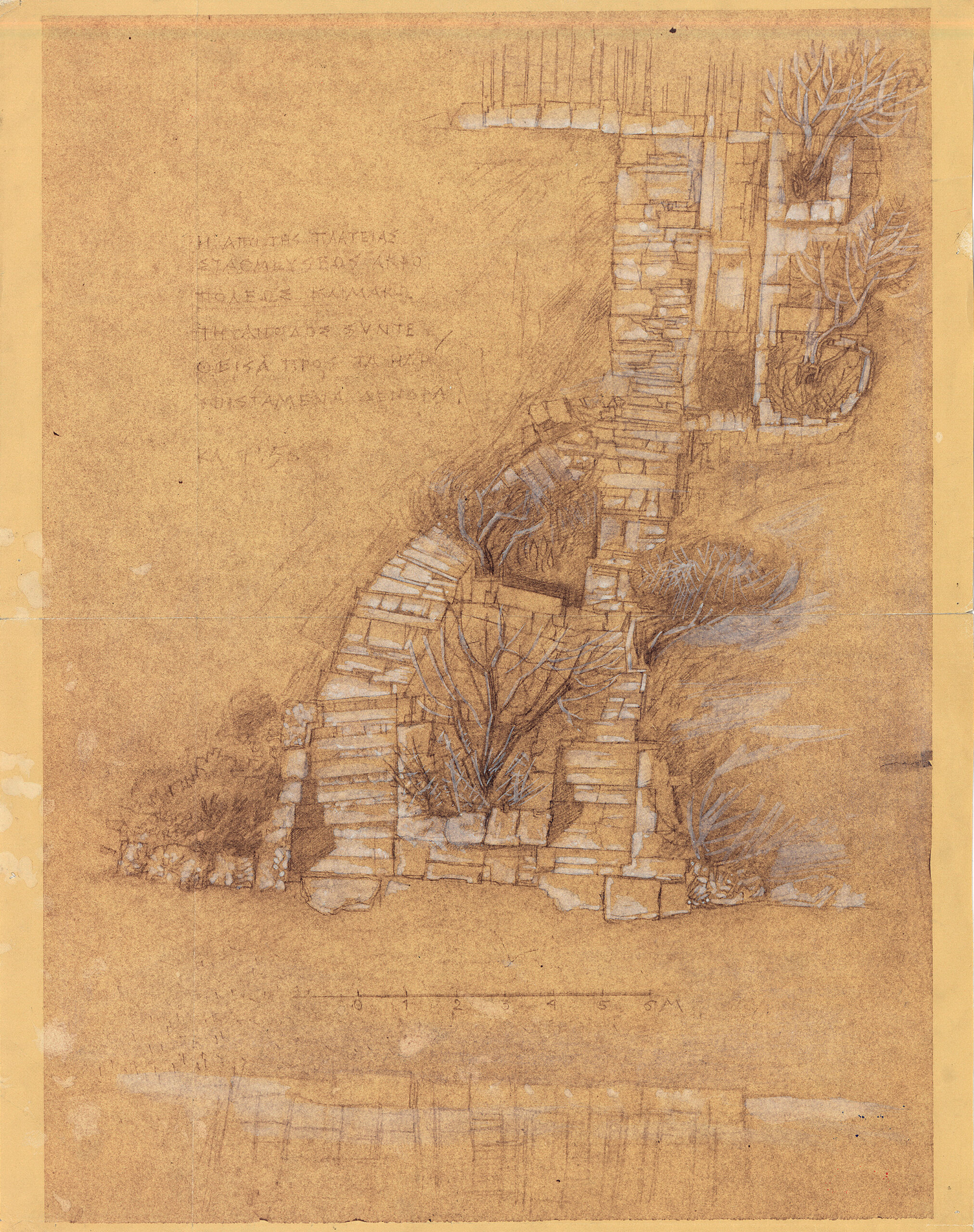
A drawing related to Pikionis’ most famous work, the landscape design and execution of the pedestrian pathways around the Acropolis and Filopappou hills.
© Photos from the exhibition “Dimitris Pikionis: An Aeasthetic topography” - Benaki Museum
One of the most remarkable examples of this approach is the landscape design around the Acropolis and Filopappou hills, a serene network of pathways that feels as if it emerged organically from the very rock of Attica. This landmark work embodies his philosophy in full, standing as a rare synthesis of architecture, nature and history.
For a city long dominated by neoclassical façades, Pikionis’ intervention was revolutionary in its consideration of the surrounding environment. He employed traditional techniques, reclaimed materials, irregular stones, and patterns reminiscent of vernacular cobblestone lanes to craft pathways, stone-paved routes, and small structures with that bind past and present without a trace of aesthetic intrusion.

Decorative stonework in the garden of the Pouri Mansion, Maroussi, 1953-1955.
© Photos from the exhibition “Dimitris Pikionis: An Aeasthetic topography” - Benaki Museum
The route serves to remind visitors of their own relationship with the surrounding landscape and the culture that shaped it. Thanks to Pikionis’ vision, the Acropolis is not just a monument but an evocative space of contemplation.
The same spirit can be found in the playgrounds of Filopappou, the Children’s Garden of Filothei, and the houses and gardens he designed, where human scale, simplicity and craftmanship quietly prevail.
One of the defining elements of Pikionis’ thinking was his profound sense of the architect’s moral responsibility toward the city and its people. In the early 20th century, Greece was under intense pressure to expand its urban fabric, and Pikionis believed that architecture was not merely a technical necessity but an ethical mission. With buildings such as the Lycabettus Primary School and the Xenia hotel, he placed architecture at the service of Greek culture. He had no interest in superficial profit or in cheap imitations of modernity; his aim was to contribute to the country’s reconstruction as a Greek citizen grounded in a deep understanding of history and tradition.

The northwest side of the Pefkakia Primary School, Lycabettus, completed in 1932.
© Photos from the exhibition “Dimitris Pikionis: An Aeasthetic topography” - Benaki Museum
In 1943, he was appointed professor at the National Technical University of Athens; in 1966, he was elected to the Academy of Athens. Contemporary practice still has much to learn from his approach. What we now call “urban landscaping,” the idea that architecture must respond to its context and terrain, has its roots in his conviction that every structure must enter into dialogue with what already exists. In his writings, he often returned to the relationship between parts and whole, the notion of a “universal harmony,” which he considered a fundamental principle of meaningful architecture. Through his work, we understand how architecture can engage with nature, history and culture without losing its humanity or its sensitivity.
Dimitris Pikionis passed away in 1968. More than five decades later, his legacy is not something to be taken for granted. In Athens, much of his work has suffered from neglect, uneven stewardship and a lack of sustained care. His vision now demands protection, restoration and thoughtful attention, not as a monument to the past, but as a living lesson in how the city might still learn to build with wisdom, restraint and respect.
The Landscape Design of the Acropolis and Filopappou Hills (1954-1957). His most characteristic creations were the stone-paved pathways that lead to the Acropolis; the landscaped areas around Filopappou Hill; the seating terraces and viewing platforms there; and the mosaic-like patterns in the paths crafted from reclaimed materials. These works display a unique fusion of vernacular craftsmanship and modern composition.
The Playgrounds on Filopappou Hill are small, sculptural interventions in stone and wood, designed with imagination and inspired by folk art.
The Dimitris Pikionis Residence (1930) His home in Plaka (on Mnisikleous Street) is defined by striking simplicity and strong traditional elements.
Pefkakia Primary School (1930-1932) An innovative school complex for its time, it reflects progressive pedagogical and architectural ideas
(70 Sina).
Mitropoleos Square (1920-1930, selected elements) Contributions to early urban design studies, notable for his emphasis on traditional aesthetics.
Note: Some of Pikionis’ works in Athens have been altered or modified over time, but their essential character remains visible.
From Christmas markets to New Year’s...
Mild weather and a slower pace...

Not all surprises are pleasant, but...
Spend a day exploring one of...