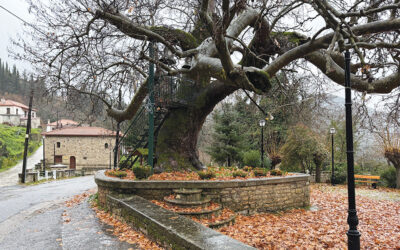
A Winter Escape to Aroania, the Quiet Mountain...
We spent a quiet weekend in...

© Christina Georgiadou
Today, Pantopoleio Mavrikis functions primarily as a taverna and traditional Greek coffeehouse, a far cry from the grocery store it was when it opened in 1879. Back then, it also housed a butcher shop. The business was founded by the Mavrikis family, one of Alagonia’s most prominent, whose patriarch, Panagiotis Mavrikis, served as village president for 20 years. Today, his grandchildren and great-grandchildren carry on the family tradition, having expanded the original, modest menu to showcase a wider range of local specialties.
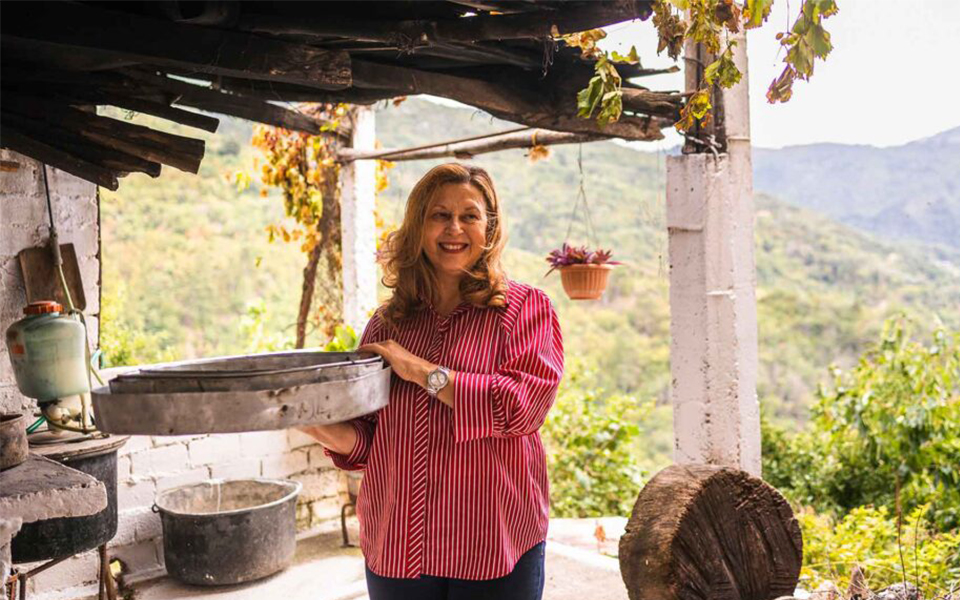
At the helm of the kitchen is Ioanna Papagiannea-Mavriki, who cooks with sweeping views of the surrounding mountains and ravines. Alagonia, in the Messinia region of the Peloponnese, clings to the slopes of Mount Taygetos at an elevation of about 2,950 feet. The delicious food and Ioanna’s commitment to honest, traditional cooking make the three-and-a-half-hour drive from Athens well worth the trip. On weekends, in fact, finding a table can be a challenge.
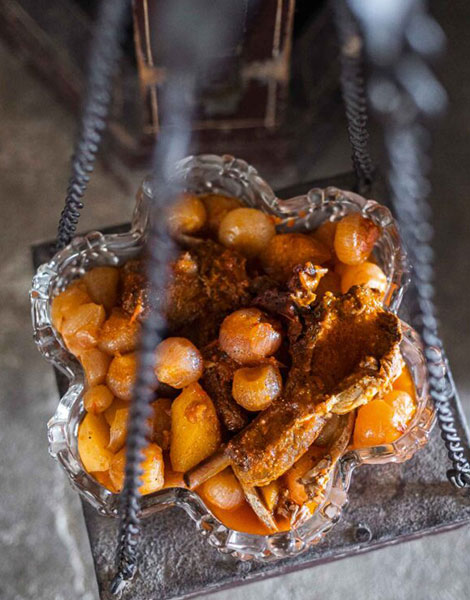
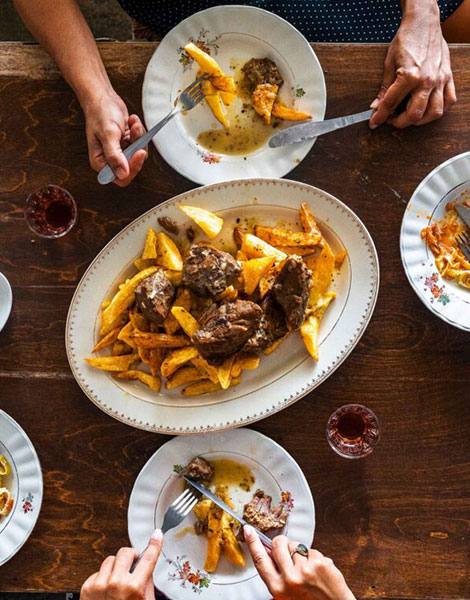
Ioanna’s wild boar stifado is one of the best we’ve ever tasted. Aromatic with spices, sweet and tangy, and wonderfully rich in flavor.
© Christina Georgiadou

The finishing touches make all the difference.
© Christina Georgiadou
“I was born on April 24, 1968, at the maternity hospital in Kalamata,” Ioanna begins, wiping her hands on her apron. She takes a seat at the table closest to the kitchen and starts reminiscing. “My parents lived in Alagonia, so that’s where I grew up. I’m the eldest of three children, and we lost our mother when I was four years old. My childhood was difficult… Anyway, I got married at 17 and moved into my in-laws’ house, where my husband’s grandparents also lived.
“Back then, I didn’t even know how to boil an egg. Little by little, I learned to cook traditional dishes from my mother-in-law, Eleni, and Takis’ grandmother. I enjoyed cooking, so I asked Takis to buy me a cookbook by Skoura, and whenever I found a recipe I liked, I’d try making it. If I visited a friend and tasted something I enjoyed, I’d ask for the recipe. That’s how I gradually learned my way around the kitchen.
“We used to invite people over all the time. Our door was always open, and on holidays, we’d welcome as many as 70 guests. During the early years of our marriage, we lived in Kalamata. I stayed home with the children while they were little, and started working as a babysitter when they got a bit older. I did that for about 15 years. But my dream was always to bring the family business back to life. I wanted to breathe new life into the village. It made me sad to see it slowly emptying out.
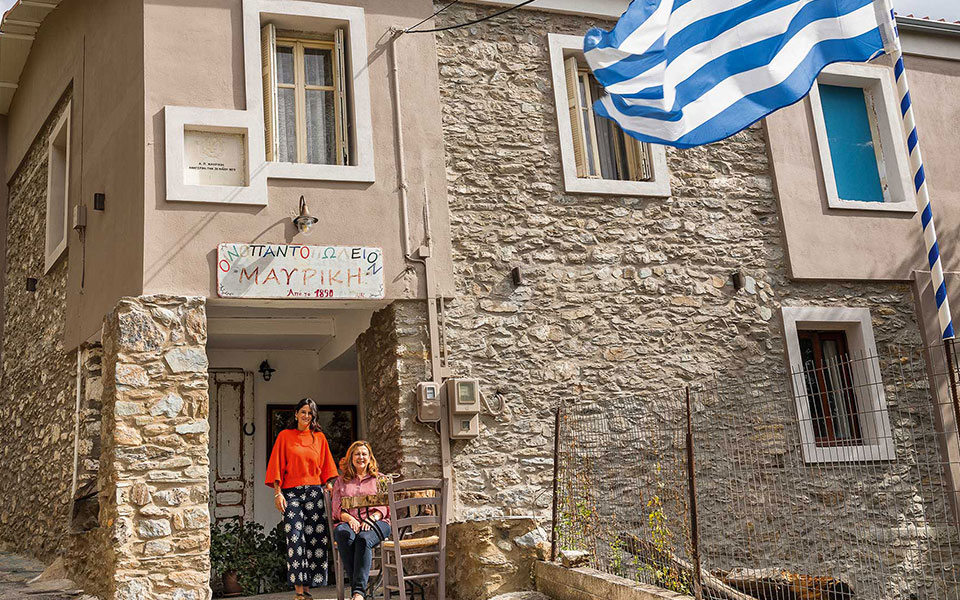
Ioanna is the hostess at Pantopoleio Mavrikis, and for much of the year, her daughter Elena is by her side, lending a helping hand.
© Christina Georgiadou
Alagonia was once a thriving village of 2,000 people, but residents gradually began leaving, many emigrating to Germany, and others to America and Australia.
“The first thing I wanted to do was build a spacious terrace, because the place only had a tiny balcony. Until then, it had operated as a grocery and wine shop, as well as a butcher’s and a small eatery serving meze. Back in those days, there wasn’t much on the menu. People were poor. They served fried liver, tzigeri (a type of tripe dish) and French fries. That was about it. My mother-in-law, Eleni, kept things going in the same way, and that’s how we took over the business.
“I started cooking full meals in 2015. My mother-in-law would help by cleaning wild greens and peeling potatoes, while I did the cooking. Everything I prepared for you today I learned from her and, later, from my beloved cousin, Ioanna Papagiannea-Iliopoulou. These are all traditional dishes from our region. Wild boar stifado, cheese pie, rooster with my homemade hilopites pasta, stuffed vine leaves, meatballs… And there are plenty of other traditional dishes from our village that I also serve at the taverna, such as tsouchti pasta, tzigeri, giaprakia made with tsaparisto goat (chopped with a cleaver), and beef cooked with plenty of parsley. Wonderful dishes from Mount Taygetos.
“My days are always full. I usually wake up around nine or ten in the morning because we go to bed late. I have a Greek coffee, no sugar, and a toasted sandwich out on the terrace, chat with my husband for a while, and then start preparing things in the kitchen.”

Boiled goat, a dish bursting with rich, hearty flavor.
“I call her and ask, ‘What are you doing?’” her daughter, Elena, chimes in with a laugh. “And she says, ‘Chores. Chores, chores, chores.’”
“First, I clean the kitchen, prepare lunch, do the laundry and take care of all the chores around the taverna and the house. My son Dimitris and Takis bring the supplies to the taverna. On weekdays, people usually come in the evening, after work, from around seven onwards, for a coffee, some tsipouro or wine, and a little meze. I don’t cook much during the week because the locals mostly eat at home. But there’s always something available if someone comes in hungry. A few meatballs, pork cooked in wine, a grilled sausage, an omelet… On weekends, though, we cook a full menu. I have a pretty good idea of how many people to expect, so I prepare accordingly. For example, I’ll make 30 portions of beef, 18 portions of rooster, and buy two kilos of minced meat for meatballs… But the dish everyone goes crazy for is wild boar in tomato sauce with hilopites pasta.
“I remember one year, on the eve of the Feast of the Dormition of the Virgin Mary, on August 15, I’d prepared enough food for 150 people. Suddenly, people started arriving from Mardaki Monastery after the church service, and as soon as Vespers ended, the taverna filled up all at once. I think everyone who’d attended the service came here! I ran out of everything, including the food I’d set aside for the following day. So, after everyone left, I had to cook all night. I kept cooking until lunchtime the next day, when a new wave of customers arrived for the feast itself. The wild boar is especially popular in winter. But the meatballs are also in huge demand. Once, when chef Lazarou visited, he ordered everything on the menu and told us how much he enjoyed the food. The meatballs, in particular, reminded him of his mother’s cooking.

Veal in lemon sauce.
© Christina Georgiadou
“On weekends, when we have visitors, the village comes alive again. It really upset me to see fewer and fewer people coming here and the place falling into decline. That was my motivation from the beginning, and it still is. We cook with whatever our region produces. We use local meat whenever possible, and if we can’t find any, we get it from a butcher in Kalamata. We have our own eggs from our chickens, and if we need more, we buy them from friends in the village. I use local olive oil for cooking and local butter for baking. We buy our fruit and vegetables from fellow villagers or neighboring villages, and when supplies are scarce, we get them from Kalamata.
“The soil, the altitude and the water all affect the flavor of the vegetables grown here, especially the potatoes. Alagonia was once famous for its potato production, and the seed potato factory, which operated until 1990, employed nearly 100 people. Our village, which now has just over 100 permanent residents, has long been known for its rich, thick olive oil, made from the local Tsounati variety, as well as for its exceptionally good water.
“I try to get away for two or three days a week to spend some time at our house in Kalamata. Especially when Elena is around, we go out for walks, have a coffee, do some shopping, just to get away from it all for a while. Takis stays here in the village and keeps himself busy with all sorts of things. He chops wood, does repairs around the house, gets involved in community affairs, helps with tree-planting projects – he’s everywhere!
“You know, I wouldn’t want to change anything about my life. We’re doing just fine. All I ask is that we stay healthy. When I was a child, I dreamed of studying architecture. That’s something I wish I’d done. Learning foreign languages was another dream I never fulfilled. I also loved photography and used to take lots of pictures.
“My husband and I have always enjoyed traveling. Not that we’ve stopped, of course. We’ve been almost everywhere in Greece, and we’ve traveled abroad too. We explored Italy from south to north. I absolutely love Italian pasta dishes. I love pasta in general, but my favorite dish of all is spaghetti with minced meat sauce. My husband likes everything, but if I wanted to make him something really special, I’d cook rooster with hilopites.
“Unfortunately, old recipes are being forgotten. The older generations are passing away, and the customs associated with food are gradually disappearing. Young people want to watch and take part in these traditions, but they don’t make the effort to learn how to keep them alive. Greek cuisine is incredibly rich, healthy and varied. It’s true that younger generations are showing renewed interest in Greek cooking, as part of a broader trend in the food industry, and we do get plenty of young visitors here too. But the reality is that the pace of life has changed, and people simply don’t have enough time to cook anymore.”
Originally published in Greek at gastronomos.gr
Pantopoleio Mavrikis is located in Alagonia, on the slopes of Mount Taygetos, Peloponnese.
Tel. (+30) 697.489.4724.
We spent a quiet weekend in...

We’ve compiled ten of the tastiest,...

Christopher Nolan's The Odyssey is already...

Since 1944, generations of sailors, workers...