Winter Stays: Five of the Best Guesthouses in...
From mountain villages to forest retreats,...


© Aspasia Kakari
At the entrance to the village, a sign reads “Welcome to Sopoto.” Although its official name has been Aroania for nearly a century, locals still use the older name (likely of Slavic origin). A three-hour drive from Athens, this picturesque settlement on the slopes of Erymanthos greets visitors with towering plane trees, beautiful churches, stone mansions and fountains where water still runs freely. Here, at the border of Achaia, Arcadia, and Elis, Sopoto once stood as an important administrative center of the Peloponnese. Today, in contrast to the livelier Kalavryta, it lives quietly, especially in winter, when human presence fades and the village yields almost entirely to the sounds of wind, water, and forest.
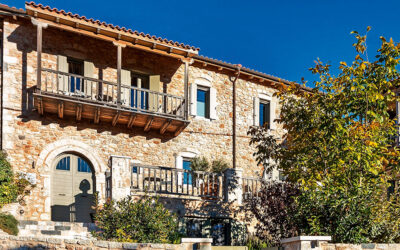
Known as the birthplace of Saint-martyr Paul, patron saint of Tripoli, and many fighters of the Greek War of Independence, Sopoto – where the eponymous Greek School was founded in 1796 – flourished in the 18th and 19th centuries. Evidence survives in the village’s two-and three-story houses, carefully spaced and built by master stone masons from Lagadia in Arcadia, whose craftsmanship still defines the settlement’s architectural character.
“The village once had greater purchasing power than Patras,” says Kostas Louridas, president of the local community, who remembers Sopoto when it was full of life. “In 1975, when I finished secondary school, we had 18 civil servants. There was a magistrate’s court, a land registry office, a post office and large commercial shops. Then the village began to empty. Young people left to study and never came back.” Today, Mr. Louridas is among the handful of residents who remain in the village year-round.

© Aspasia Kakari
Of the 46 permanent residents recorded in the 2011 census, only around ten remain today. Last year, even the stove of the village café – burning continuously since 1939 – went cold. That changed when a farming family from Marathon came across a listing by the community association and decided to lease the café, breathing life back into the village square. “We cook the way we cook at home, for our family and friends,” says Stelios Patelis, who, after a serious health scare, chose to leave Athens and settle in the countryside with his wife and their four children.
Renting a house in Sopoto for just 60 euros a month, the family nearly doubled the village’s population. Their café, aptly named I Hara tis Zois (“The Joy of Life”), has revived the square, drawing visitors from neighbouring villages as well as from Kalavryta, Tripoli, and Patras. Guests come for coffee, but stay for Mrs Maria’s homemade sweets and liqueurs, stuffed cabbage rolls, boiled goat, and Saturday nights filled with live music. “If you adapt to the close-knit nature of rural life,” says Mr Patelis, “the opportunities that open up are extraordinary.”

© Aspasia Kakari
The village square is also the site of the three-aisled basilica of the Annunciation of the Virgin, standing since 1703, alongside notable early-19th-century houses. Above the square stands the stone-built primary school – closed since 1988 and now used for cultural events – and nearby lie the ruins of the original Greek School of Sopoto. The new Greek School of Sopoto, which today operates as a traditional guesthouse, can be found in the parish of Aghios Georgios.
Other highlights include the Petmezas Tower, belonging to the well-known Kalavryta family that played a prominent role in the Greek War of Independence, and the carefully maintained Church of Aghios Pavlos, a large private church with a lending library, conference center and guest accommodations, built by the Anagnostopoulos family in 1992.
Between the guesthouse and the Basilica of Aghios Georgios, a small cultural and historical centre completes the picture. Housing books, photographs, traditional costumes, and family heirlooms, it traces Sopoto’s story over the past two centuries. This intimate, informal museum opens by appointment through the community president, Mr Louridas (Tel. (+30) 693.742.8829).
From mountain villages to forest retreats,...

A group of scientists with a...

These are Greece's nominees for this...

Inside the newly opened Palace of...