Why Hydra Remains Greece’s Most Timeless Island Escape
A car-free island near Athens balances...

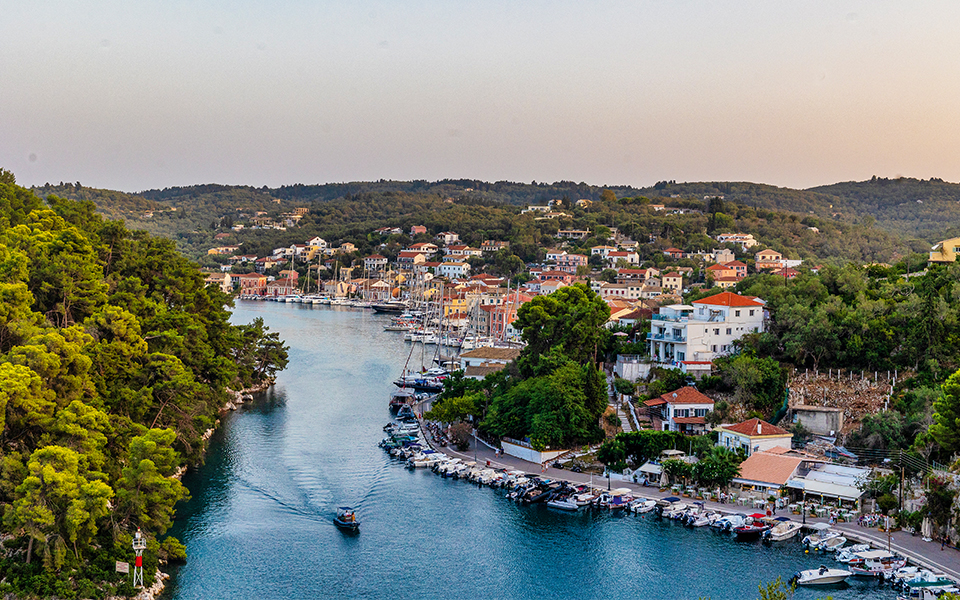
Gaios’ natural channel, a picture-postcard scene from the Ionian island.
© Perikles Merakos
If the tourist season on Paxos hadn’t already ended – it usually begins shortly before Easter and winds down after September 20 – we would’ve had to wait amid the crowds to admire this extraordinary landscape up close. In peak season, dozens of boats, many of them day-trip vessels and mainly from Corfu and Parga, crowd the island’s indented coastline. Their horns sound incessantly, much to the delight of tourists packed aboard. The absence of those boats, which often illegally tie their stern lines to the rocks and block access to the beaches, is certainly one good reason to visit Paxos in the fall.
According to mythology, the island of Paxos owes its existence to Poseidon. While on Corfu with Amphitrite, the sea god struck the island with his trident, breaking off its southern tip in order to create a more secluded place, where he could enjoy his love for the daughter of Nereus undisturbed.

The Spyroua mansion in Grammatikaiika.
© Perikles Merakos

A stroll through the olive groves, a defining feature of the island’s interior.
© Perikles Merakos
Almost the entire western side of Paxos is a geological spectacle. Erosion of the limestone has carved out undulating rock formations and created more than 30 sea caves – known locally as graves – as well as natural arches and sheer cliffs. Heading south down that coast, about ten minutes beyond Ypapanti Cove, we come to Erimitis Beach, with its turquoise waters and towering white cliffs.
Here, olive groves and their traditional dry-stone walls, built to hold the soil on the steep terrain, reach all the way to the sea. The people of Paxos worked to make the island’s rugged, dry landscape productive. Wherever they could, they built terraces for their olive trees and large cisterns to collect water. Many also supplemented their income by fishing. “That little hut at the edge of the slope belongs to my father-in-law. He used it to shelter a boat that he built himself,” says Faye Lychnou, a lead organizer of the summer Paxos Festival, as she shows us around her island.
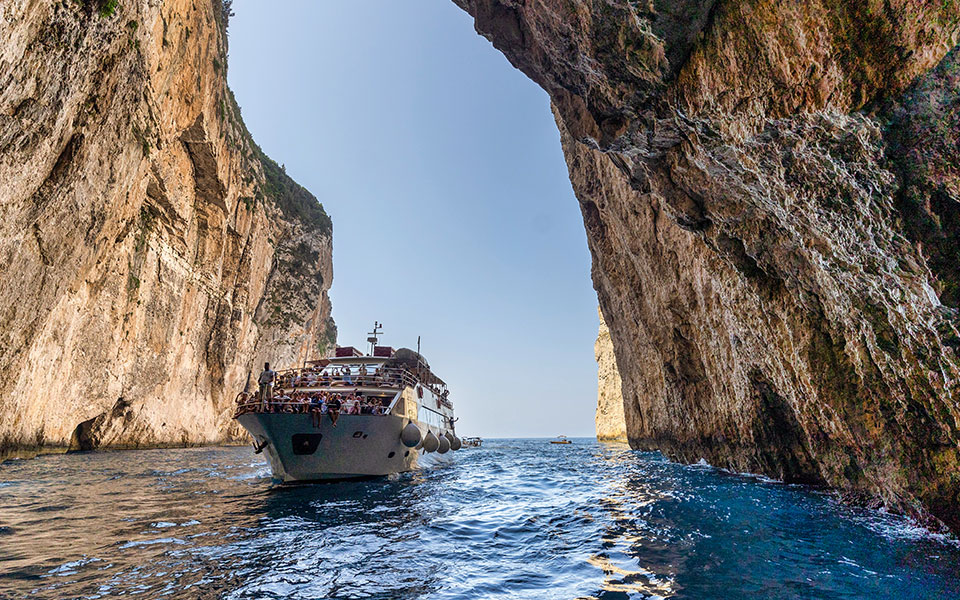
The spectacular Ypapanti sea cave.
© Perikles Merakos
Beyond Erimitis, we approach Ortholithos, a huge rock rising from the sea whose shape recalls one of Obelix’s menhirs. “Climbing Ortholithos and diving into the water was a rite of passage for young boys. There are postcards from the 1970s showing wooden boats full of young men gathered around it,” says Faye. As children, she and her sister Anastasia spent whole days in the nearby caves, fishing and listening to the waves.
Their father, Tasos, was a fisherman’s son who became a notary because he didn’t want to haul ice from Preveza to preserve the catch. The first gift he gave his daughters was a boat. And there is no better way to explore the hard-to-reach shores of Paxos and its smaller satellite island Antipaxos – just 15 minutes apart by speedboat – than to rent a vessel and spend the day cruising. From Tripitos, a natural stone arch near the village of Ozias, to Voutoumi and Vrika beaches on Antipaxos, where the water is so clear it’s like swimming in a pool, the islands offer countless places to stop for a swim or a photo.
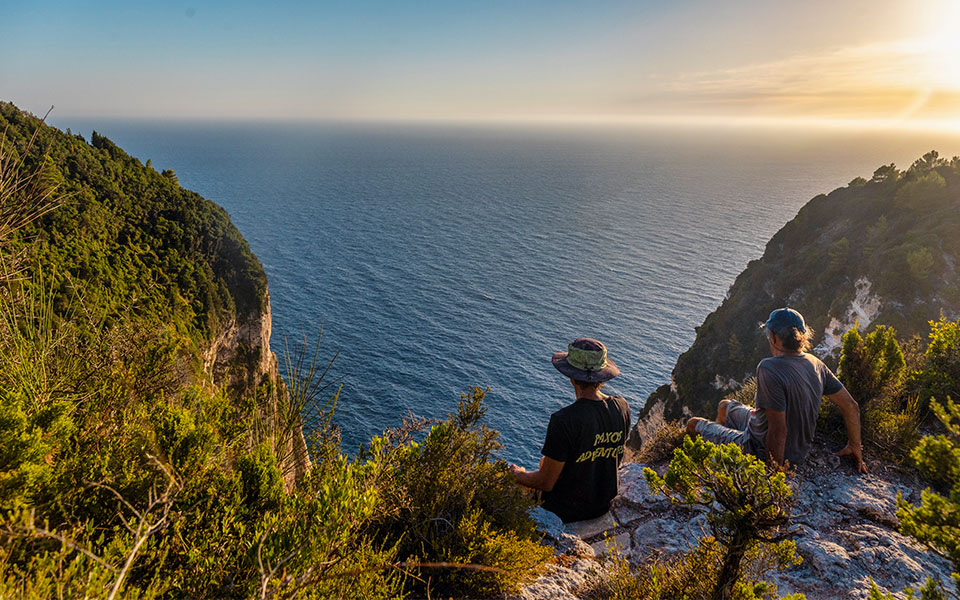
After a short walk, you can find a clearing and admire the sunset.
© Perikles Merakos
Beyond escaping the crowds, another reason to visit Paxos as summer draws to a close is the chance to explore on foot in cooler weather. The intense heat and oppressive humidity can make the island stifling, especially in August. It’s difficult then to follow the marked trails winding through the vast olive groves, or even to stroll around the three main coastal villages: Gaios, Loggos and Lakka. And because the wastewater treatment system is not yet fully operational, unpleasant odors can linger on some summer evenings.
The island’s interior is just as intriguing, with countless small settlements named after Paxos families, such as Boikatika and Bogdanatika. Sights revealing the island’s unspoiled beauty include stone houses with low roofs, once hidden beneath the trees for fear of pirates; dry-stone walls and carved cisterns; centuries-old olive trees whose enormous trunks look like works of art; the ruins of old olive presses; and dozens of privately founded. Yet here and there haphazard construction and signs of neglect of its cultural heritage mar the scene. The ancient necropolis, for example, remains unfenced and overgrown with wild vegetation.

A view of the 19th-century British governor’s residence in Gaios.
© Perikles Merakos

© Perikles Merakos
“Fifty olive mills once operated on the island. Our olive trees – more than 200,000 of them – are a legacy of the Venetians. Gradually, olive oil lost its value, and from the 1970s onward people turned to tourism in large numbers,” says Nikos Mitsialis, an 86-year-old retired lighthouse keeper. Sitting in his courtyard beside a cistern that once collected rainwater from the roof tiles, he tells me wistfully about a bygone way of life. He recalls the years when people cut cigarettes in half with a razor blade to share them, the soft drinks served at Bournau’s postwar café in Magazia, the island’s former capital, and the locally made soap that all islanders once used at bathtime.
“We’re a rock – that’s what my father used to say. In winter, even God forgets us,” says Anastasia Lychnou, who, like many people from Paxos, divides her time between the island and Corfu. “I remember how, because we were poor, everyone would bring whatever they had to the table – bread, watermelon, moray eel cooked over charcoal – and we’d make a celebration out of nothing. We had to get along,” she says.
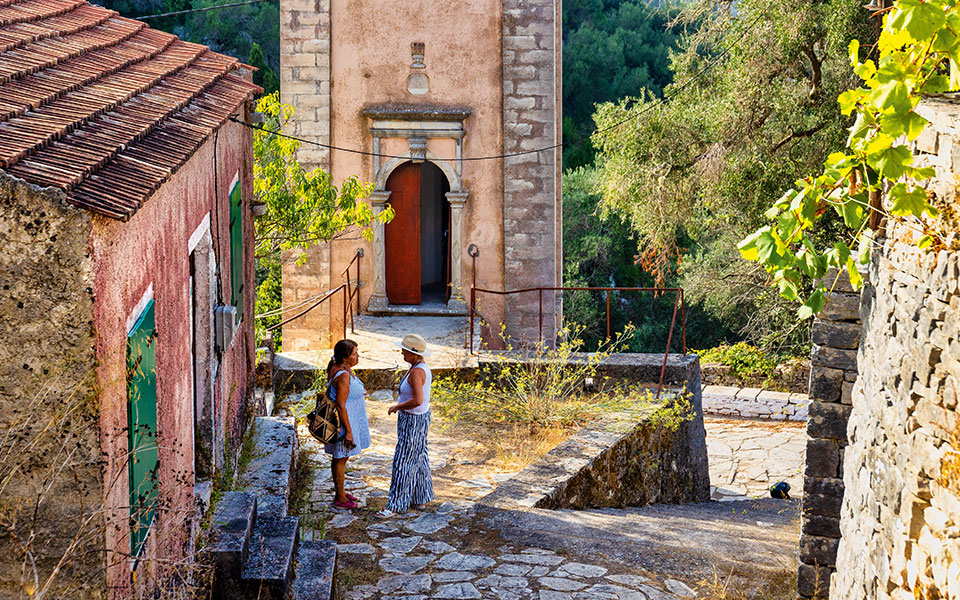
Faye Lychnou with her sister Anastasia in front of the bell tower of Ypapanti Church.
© Perikles Merakos
Today, the island no longer produces soap, very few people bottle their own olive oil, and moray eel cooked over charcoal is a thing of the past. A striking example of how Paxos’ economy and society have changed is the old Anemogiannis factory in the picturesque fishing village of Loggos. Built on the waterfront in the late 19th century, it once served as an olive mill and soap factory. Foreign investors are now converting it into a modern hotel complex.
The British left a lasting mark on the island during their period of rule, with buildings such as the Governor’s Residence in Gaios and the construction of roads. Later, John Gough, an amateur pianist, founded the Paxos Festival in 1986. The British influence also helped plant the seeds of tourism.

At the historic Bourn aos?
© Perikles Merakos

Yoga teacher Mikaela Desylla at her home on Paxos.
© Perikles Merakos
In the early 1960s, Britons who had come to know Paxos through the Royal Navy began returning for vacations. Eliot Watrous and Patrick May are considered pioneers of tourism on the island. Watrous founded the Greek Islands Club, bringing British visitors to Paxos on organized trips and renting old island homes for them to stay in.
More than half a century has passed since then. Christoforos Papakaliatis’ television series Maestro, set on Paxos, renewed interest in the island and introduced it to an international audience through Netflix. British visitors remain the largest group by nationality, but the island they love has changed. Enormous villas are being built on cliffs, exceeding permitted building limits. In summer, sewage mixes with seawater in front of the tiny Church of the Ascension on Gaios’ main square. And there are now so many boats in the waterthat finding a place to moor can be difficult.

Yoga in an olive grove overlooking the sea at Paxos Yoga Shala.
© Perikles Merakos
“Building permits fall under Corfu’s planning authority, so we don’t know how many applications have been submitted. Nevertheless, inspections are carried out for every construction project, and we expect the new local development plan, which will also determine land use, to be issued in 2027,” says Mayor Spyros Vlachopoulos. He attributes the uncontrolled construction to what he calls “the schizophrenic nature of the state.” He says that Paxos in the Ionian Sea and Symi in the Dodecanese have jointly requested that a fee be established, to be paid by passengers on day-trip boats, the proceeds of which would help fund local services on the respective islands.
For now, that request, the mayor says, is still being processed at the Ministry of Maritime Affairs and Insular Policy. Completion of the sewer network is also pending while defects found during the wastewater treatment plant’s trial operation are corrected. The project, which was put out to tender in 200, was only completed two years ago.
The mayor remains optimistic. “Once the landfill has been temporarily restored, the local spatial plan is issued and the wastewater treatment plant is fully operational, which we expect within six months, the island will be able to breathe again,” he says. After all, the real challenge is not attracting more visitors to Paxos, but ensuring it remains a place worth visiting, both during and beyond the tourist season.
Food
Bournau’s Kafeneio (Magazia, Tel. (+30) 26620.319.06). Dating from 1951, this café has a lovely stone-paved courtyard and a centuries-old olive tree. It serves breakfast as well as small dishes to accompany tsipouro, including marinated anchovies and talagani cheese with fig syrup. There’s also a wide selection of beers and spirits.
Vasilis (Loggos, Tel. (+30) 26620.315.87). A waterfront restaurant in the picturesque fishing village of Loggos, this establishment serves fresh fish and seafood as well as inventive dishes such as grouper tartare (inspired by giouvarlakia) and appetizers that include mixed legumes.
Karavokyris (Mongonissi, Tel. (+30) 698.576.3799). On the shore of Mongonissi’s idyllic sheltered bay, chef Tasos Bacharidis prepares Greek dishes with fresh ingredients. Highlights include mussels stifado, squid with spinach and rice, and a particularly good light and fluffy taramasalata.
Coffee & Drinks
Averto (Magazia, Tel. (+30) 26620.302.39). An attractive stone-built spot with a large bougainvillea by the entrance and a pleasant back courtyard, Averto opens early for coffee and breakfast. A classic bar in the evening, it also hosts parties and live music nights.
Places of Interest
Church of the Presentation of Christ (Grammatikaiika, Lakka). Set amid lush greenery, this double-domed church dates from 1601. Its impressive bell tower was built by craftsmen from Paxos in 1772.
Castle of Saint Nicholas (Gaios). This Venetian castle dating from 1510 stands on the islet of Saint Nicholas directly opposite Gaios. The coastal fortress atop the islet was built by the Venetian baron Adam II San Ippolito to protect against pirates and the Ottomans.
Rock-cut cisterns (Boikatika, Magazia). Paxos is dotted with cisterns and wells of various kinds, all built to collect rainwater. The best known are the Sarakinos cisterns, also called Bouloukou, which resemble stone huts carved from the rock. Follow the signs; the cisterns are accessible only on foot.
Activities
Panos Boats & Trips (Loggos, Tel. (+30) 26620.313.33) has organized day trips aboard a boat of your choice. Experienced staff will guide you through the striking Blue Caves of Paxos and take you to the sandy beaches of Antipaxos, including Voutoumi.
Paxos Yoga Shala (Mougelatika, Tel. (+30) 698.978.1174). Mikaela Desylla offers group and private yoga classes in a beautiful space just above Orkos Beach. Sea views, a sprawling olive grove and cypress trees create a peaceful setting for relaxation and well-being.
Paxos Adventures (Ozia, Tel. (+30) 694.533.3533). Explore Paxos by sea on an organized kayaking trip or on foot along trails through its vast olive groves. Routes are tailored to participants’ experience levels.
Platanos (Platanos, Tel. (+33) 686.589.809). Gallerist Christoforos Boikos and his associate Thanos Tsolas opened a contemporary ceramics workshop this year. Established and emerging ceramic artists from Greece and abroad will lead workshops throughout the year.
A car-free island near Athens balances...

As development reshapes the Cycladic island,...

Spring is the best time to...

How one retired American teacher helped...