7 Ways to Experience Oinousses
In the Oinousses island group in...


© Shutterstock
On Kythnos, also known as Thermia, Easter begins with long-standing local customs. On Holy Thursday, villages bustle with the baking of Easter biscuits, the dyeing of eggs, and the whitewashing of narrow alleys. By Holy Saturday, women are busy preparing the island’s renowned Thermiotikes pies. The pastry is rolled by hand, while unsalted sour mizithra cheese, fresh eggs collected straight from henhouse nests, and generous amounts of dill are mixed in large bowls. Kythnos’ reputation for excellent cheese shines through every bite.
Easter Monday brings the highlight of the island’s festivities: the swing, or mamouni, in the main square of Hora around 6 p.m. A boy and girl ride together on a double swing adorned with flowers as the community gathers, singing traditional swing songs. Legend has it that any couple who rides the swing is destined to marry. The event concludes with dancing and treats; a magical tradition whose roots are lost in time, and a must-see for anyone visiting the island.

Syros
© Shutterstock
Easter in Syros is remarkable for one extraordinary reason: Orthodox and Catholic communities celebrate side by side, even when their calendars differ. This rare shared observance, unmatched anywhere else in the world, is a testament to the long-standing harmony between the island’s two faiths.
Even before Holy Week begins, pastry shops and bakeries in Syros fill their windows with “meletinia” (small cheese pastries filled with fresh mizithra cheese) and cheese pies following a traditional Kassiani recipe, combining brioche-like pastry with mizithra, honey, mastic, and cinnamon. Syros’ Holy Week customs are equally enchanting. On Holy Tuesday, shortly after 8 p.m., visitors may hear a mixed choir perform the Hymn of Kassiani, one of the most beautiful Byzantine hymns, accompanied by an organ, in the imposing Church of Saint Nicholas, Ermoupoli.
The pinnacle of Holy Week arrives on Good Friday, when the island’s epitaphs – from the Metropolitan Church of the Transfiguration of the Savior, the Catholic Church of the Annunciation, and the churches of Saint Nicholas and the Dormition of the Virgin – proceed simultaneously through the streets. Historically, those following the Orthodox epitaphs carried staffs, dice, sponges, and robes as symbols of Christ’s Passion. Shortly after 10 p.m., the four processions converge at Miaouli Square, in front of the Town Hall, where hymns are performed by the choir and the Municipal Philharmonic Orchestra.
In the Catholic churches of Azolimnos and Episkopeio villages, the solemn Way of Christ (Via Crucis) is observed, a processional reenactment of Jesus’ journey to Golgotha. According to the Catholic Diocese of Syros, this year the Via Crucis begins at 3:00 p.m. from the Church of Saint Francis in Azolimnos and at 4:30 p.m. from the Church of the Assumption in Episkopeio.

Naxos
© Shutterstock
On Holy Saturday, people prepare “avgokouloures” and “vathrakakia” (figure-eight shaped biscuits with an egg in the middle). During the Easter Sunday service, icons from the churches are carried in procession through the village streets.
The traditional Easter dish in Naxos is “lambriano,” lamb or goat stuffed with cheese, rice, offal and greens. Visitors can taste it, by prior order, at traditional tavernas such as Axiotissa and Amorginos in Apeiranthos.
One of the most distinctive Easter customs in Naxos is the flaming reeds. On Good Friday, young people light reeds in the villages of Eggares and Galini, as the epitaph procession passes, creating a dramatic, almost cinematic atmosphere. In Melanes, the reeds are known as perifanes (from the Greek for “around” and “lantern”) and are believed to symbolize the torches carried by Roman soldiers when they went to arrest Christ.
Kea
© Shutterstock
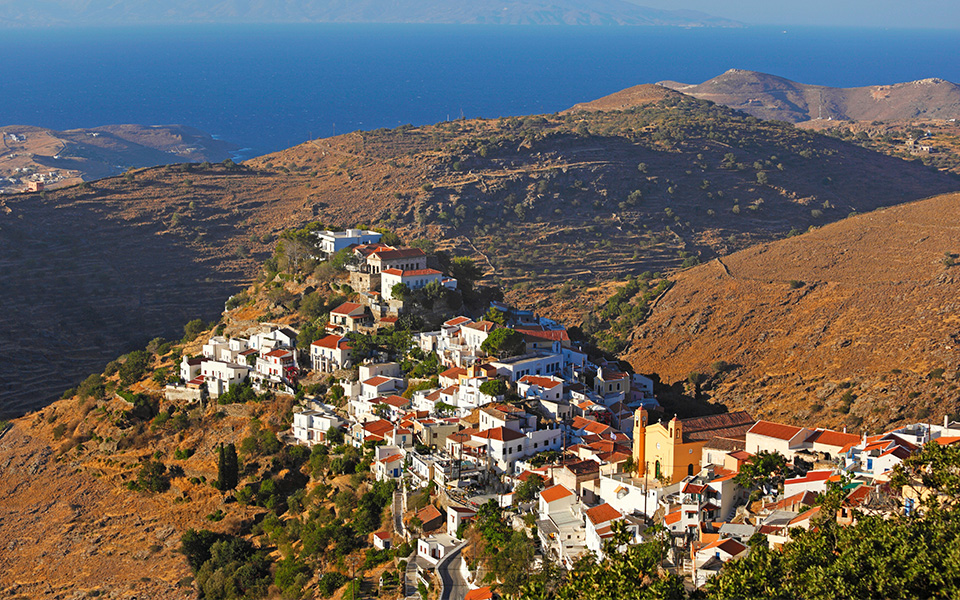
In Kea, Easter is marked by the solemn and fragrant decoration of epitaphs on Holy Thursday in Ioulida, Korissia, and Vourkari. On Good Friday, the early procession in Vourkari begins at 5:30 p.m. from the picturesque chapel of Saints Anargyroi, winding along the seafront and overlooking the bay of Aghios Nikolaos.
In Korissia, the evening procession begins at the Church of the Holy Trinity at 9:45 p.m. and continues all the way to the ferry docked in the port. residents line the streets, while the captain and crew greet the procession with flares and ship whistles. In the island’s capital, Ioulida, the town’s three parishes converge around 10 p.m. in the main square, after passing through whitewashed alleys, covered passageways, and clay balustrades. Lanterns and hymns combine to create a hauntingly atmospheric experience unique to Kea.

© Christina Georgiadou
On Andros, Easter celebrations are lively, playful, and deeply traditional. “Labriatis” is a goat stuffed with eggs, cheese, fried bread and herbs, baked from Holy Saturday afternoon and enjoyed after the Resurrection service. By Easter Sunday, it appears in tavernas across the island.
The maskoula are homemade “explosive” devices – iron tubes packed with gunpowder – lit and exchanged between Upper and Lower Village residents in Stenies immediately after the proclamation, “Christ is Risen.” The fiery battle lasts about two and a half hours, echoing the island’s maritime history.
Finally, Easter Monday morning brings tsounia, a traditional Andrian game resembling bowling. Wooden targets are arranged in a set formation in the main squares of Paleopolis and Ormos Korthiou, and players attempt to knock them down with a wooden ball. Visitors are encouraged to try their hand at this centuries-old pastime.

Folegandros
© Shutterstock
Easter in Folegandros is a truly unique experience. The icon of the Virgin Mary visits every house on the island during a three-day procession. It begins on Easter Sunday in Chora, continues on Easter Monday in Ano Meria, and concludes on Easter Tuesday in Petousis, Livadi, and the port of Karavostasis, where even the fishing boats receive blessings.
Visitors who follow the entire route will be rewarded with endless treats – tsipouro, honey pie, milk pie, pies with Folegandros manoura cheese and mizithra – prepared by the women of the villages and served to worshippers entering their homes. Alongside the flavors, visitors gain an intimate view of the island’s daily life, rarely experienced by outsiders.
On Paros, the village of Marpissa brings Easter stories to life through decades-old religious reenactments during the epitaph procession. Children – from kindergarten to high school – act out the Raising of Lazarus, the Entry into Jerusalem, Mary Magdalene’s repentance, the Last Supper, Roman soldiers, Jesus riding the donkey, Pontius Pilate, and Christ’s disciples. More demanding roles are taken on by adults, whether local residents or Athenians with roots on the island.
In the Oinousses island group in...

For nine days, during the 15th...

Spring is the best time to...

Mykonos native Dimitris Rousounelos shares his...