Despotiko: A Remote Sacred Island in the Cyclades
New excavations shed light on an...


Looking out toward the chapel of St Nicholas from the ruins of the Basilica of St Stephen, on Kefalos beach.
© Angelos Giotopoulos
“When the spirits are low, when the day seems dark, when work becomes monotonous, when hope hardly seems worth having, just get on a bicycle and go for a good ride along the road, without thinking of anything except the journey you are taking…” wrote Sir Arthur Conan Doyle in 1895. “If nothing else, the bicycle, unlike the horse, does not need food and care,” he noted in another article, speaking of the advantages of his favorite means of transport.
The Italian army was also fond of the bicycle; it had been using for military purposes since the late 19th century. So, when the Italians occupied the Dodecanese in 1912, the first bicycles to appear on Kos were military ones. At a time when cars and motorcycles were scarce, bicycles allowed soldiers to move quickly, quietly and discreetly, covering greater distances than they could on foot.
Not everyone was allowed the convenience of this means of new conveyance, however. As Italian journalist and cyclist Luciano Coluzza notes, during the early years of their spread, the use of bicycles was forbidden to officers, as well as to priests and women, lest they be ridiculed, since it was thought that pedal power was wholly unsuitable for those in skirts, cassocks or dress uniforms.
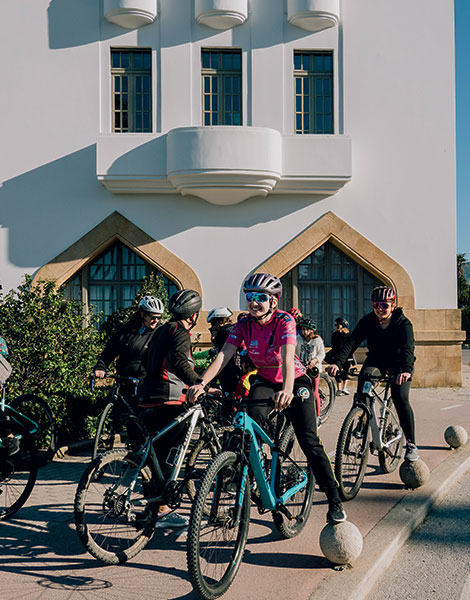
Cyclists from the Asklipios Kos team during their Sunday ride along the cycle path.
© Angelos Giotopoulos

The founder of the cultural organization DREPPO “Fainareti,” Minas Hadjiantoniou, outside the former Italian hotel Aurora.
© Angelos Giotopoulos
Much has changed since then, of course. The Italians left, but the bicycles remained. Today, there is hardly a home on Kos without at least one two-wheeled contraption somewhere around. With more bicycles than residents, dozens of kilometers of cycle paths, bike racks scattered across many villages, countless bicycle shops, and six active cycling clubs, Kos has rightfully established itself as “the island of the bicycle.” In recent years, it has also earned several distinctions in the cycling world, most recently with the Kos Academy winning first place in Greece in the cycling skills category.
“You’d be hard-pressed to find a child on the island who doesn’t know how to ride a bike. Nonetheless, in the past, parents would enroll their children in football, basketball, or athletics rather than cycling,” says Tamara-Maria Toumbazi, coach of the Athletic Club Kos Academy and a former athlete with national distinctions in cycling and international success in triathlon. Tamara took part in her first cycling race simply because it happened to be taking place in front of her father’s restaurant.
“Since I had already trained in athletics, I won, and that’s how I got involved in the sport. At the time, there was only one club on the island, but our coach was actually an athletics coach. Whatever we learned, we really learned on our own.”
Toumbazi is one of the club’s three professional trainers. Founded in 2021, the club is already ranked sixth in Greece in terms of active athletes among the 81 clubs of the Hellenic Cycling Federation.
In the Tsoukalaria forest, one of the many place where the academy’s athletes train, children as young as five, riding bicycles often bigger than they are, practice mountain biking on one of the island’s most accessible routes. They ride up and down small hills, weave between cypresses and pine trees, fall into the dirt, get back up, and keep going, learning both technique and determination.
“Here, children learn to pedal before they learn to walk,” jokes Minas Hadjiantoniou, founder of the cultural organization DREPPO Fainereti, who still cycles despite being in his seventies. “At the same time, though, we see many parents driving even high school students to school, when awareness programs could easily be implemented and bicycle racks installed in schoolyards so that children could get around by bike.”

A bastion of the Castle of Neratzia in Kos Town.
© Angelos Giotopoulos
“Parents need to believe in their children’s abilities,” says Anna, the mother of Michalis Kalleres, the only athlete with autism who took part in the XTERRA World Championship in Molveno, Italy, last September and managed to finish the race. “In the beginning, when he was training, I was always driving along behind him, but I realized I had to let go of my fear, because it wasn’t helping him.”
Until a few years ago, Michalis could not even walk, and doctors believed it was dangerous for him to ride a bicycle. But once he got on a bike and started pedaling, he never got off again. He now trains every day with Nikos Prezas, president of the Kos Cycling Club. At 6:20 in the morning he rides in the mountains, and at 7:00 he swims in the sea. “The doctor who saw his latest EEG could not believe that he had completed a triathlon in six hours and fifty minutes. Michalis has now stopped taking medication and can live independently. He has made tremendous progress thanks to cycling,” his mother says.

Training session of the Kos Academy team in the Tsoukalaria forest.
© Angelos Giotopoulos

The Government House, known as the Eparcheio, is one of the island’s landmarks from the Italian occupation period.
© Angelos Giotopoulos
Rain or shine, cyclists take advantage of the island’s relatively flat terrain. When the weather improves, riders of all levels fill not only the town’s cycle path, but also the paved roads and dirt tracks leading in every direction. During the summer months, when the island of 38,000 residents welcomes its largest crowds of tourists – now reaching a million and a half annually – the bicycle emerges as the island’s only truly sustainable mode of transport.
“At the moment, we’re preparing a carrying-capacity study and a traffic study that includes micromobility and low-speed circulation on urban roads,” says the mayor of Kos, Theodosis Nikitaras, who has also pledged to extend the existing cycle path four kilometers east toward Therma and ten kilometers west toward Tigaki Beach.
In recent years, with the rise in tourism, this legacy of the Italian occupation has proved especially valuable for residents’ everyday lives. Beyond its health benefits, the bicycle frees them from the stress of driving in traffic and the search for parking spaces.
As the women learning to cycle for the first time with the Asklipios Kos group explain, the bicycle isn’t just a way to get to work in the summer, it’s also a means of exercise and it provides an opportunity to go out with friends. “It clears your mind,” says Dutch retiree and former nurse Carla Pollak, who finally found time for cycling at the age of 61. Today, she no longer limits herself to the town’s cycle path, which stretches for 15 kilometers from Faro Beach to Psalidi, but rides as far as the mountain village of Zia or even farther, to picturesque Kefalos, 42 kilometers from the town.
“When we said a few years ago that we wanted to create a women’s team, people laughed at us,” says former athlete and club coach Effie Sideri-Tsoutsi. “Today, there’s no one left on the island who doesn’t know how to ride a bike.”
New excavations shed light on an...

Spring is the perfect time to...
We celebrate Easter across seven Cycladic...

A photographic journey through Lesvos.