Kampos: The Secret Life of Chios’s Citrus Estates
As its historic estates fade and...

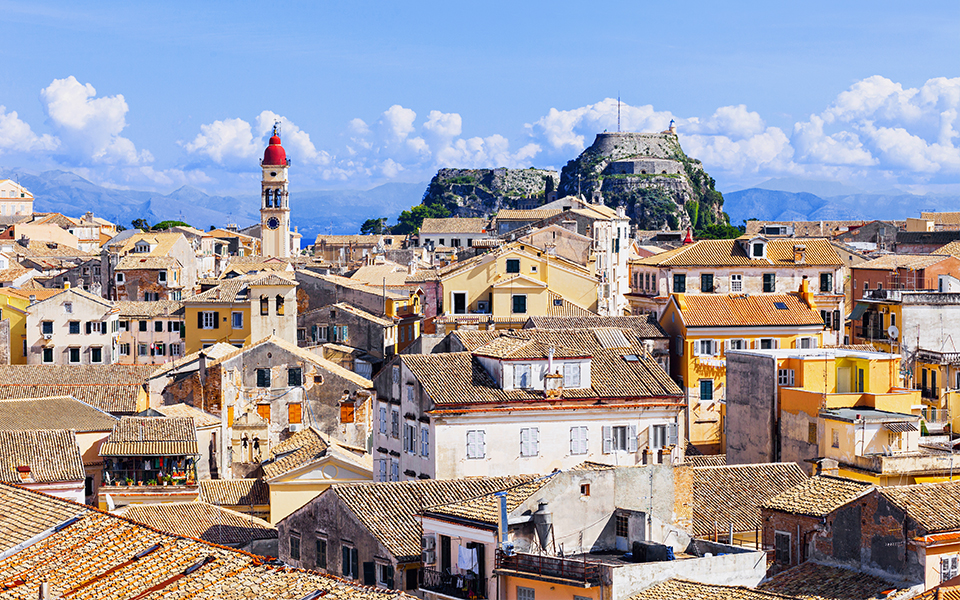
The bell tower of Saint Spyridon and the Old Venetian Fortress dominate the skyline of the Old Town.
© Shutterstock
Who said Corfu is only for Easter and summer? Outside of peak season – and contrary to the belief that all islands are deserted during this period – Corfu Town remains lively, thanks to the outgoing nature of its residents and the mild temperatures that encourage strolls through its streets. Before the influx of visitors for Easter celebrations and the summer season, we traveled to the island known to Greeks as Kerkyra and put together a small guide to help you take the pulse of the city in 30 hours.
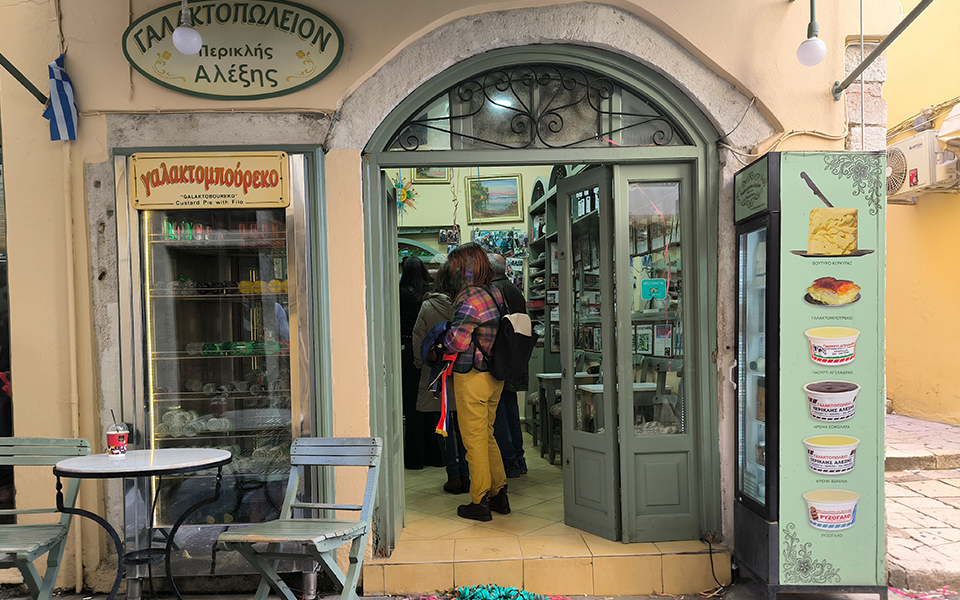
For vanilla custard and galaktoboureko made with Corfu butter at Periklis Alexis Dairy Shop.
© Pantelis Tsompanis
The starting point for your exploration of Corfu’s Old Town is Saroko Square, on the edge of the newer part of the city. After passing the Catholic Church of the Annunziata, follow Vrachlioti Street to your first stop at the square of the same name, where you’ll find Periklis Alexis Dairy Shop (12 Aghiou Vasileiou, Corfu, Tel. (+30) 26610.390.12), in operation since the 1950s.
Every morning they source soft bread rolls from the bakery and cover them generously with Corfiot butter and honey; they also make their own vanilla and chocolate custards, and rizogalo (Greek rice pudding).

One of Corfu’s oldest “volta,” as the vaulted arches with carved reliefs at the entrances of houses are known. This particular one was rebuilt in 1728.
© Pantelis Tsompanis
After breakfast, put your phone away, ignore your GPS apps, and simply wander the alleys of the Old Town. The labyrinthine neighborhood of Kampiello, the impressive portonia (large entrance doors) of modest houses with their stone volta (arched passageways with carved details above the entrances), the scattered passatseta (passages connecting houses), the tiny squares with Venetian wells, and the shadows of laundry hanging above the narrow streets all reveal traces of the city’s medieval history.
Among the many churches scattered across the Old Town, one stands out thanks to its imposing bell tower: the Church of Saint Spyridon, dedicated to the patron saint of the island and built in 1589. Inside, the saint’s relics are preserved in a silver casket.

Wooden sculptures from Hindu temples on display at the Museum of Asian Art.
© Pantelis Tsompanis
Whenever the Museum of Asian Art (Tel. (+30) 26610.304.43, matk.gr) is mentioned, the first question that arises is why Corfu might have a museum focused on the cultures of Asia. The short answer is that this institution, founded in 1928, was created following the donation of the Asian art collection of diplomat Grigorios Manos to the Greek state, and that the museum was located here because a suitable space was available. That space is on the upper floors of the Palace of St. Michael and St. George, a structure built of Maltese stone and erected in 1824 during the tenure of the British High Commissioner Thomas Maitland.

The impressive dome inside the circular reception hall (Rotunda) of the Palace of St. Michael and St. George.
© Pantelis Tsompanis
The museum’s collections include around 15,000 artifacts, although far fewer are displayed in the exhibition cases. Even so, what is on show offers an excellent introduction to the cultures of India, the nomadic peoples of Turkmenistan and the traditions of the Far East. Informative descriptions about the religions and customs of Asian peoples accompany exhibits such as Hindu wood carvings, Noh theater masks, samurai swords, porcelain figurines and ceramics.
Meanwhile, in the colonnaded gallery on the first floor, visitors can also see the official rooms of the Ionian Senate and the Order of St. Michael and St. George: the circular Reception Hall (Rotunda) with its impressive domed skylight, the Throne Room and the Banqueting Hall.

A stop for focaccia at Di Santo.
© Pantelis Tsompanis

© Pantelis Tsompanis
Corfu without sofrito, pastitsada and bourdeto simply wouldn’t be Corfu. One place locals recommended to us is Marina’s Taverna (35 Velissariou, Tel. (+30) 26610.420.71), which serves classic local specialties.
For a quick bite – such as a juicy souvlaki in pita with quality meat, hand-cut fries, tzatziki and tomato sauce – stop by Ninos Grill (44 Sevastianou, Tel. (+30) 26610.461.75).
Street-food lovers should head to Di Santo Premium Sandwiches (3 Evgeniou Voulgareos, Tel. (+30) 26610.219.74 just before the Liston), a focacceria that will transport you to Italy with its fresh cheeses and cured meats. The menu includes several variations of focaccia sandwiches. For a more “local” take, try the Grecano, topped with noumboulo (Corfiot cured pork), feta cream, cherry tomatoes and tomato sauce. Clear Italian influences also appear in the Di Santo sandwich, made with Aegina pistachio cream, burrata and mortadella with pistachio.
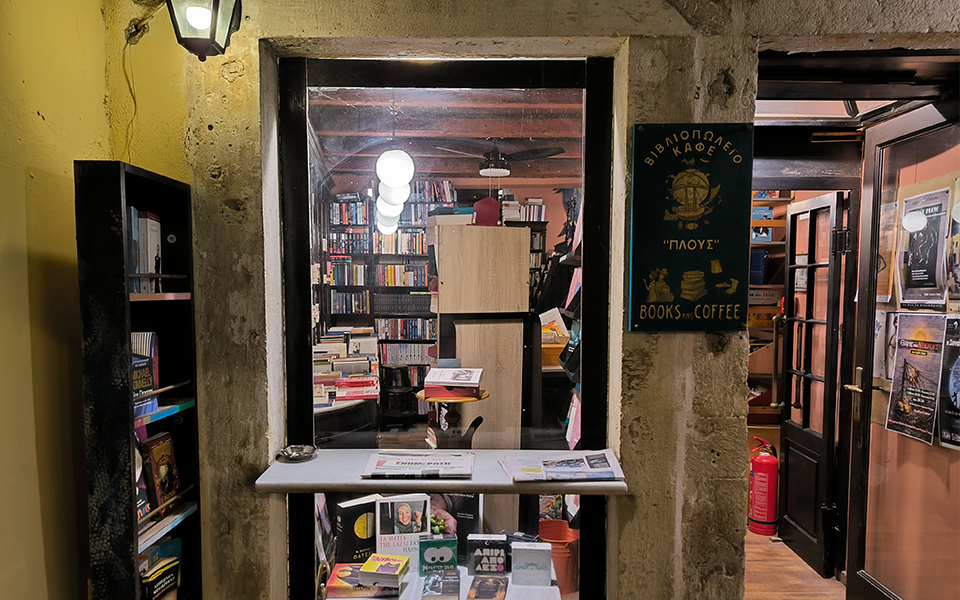
A stop at Plous Bookstore, on Nikiforou Theotoki Street.
© Pantelis Tsompanis
Shortly after sunset, a stroll around Spianada Square, the illuminated Liston, and the central pedestrianized street of Nikiforou Theotoki is a must. There you’ll find Plous Café-Bookshop (91 Nikiforou Theotoki, Tel. (+30) 26610.351.91), in operation since 1987. Its section dedicated to historical and literary publications about Corfu is particularly interesting.
If beautiful melodies reach your ears, they will likely be coming from the Corfu Philharmonic Society, rehearsing at its headquarters on Theotoki Street, or from the piano at the antique shop and café Bizou, located in the Kantouni of Bizis (30 Maniarizi Arlioti, Tel. (+30) 694.874.7022).
For a drink in the evening, our wander through the kantounia led us to Locale (9 Sotiros, Tel. (+30) 698.017.4668), a small wine bar with an extensive wine list. The welcoming and attentive owner will guide you through wines you might like to try and prepare a tailor-made platter of cheeses and cured meats to match your selection.
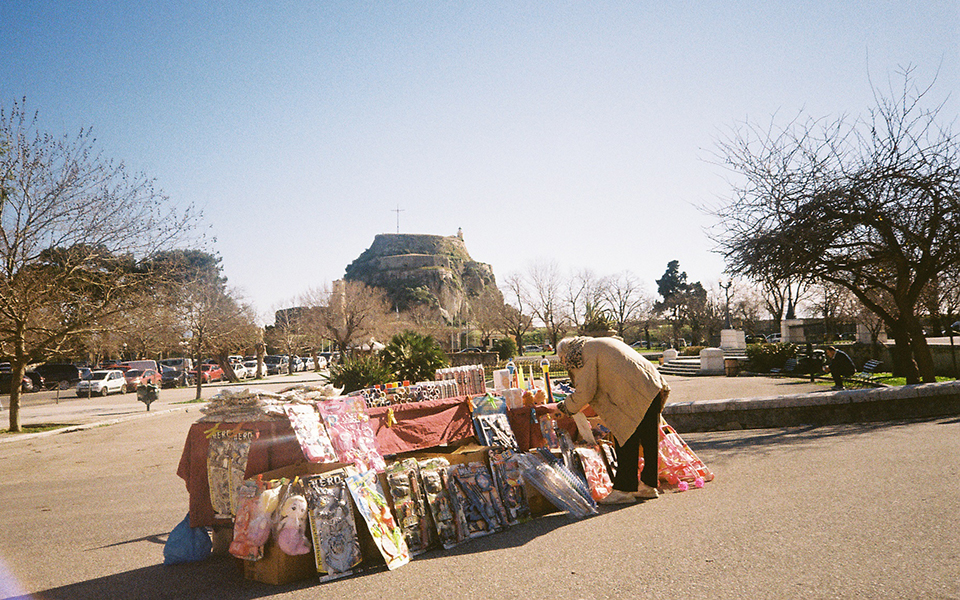
Street vendors set up their stalls in Spianada Square.
© Pantelis Tsompanis
In Corfu, you’re quite likely to encounter visitors from Serbia who have come to pay honor to the 150,000 Serbian soldiers who found refuge there after the defeat of the Serbian army by Austria-Hungary during WWI. Corfu also hosted the Serbian government-in-exile under Nikola Pašić until the end of hostilities.
Today, on the small island of Vidos at the entrance to the town’s harbor, stands a monument to the thousands of WWI Serbian soldiers who, suffering from infectious diseases, were quarantined there. Many perished on the island and were buried at sea. The monument, which commemorates this tragedy, is an oft-visited sight.
In a three-story neoclassical building in town, the Serbian Museum of Corfu (19 Moustoxydi, Tel. (+30) 26610-26724) presents photographs, uniforms, weapons and other historical documents from this same period.
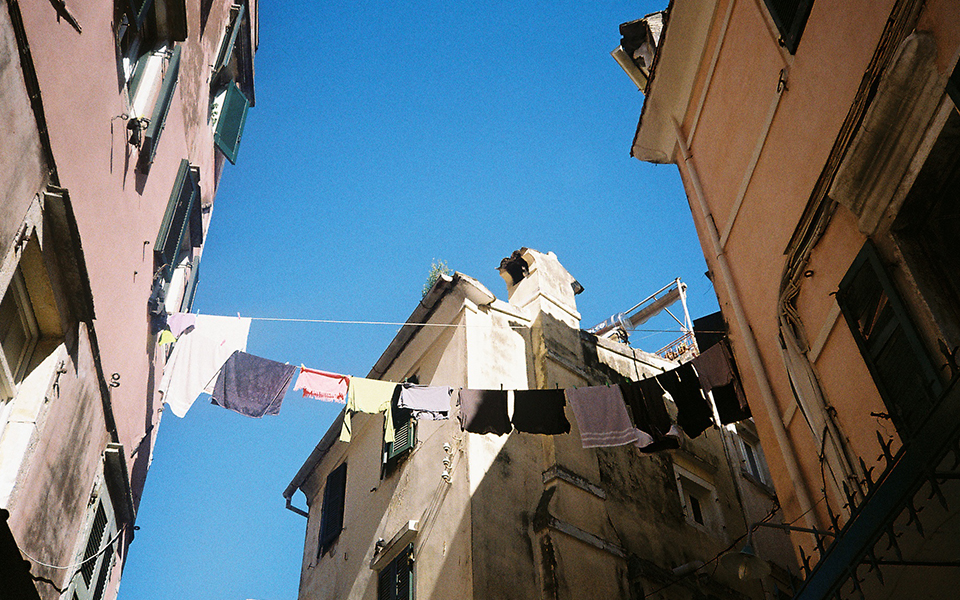
Lines of colorful laundry and the scent of freshly washed clothes evoke another era.
© Pantelis Tsompanis
Corfu’s Old Fortress, which dominates the harbor, is well worth exploring. One of the many surviving Venetian fortresses dotting the Mediterranean coastline, it attracts thousands of visitors each year.
From Spianada Square, cross the tall bridge over the Contra Fossa moat and pass through the fortress gates. Among the most important buildings within the fortress are the one housing the Department of Music Studies of the Ionian University (formerly the British military hospital) and the Church of St. George, built by the British in 1840.
Climb the stone steps of the fortress to reach the Great Lighthouse, which offers sweeping views over the entire city of Corfu.
As its historic estates fade and...

How one retired American teacher helped...

Five memorable ways to enjoy Chios...
From family traditions to modern innovation,...