7 Ways to Experience Oinousses
In the Oinousses island group in...


Tanning and movies go hand in hand at Marianna open-air cinema, set in the paved courtyard of Skala Primary School.
© Perikles Merakos
“Why are you out in this heat?” an elderly woman asks a friend. They have run into each other at a crossroads in Hora, both carrying bags from Fengaros bakery. It is 11 in the morning. I have already taken a walk around the Monastery of Saint John the Theologian, whose construction began in the 11th century as a fortified castle. The houses spread out directly below it because, in the past, the islanders would seek refuge within its walls during pirate raids. I smile at the two women and they greet me. “How do I get to the Cave of the Apocalypse?” I ask. They point me toward a shortcut along a footpath instead of the main road. Before following their route, I pause to take in the atmosphere of the relatively empty Hora – the island’s short tourist season will begin in a few days and end in September.

Surprisingly, or perhaps not, I am not on the island for the Saint John experience, but for the 15th Aegean Film Festival, which this year has attracted prominent members of the international film community. Before I have a chance to mingle with them, I notice festival posters everywhere, plastered on the doors of Hora’s bars, which are still closed – they will open in the afternoon. A seahorse set against a starry sky is the recurring image. In the alleyways, conversations among permanent residents occasionally mingle with French, Italian, and Turkish. Whitewashed houses are punctuated by pots of geraniums and cacti. Elsewhere, bougainvillea and prickly pear cactus spill over walls, heavy with fruit that has yet to ripen. I stop at the gallery of Andreas Kalatzis, a well-known figure on the island, where nine short films were screened on the festival’s opening day, including The Missing Piece by Alma Jodorowsky, filmed on Amorgos. On the gallery floor, splattered with paint, children draw on sheets of paper. Kalatzis, who studied at the Patmian Ecclesiastical School, is putting the finishing touches on a painting of a lobster.
A bit farther down, Despina Melianou, another of the island’s distinctive personalities, welcomes me to Koukoumavla, a chamber of curiosities where books share space with her paintings and an assortment of other objects. After buying a Freddie Mercury pin, and with my head full of images of boutiques selling boho clothing, jewelry and souvenirs, I finally make my way downhill toward the Cave, along roads lined with stone pines. There, I encounter the island’s more spiritual side. A young woman wearing a white dress and matching veil, almost like a bride, sits beside a more simply dressed man. Motionless as statues before the rock that, according to Christian tradition, split into three during Saint John’s visions, they hold hands. Who knows what has brought them here? Unable to get them out of my mind, I set off again, this time guided by Google Maps, heading downhill toward Skala, the island’s port and the beating heart of the festival – and, as it happens, the location of my hotel.

Christian Jeune, Thanassis Karathanos and Ada Solomon brought a European flair to Patmos’ cinephile meltemi winds.
© Perikles Merakos
Over four days on the island, I moved between the Patmion Municipal Cultural Center on the waterfront and Skala Primary School. In the courtyard of the former, the 100-seat Asterias cinema had been set up for the festival, screening films that included David Attenborough’s Wild London. One of the highlights for me was the documentary The Blind Couple of Mali, about the duo Amadou & Mariam, who became superstars in France in the 1990s with the wonderful Afropop song Je pense à toi. Before the screenings, visitors could explore two exhibitions held in rooms on the ground floor: “Something of Their Own” by photographer Maria Pavlaki and “Wordless Stories” by visual artist Antonio Milana. The Patmion Cultural Center also housed a specially designed VR space, where visitors wearing virtual-reality headsets could experience the wild, psychedelic work Feedback VR: An Anti-Futuristic Musical by AMiXR, a collective based in Peru.
Tickets for the VR works cost 12 euros for two screenings, with nine works available in total. Film tickets cost 10 euros, and the program included 10 narrative features, seven documentaries and 38 short films. For the shorts, a single ticket covered multiple screenings. All the narrative features were shown in the courtyard of Skala Primary School, 400 meters inland from Patmion, where the 250-seat Marianna cinema had been set up. One film I particularly enjoyed there was Gazelle, which follows, by turns humorously and harshly, the odyssey of a Turkish music teacher who fled for New York as a political refugee. The Audience Award, determined by viewers’ ratings after each screening, went not to Gazelle but to La Vénus électrique, which opened the Cannes Film Festival in May. The documentary award went to Richard Ladkani’s Yanuni, co-produced by Leonardo DiCaprio, about Indigenous peoples of the Americas. The film premiered at the Tribeca Festival last year.

The writer in Hora, with the festival tote bag slung over his shoulder.
© Perikles Merakos

The Asterias open-air cinema at the Patmion Cultural Center.
© Perikles Merakos
The audience was not alone in handing out awards. An exceptional three-member jury, judging films across four categories, brought a touch of Cannes and European cinema to Patmos. I met its members – Ada Solomon, Christian Jeune and Thanassis Karathanos – in the courtyard of Benetos restaurant in Sapsala, a quiet bay near Patmion. Solomon, a former producer who worked alongside Franco Zeffirelli on Callas Forever (2002), is now chair of the board of the European Film Academy, founded 37 years ago by Ingmar Bergman and currently headed by Juliette Binoche. “One thing I appreciate about smaller festivals,” she tells me, holding a glass of Aperol, “is that you can genuinely communicate with other members of the film community. Especially here – where, despite the holiday feel created by the island setting, people are still working – you can connect with others in a way that simply doesn’t happen at major film events, where everyone is constantly on the go.”
Christian Jeune, deputy director of the Cannes Film Festival, where he has worked since 1983, and director of its Film Department, ended up in Patmos largely by chance. He met Babis Tsoutsas, artistic director of the Aegean Film Festival, in Cannes, and the two struck up a conversation that sparked Jeune’s curiosity about how a festival on Patmos might engage with its local audience. “From what I’ve seen, people really do come to watch the films, and that’s what gives me the greatest pleasure.” As we crossed paths several times between screenings, he returned to the same point. He had forgotten what it was like to see people lining up outside a cinema to buy tickets, and rediscovered that experience in Patmos. At the major film-industry festivals he usually attends, much of the audience consists of industry professionals who do not buy tickets.
Thanassis Karathanos is a different case altogether. He knows Patmos like the back of his hand, having spent his holidays – and occasionally lived – on the island for the past 30 years. He has also attended the festival since its very first edition. Born in Berlin, he has produced dozens of international and Greek films and was a co-producer on Paul Verhoeven’s Elle, which was nominated for the Palme d’Or and earned its star, Isabelle Huppert, her only Oscar nomination to date. He has also known the other two jury members for even longer than he has been coming to Patmos. “By coming here,” he says of Solomon and Jeune, “they’re supporting what Babis is doing – running a boutique film festival on Patmos – which is no easy feat.”
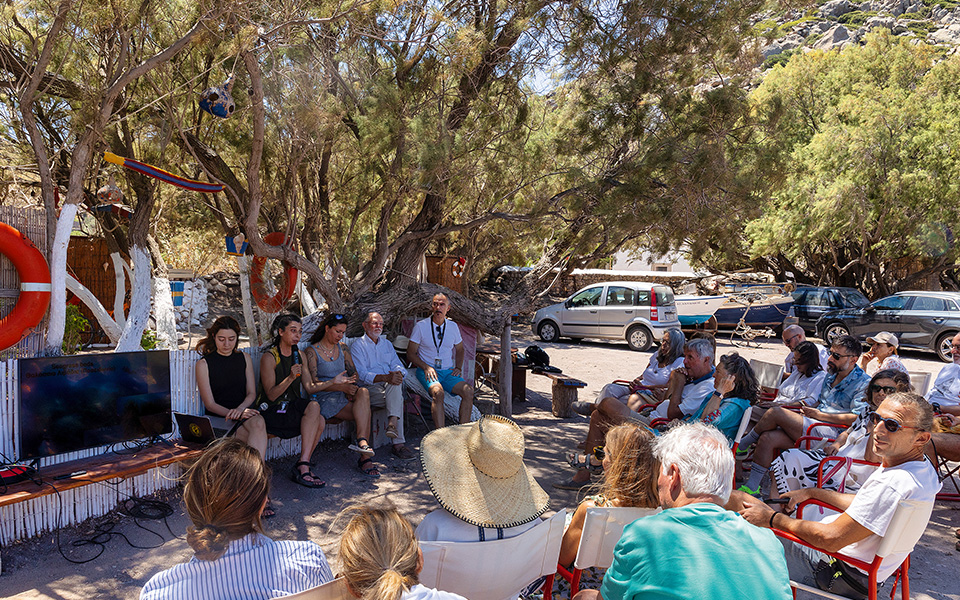
One of the panels of the Aegean Film Festival’s Echoes environmental program took place at Lefkes Beach.
© Perikles Merakos
Babis himself was rushing around trying to keep on top of everything during my time on the island. I managed to steal half an hour with him at Lefkes beach, where a panel discussion on marine ecosystems was taking place as part of “Echoes,” the festival’s environmental program, which also included free documentary screenings thanks to support from Greece’s Green Fund. Born in Athens in 1979, Babis Tsoutsas studied international business management at Deree College, filmmaking at Prague’s PCFE film school, and photography under Platon Rivellis. So how did he come up with the idea of turning Patmos into “Greece’s little Cannes”? In 2009, while vacationing on the island with his wife and several friends from abroad who worked in the film industry, he realized that Patmos did not have a single movie theater. On the spur of the moment, he drew up a budget on a napkin for a festival where they could screen the films they wanted to see. And so the Patmos International Film Festival was born, before being renamed the Aegean Film Festival in 2017.
The festival built its international reputation without much fanfare. “Five years ago, we didn’t even have social media accounts,” he explains. Yet he cannot quite pinpoint what persuaded major industry figures not only to join this year’s awards jury but also to support the festival over the years by serving on its programming advisory board. Its members include two-time Oscar-winning Greek-American director Alexander Payne, Tribeca artistic director Frédéric Boyer, and Robert Dick, head of corporate development at Sundance. Next year they will be joined by Bruno Muñoz, head of the Short Films Department at the Cannes Film Festival, whom I spotted several times in the audience. All this comes at a moment when – 17 years after Yorgos Lanthimos won an award at Cannes and the subsequent rise of the Greek Weird Wave – independent Greek cinema appears to have come of age in the international market. Next year, on January 16, the European Film Awards will take place at the Stavros Niarchos Foundation Cultural Center. “Preparations are in full swing,” Solomon told me at one point. A few months later, Greece will be the Country of Honour at Cannes’ Marché du Film, where some of the film industry’s biggest deals are made. As the sun set over the sea, I listen to Babis Tsoutsas describe the festival’s audience. “You might have Valeria Golino sitting in the front row at Asterias, with a local grandmother right next to her,” he says.
The 15th Aegean Film Festival took place on Patmos from July 16 to 27. More information is available on the festival’s website, aegeanff.com.
In the Oinousses island group in...
On its own or paired with...

From Lefkada and Anogeia to Paros...
From its dazzling Hora and iconic...