Dry Stone Walls: A Living Art of the...
More than a traditional building technique,...

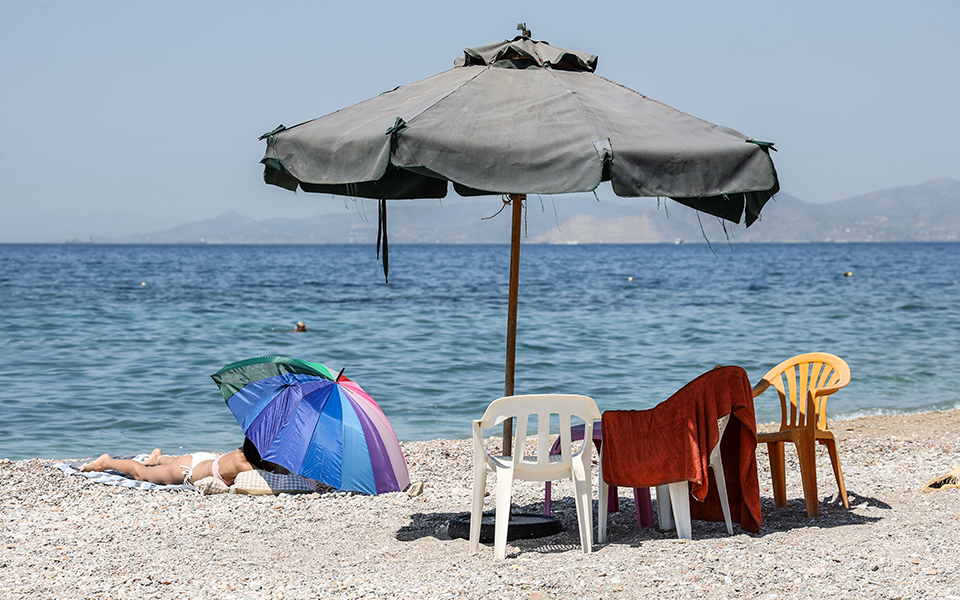
White, but also found in every other color imaginable, the plastic chair reigns over our summer dreams. Here in Palaio Faliro, right on the sand.
© Nikos Kokkalias
Its origins remain uncertain, but its silhouette is instantly recognizable: inexpensive, durable, usually white. Sometimes it has armrests, sometimes only its curved backrest. It stacks, travels, disappears and reappears with ease. It belongs to everyone and no one at once. Often described as the most democratic piece of furniture ever made, it has become a quiet constant in everyday life, from seaside terraces and village squares to city sidewalks across Greece and far beyond.
The monobloc chair, named for its single-piece construction, emerged in the 1960s, when plastic was reshaping industrial design and environmental concerns were still distant. Its early lineage is often traced to Canadian designer D. C. Simpson, who produced a one-piece plastic chair in 1946, though not in the form we recognize today.
The decisive shift came in the mid-1960s, when designers including Helmut Bätzner, Joe Colombo, Verner Panton and Henri Massonnet began refining the idea, experimenting with mass production, molding techniques and new forms of domestic minimalism.
It is this combination of ubiquity and design pedigree that led T Magazine of The New York Times to include it among the 25 most defining pieces of furniture of the past century. A panel of designers, a curator, an artist and an actress even debated whether it might be “the most important chair of our time.” Writer Max Lakin described it as “the antidote to design idolatry,” an object that is both original and copy, everywhere and nowhere at once.

Cheap and accessible, it managed to appeal across classes without losing its relevance within design discourse.
© Shutterstock
According to Giorgos Tzirtzilakis, professor at the Department of Architecture at the University of Thessaly and a scholar with extensive experience in design and exhibition curation, the white plastic chair is “the quintessential expression of postwar liberalism. In a paradoxical way, and through a series of reversals, the white monobloc chair became the most modernist piece of furniture of the postwar era.” Cheap and accessible, it managed to appeal across classes without losing its relevance within design discourse.
“It is common to own objects not necessarily because they are practical or comfortable, but because they evoke strong emotions that outweigh their ergonomic shortcomings. We often say: ‘The chair isn’t very comfortable, but the design is beautiful’ or ‘The dining table is too low, but it’s a wonderful piece of craftsmanship’ or ‘What a lovely sofa – it reminds me of my childhood, even if it’s too narrow,'” says award-winning architect and designer Katerina Apostolou. “With the plastic chair, it works the other way around.” And indeed, most of us have sat in one for hours, not because we chose to, but because it was simply there, waiting.

A woman sits on a plastic chair on the balcony of her apartment in the Refugee Buildings on Alexandras Avenue.
© Nikos Kokkalias
Across the Mediterranean, the ritual is familiar: chairs placed outside in the evening heat, conversations unfolding in the street, life moving outdoors. In Spain it is known as tomando el fresco (“enjoying the cool air”), a practice once even considered for UNESCO recognition. Athens has its own version. “I don’t use air conditioning at home,” says Roula, who lives in a neighborhood where residents still gather outside in the evenings. “Even on the hottest days there’s usually a breeze. Everyone brings their chairs out. The heat is strong, but it gets better at night.”
Her neighbor Athanasia, 28, puts it more simply: “It’s like a shared living room.” The practice stretches back generations. “They used to bring their chairs out when the refugees first arrived,” Roula recalls. “They would fan themselves and exchange news. Times change, but this remains.” From working-class streets to global pop culture, the chair has travelled far. It appeared on a Bad Bunny album cover, prompting fans worldwide to recognize their own childhood furniture in a new context. As Greek pop star Marina Satti once put it: “Greece is the plastic chair and the frappé.” It is a shorthand that turns out to be surprisingly accurate.

Whether encountered as art object or street-side fixture, the white plastic chair has already secured its place in both design history and everyday life.
© Shutterstock
Romantic as it may sound, the chair’s disappearance seems unlikely. It continues to exist simultaneously as mass-produced object and design reference point. “When we design furniture, we look for certain qualities, and the monobloc chair fulfills them almost perfectly,” says designer Ioannis Solomozis, founder of SØLØ.
Greek designers have also reinterpreted it in more experimental directions. In 2010, Greece Is for Lovers launched Go Naked, covering the chair in fur. Designer Ioli Chiotini later reimagined it in fabric, shifting it closer to sculpture than utility. Whether encountered as art object or street-side fixture, the white plastic chair has already secured its place in both design history and everyday life. And the next time you see one – on a pavement, a balcony, or a beach – you may find yourself looking at it differently.
Based on reporting originally published in Kathimerini.
More than a traditional building technique,...

The recognition of Salamina’s kopaneli lace...

As its historic estates fade and...

On the city’s eastern edge lies...