10 Unforgettable Spring Hikes
From alpine forests and dramatic gorges...

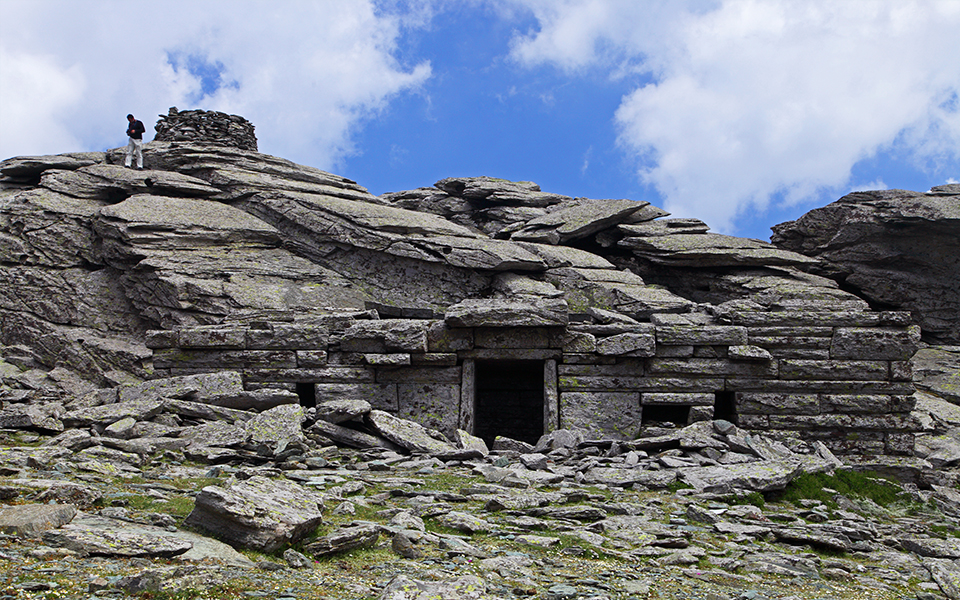
The largest and best-preserved Dragon House (Drakospito), on the peak of Mount Ochi, southern Evia.
© Olga Charami
Scattered across the rugged heights of southern Evia – near Styra, above Karystos, and crowning the summit of Mount Ochi – stand more than twenty mysterious stone buildings known locally as Drakospita, or “Dragon Houses.” They are neither vast like the white-marbled Parthenon nor refined like a colonnaded stoa. They’re squat, slate gray, and positively prehistoric in appearance; the sort of abode Fred and Wilma Flintstone might have admired for its sturdy practicality. And yet most scholars believe they were built during the Classical or early Hellenistic period, in the 5th or 4th century BC – at the height of Greek architectural sophistication.
How they were built and what they were used for, however, remains an enigma.
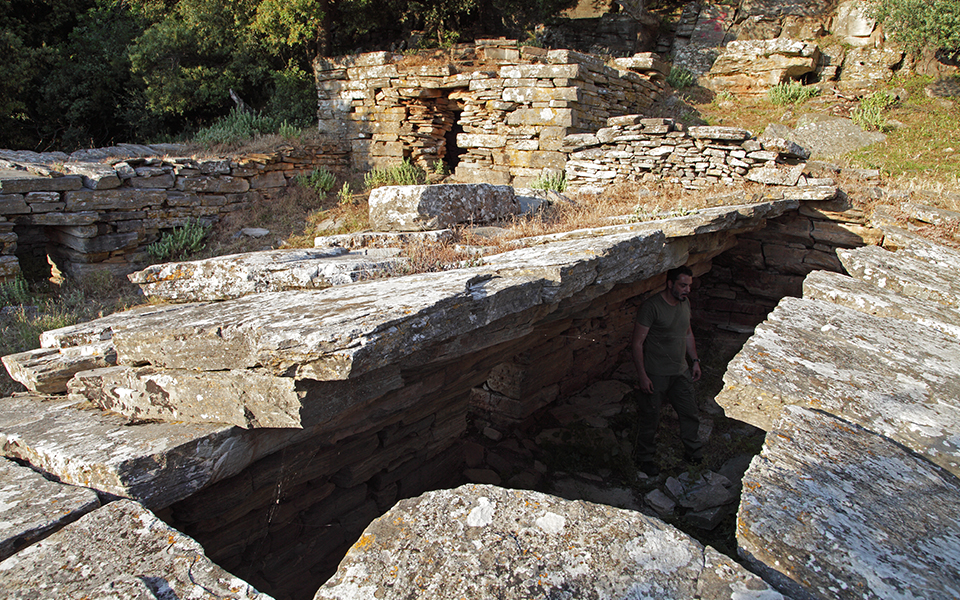
The Dragon Houses are detached from any settlement patterns and far from commercial or traffic routes.
© Olga Charami
At first glance, the Dragon Houses seem deceptively simple. Rectangular in plan and constructed from massive slabs of local “Karystian stone,” they rise directly from the bedrock without visible foundations. There is no mortar binding the stones together. The sheer weight of each block holds the structure in place, while smaller stones are carefully inserted to steady and secure the walls.
Their most striking feature is the roof. Huge stone slabs are laid in successive horizontal courses, each slightly projecting inward from the one below, until the opposing walls converge in a corbelled vault. The result is a steep, pyramidal form capped by a narrow slit that allows light – and perhaps smoke – to filter through. Inside, monolithic jambs and lintels frame the Π-shaped entrances, and stone shelves protrude from the interior walls, hinting at purposeful use.
The largest and most imposing example stands near the summit of Mount Ochi at 1,399 m above sea level. First documented in 1820 by British engineer John Hawkins, it measures 12.7 m by 7.7 m, with walls about 1.5 m thick. Its entrance is crowned by a single horizontal slab nearly four meters long and weighing an estimated ten tons. However, it was quarried, transported, and raised into position – without mortar, cement, or any evidence for the use of cranes.
Local folklore supplies a playful explanation regarding their construction. In earlier Greek tradition, the word “dragon” could refer not only to a mythical reptilian beast but to a being of superhuman strength. Who else, villagers reasoned, could have maneuvered stones of such scale into place?
And yet beyond myth, the structures endure. Exposed to centuries of wind, rain, and near constant seismic tremors, the Dragon Houses remain largely intact, their gray Karystian stone merging seamlessly with the mountainside.

How they were built and what they were used for, however, remains an enigma.
© Olga Charami

These were not casual constructions. They were carefully planned, skillfully engineered, and built with a confidence that suggests permanence.
© Olga Charami
Unlike most ancient Greek monuments, the Dragon Houses offer few textual clues. No dedicatory inscriptions have been found in situ, and their stark form resists easy stylistic classification.
Archaeology has provided tantalizing fragments rather than firm answers. In 1959, Professor Nikolaos Moutsopoulos excavated the Mount Ochi structure, uncovering pottery sherds, animal bones, and faint traces of what may have been sacrificial activity. One fragment reportedly bore an inscription, though its interpretation remains uncertain. The finds are now housed in the modest Archaeological Museum of Karystos.
On the basis of ceramics and construction techniques, and comparison with stone houses found in other regions around the Mediterranean, many scholars tentatively date the buildings to the Classical and early Hellenistic periods. Others have suggested slightly earlier or later chronologies. But without definitive evidence, the Dragon Houses hover within a broad historical window – unmistakably ancient, yet elusive in detail.
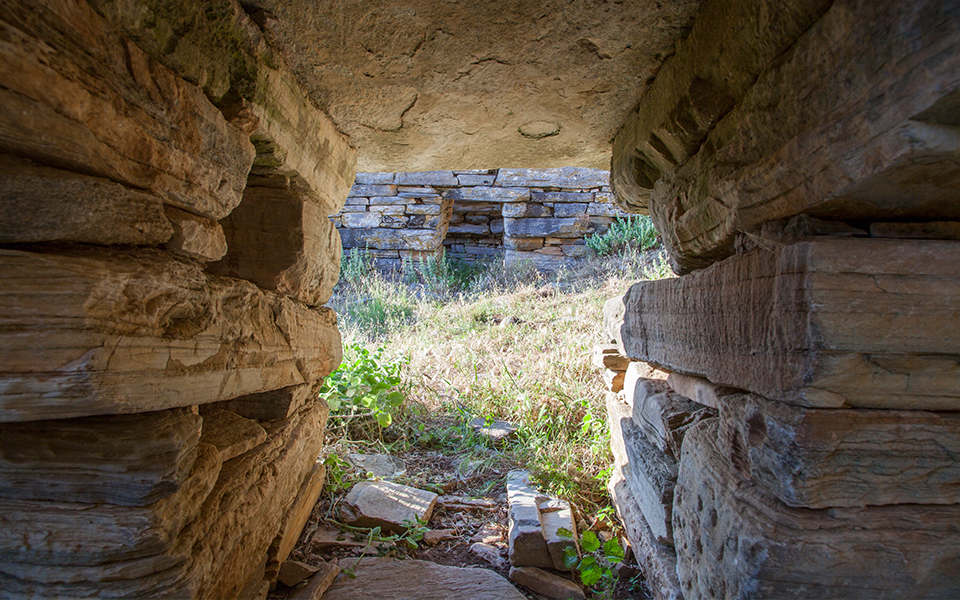
Some scholars believe the Dragon Houses served as summer dwellings for shepherds.
© Olga Charami
The debate over their purpose has endured for generations.
One longstanding theory proposes that the Dragon Houses functioned as rural sanctuaries, possibly dedicated to Zeus or Hera. Their commanding positions – perched on ridges overlooking valleys and sea routes – lend themselves to sacred interpretation. Ancient myth associates Mount Ochi with the ieros gamos, the “holy wedding” of Zeus and Hera, and at least one ancient reference mentions a temple to Hera in the region. The discovery of animal bones and possible sacrificial remains at Ochi adds a layer of plausibility to the ritual hypothesis.
Yet the buildings are austere. They lack sculptural decoration, altars or the architectural flourishes typical of known Greek temples. If they were religious sanctuaries, they were unusually restrained.
Other interpretations see them as components of agricultural estates. The well-preserved complex at Palli-Lakka near Styra consists of three rectangular buildings grouped together, suggestive of organized rural activity – perhaps a gathering point or headquarters. Southern Evia was long associated with quarrying, particularly the distinctive Karystian stone used in antiquity, particularly in Imperial Rome. Some researchers propose that the Dragon Houses served as storage facilities or shelters connected to quarrying operations. One interesting theory posits the structures as sanctuaries for the divine hero Heracles, the patron protector of stone quarry workers.
Military explanations have also been advanced. Their elevated locations and substantial walls could imply defensive or lookout functions, perhaps guarding access to quarries or monitoring coastal approaches. A tower-like example at Niborio near Styra has been interpreted as a watch post. Others favor more practical uses: seasonal shelters for shepherds, lumberjacks, or workers navigating the mountainous terrain.
Each theory illuminates part of the picture while leaving gaps elsewhere. The scale of the Mount Ochi structure, in particular, seems excessive for a simple storehouse or hut. At the same time, the absence of definitive cultic features complicates the straightforward sanctuary model.
What is beyond doubt is intention. These were not casual constructions. They were carefully planned, skillfully engineered, and built with a confidence that suggests permanence.

© Olga Charami
The most rewarding way to encounter the largest and most impressive Dragon House is to hike to the peak of Mount Ochi; a trail that leads through a fairytale-like forest and opens onto sweeping views across the southern Evian Gulf.
Mount Ochi rises above the coastal town of Karystos, its slopes forming part of a protected Natura 2000 landscape known for rare flora and a wind-sculpted terrain that feels almost elemental. The path to the summit begins near the chestnut forest of Kastanologos, where super-centenarian trees twist and swell like living columns.
From there, a steady climb leads past the Ochi refuge at 1,050 m – built in 1962 and currently awaiting restoration – and into increasingly sparse vegetation, where kermes oaks cling stubbornly to rocky ground. As the trail approaches the col, the lowest point of the mountain ridge, the view opens across the Karystia region and the glittering Aegean beyond.
The final ascent skirts the small chapel of Profitis Ilias, perched near the summit. Nearby, almost blending into the pale, rock-strewn slopes, stands the largest and best-preserved Dragon House.
Up close, its geometry reveals itself in quiet detail: massive slabs precisely aligned, the corbelled roof rising in heavy tiers, the entrance framed by monolithic stone. It resembles a fortress and a tomb, a chapel and a shelter – familiar in parts, yet entirely singular. There are no explanatory plaques offering neat conclusions. The wind threads through the narrow roof opening as it has for millennia.
For travelers to this corner of Greece, Karystos provides both a practical base and a gentle counterpoint to the austerity of the mountains. Ferries connect the town with Rafina on the Attic coast, making southern Evia easily accessible from Athens. Along the waterfront, cafés and tavernas fill on summer evenings, while the small 13th-century Bourtzi fortress stands at the harbor’s edge. Above the town, the Venetian Castello Rosso (Kokkinokastro) keeps watch over the plain and the sea.
From here, visitors can venture inland toward Styra’s Palli-Lakka complex or attempt the ascent of Mount Ochi itself. The journey is as much about landscape as architecture: quarries carved into hillsides, abandoned kylindroi (columns) left half-finished, and villages built from the same resilient stone that forms the Dragon Houses.
In Greece, the past often arrives carefully labelled and confidently interpreted. The Dragon Houses offer something rarer – a reminder that even in a land saturated with history, mystery still has room to breathe.
From alpine forests and dramatic gorges...
We discover the healing properties of...

Just two hours from Athens, Mt...
Nature walks, local flavors, wineries and...