The Famous Onion Pie of Mykonos
Francesca Chanioti, a home cook from...

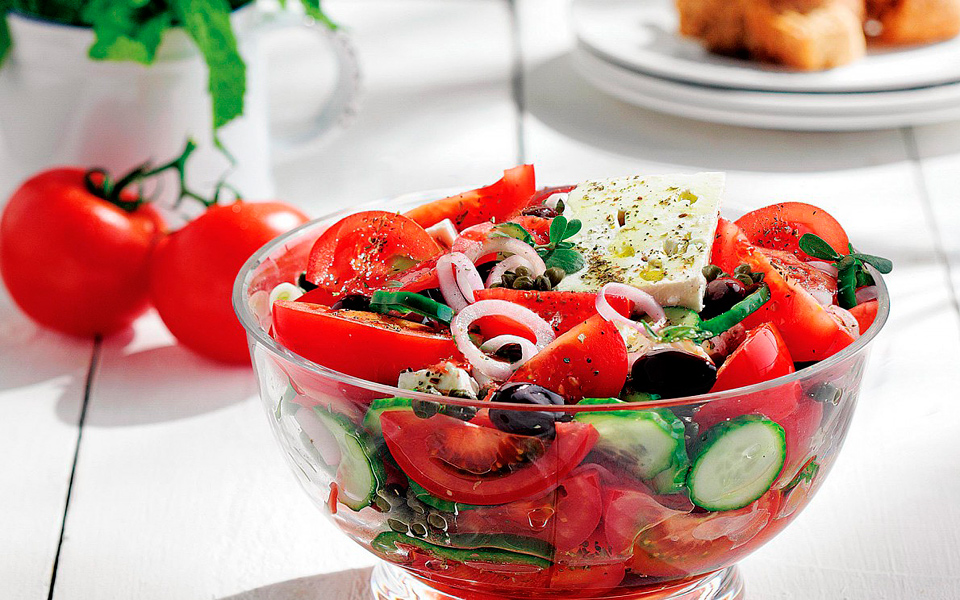
'Horiatiki' salad: a perfect combination of summer ingredients
© Giorgos Drakopoulos / Styling : Tina Webb

Preparation & Cooking time: 15'

Serves: 4
The Greek salad, also known as Horiatiki, a creation of taverna owners in the downtown Plaka neighborhood, made its appearance during the first tourism boom in the 1960s and ’70s. The wily restaurateurs found a way to circumvent government-set prices on simple salads with tomato, cucumber, onion and peppers by adding a slab of feta on top, which allowed them to charge tourists as much as they wanted for a “horiatiki” (or rustic) salad. So, while horiatiki is not a product of a specific region’s cuisine, its perfect combination of summer ingredients soon made it a household staple.
Horiatiki salad contains all the ingredients to make it a full and wholesome meal. A double serving (holding back on the oil and cheese) has everything the body needs: lots of vitamins and fibers from the vegetables (tomato, pepper, cucumber and onion), carbohydrates and more fibers from the accompanying rusk or bread often used for dunking, good fatty acids from the olive oil, proteins and animal fat from the feta and, last but not least, electrolytes like such as sodium (from the salt) and minerals such as calcium (from the tomato).
Here are some key features and ingredients of a Greek salad:
Place the tomatoes in a large salad bowl and salt lightly so that they release the juices that will form the basis of a delicious sauce for dipping your bread (a practice that is strongly encouraged at the Greek table). Cut the cucumbers lengthwise, remove the seeds and then chop into half-centimeter slices. In a separate bowl, salt them lightly and add a few drops of white- or red-wine vinegar. Mix and add to the salad bowl. Place the sliced onions in a fine sieve with a pinch of salt, and bruise lightly with your hand so they soften and lose some of their acidity. Then add to the salad.
Cut the peppers down the middle, cut away the stalk, clear the seeds and then chop in thin slices before adding to bowl. Add the capers. The feta can be chopped into cubes or broken up by hand or fork. Add to the salad after it’s been mixed so that it the feta doesn’t get too broken up. One idea to give the salad a bit of crunch is to add pieces of rye bread. These will soak up the salad juices and become delightful little bites that also make the salad more filling. Be sparing with the salt as both the capers and the feta are quite salty already.
Francesca Chanioti, a home cook from...

Discover how Christos, Athens’ master souvlaki...

Michiel Bakker, President of the Culinary...