What Ιs a “Koutouki”?
A Thessaloniki expert selects 13 spots...

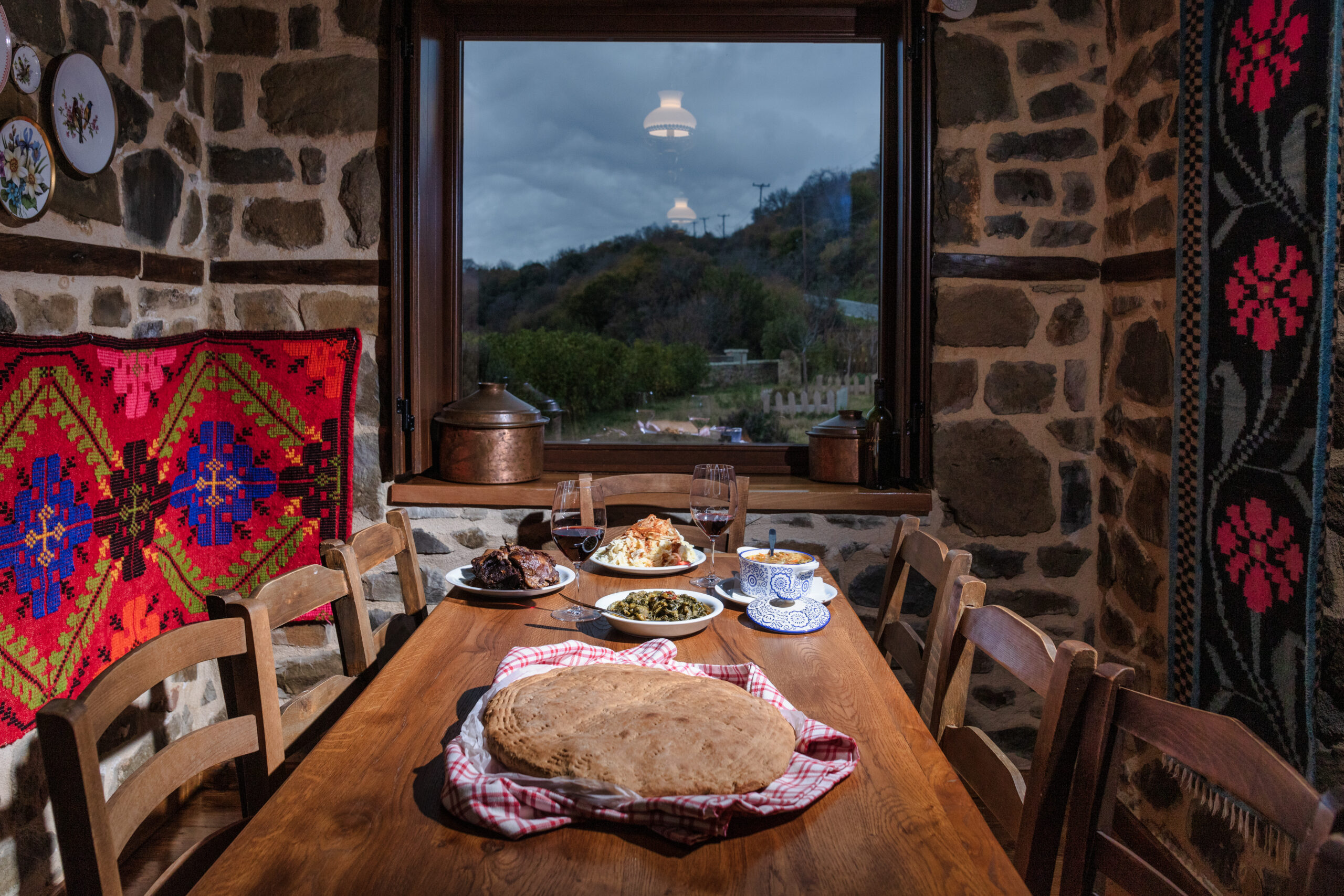
Giannis Angelakopoulos and Vaggelio Mavrikis’ Zerzova taverna in its new “home” in the village of Markou.
© Perikles Merakos
These are people who literally grew up in the kitchen, preserving their grandparents’ recipes and making the most of what the Arcadian land has to offer. People who have watched the world change yet continue to put all their passion into ensuring that every meal in their corner of Arcadia tastes authentic. Entire families devoted to the art of food who, still forage for wild greens, roll out pastry for pies by hand, make cheese and tarhana, and serve food that is simply irresistible.
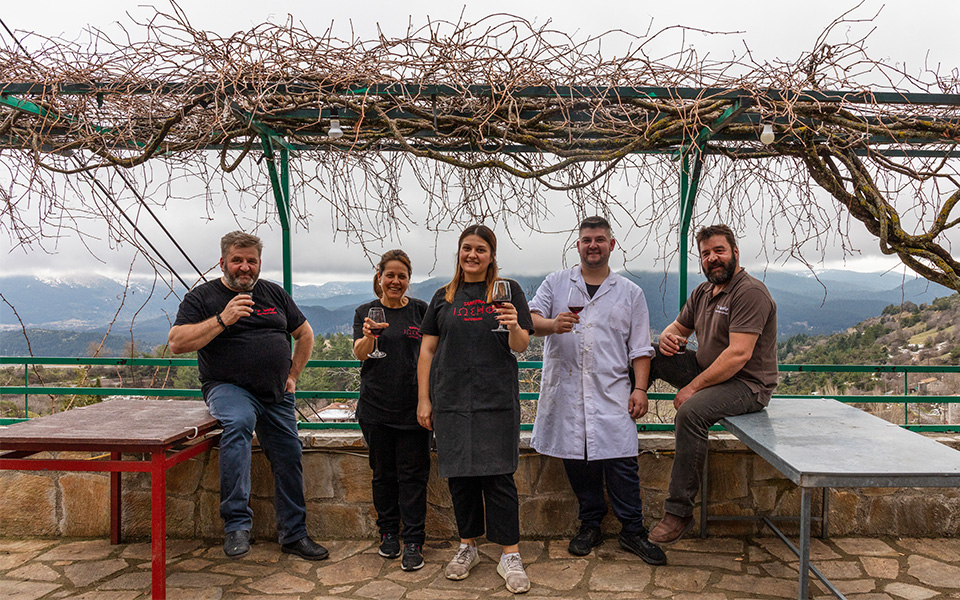
Giorgis and Thanasis Kanellopoulos with the latter’s family at Iosif taverna in Magouliana.
© Perikles Merakos
In Magouliana, the highest inhabited village in the Peloponnese, there are no more than 45 permanent residents. On most days, more people are sitting down to eat at Iosif, the Kanellopoulos family taverna that has been feeding generations of food lovers since 1969. On some weekends, guests wait outside for an hour or even two to get a table. Giorgis, who with his brother Thanasis runs the business originally founded by his father and grandfather, begins his day tending to the family’s 300 animals. At their taverna, it is hard to find meat that doesn’t come from their own farm. “Perhaps a calf, at most.” Everything else – lamb, goat, beef, sausages, as well as cheeses – is their own. Only the potatoes come from Tripoli, because they are not grown in the village. But even those are exceptional.
Iosif’s slow-roasted pork, braised goat, lamb chops and oven-roasted lamb have become famous. “People come from all over Greece to eat here. I wish my father were alive to see how far we’ve taken the place. I wonder what he would say to me,” says Giorgis, who started working there as a child, back when Iosif was a small taverna next to the family butcher shop.
Business has doubled since the five-star Manna hotel opened in the listed building of a former sanatorium, about 3.5 km from the village. Fortunately, Thanasis and Gianna’s children – the family’s fourth generation – also help out at the taverna. The youngest, Marilena, is studying nursing, but returns to the village every weekend to lend a hand. “Our land is richer than most other places,” says Giorgis. “Young people just need to have the sense to realize that.”

The Angelakopoulos family of Zerzova taverna with the dishes that made them famous.
© Perikles Merakos
“A customer said to me the other day, ‘Your food could raise the dead,’ but I don’t think I make anything extraordinary. When you’re given imported meat, no matter how much skill you put into cooking it, it won’t be good. But when the lamb is from around here, all you need is a little salt, pepper and oregano. Everything starts with the ingredients.” Vangelio Mavriki has been passionate about cooking since childhood. She made her first lamb with olive oil and lemon while she was still in primary school. Today, she cooks at Zerzova, a well-known taverna in mountainous Arcadia that she runs with her husband, Giannis Angelakopoulos, in the village of Markou. It all began in 2001, when Giannis, who was also raising goats and sheep, started working at the kafeneio his mother, Eleni, had opened in the village of Panagia, also known as Zerzova. At first, they only served coffee and tsipouro. Gradually, they began preparing a little cured pork and frying cod. When Giannis became engaged to Vangelio, who was from a neighboring village, she joined him in the kitchen, and together they began serving full meals.
“We made simple, honest food, and that’s why people came to love us,” says Giannis. “But the dish that really put us on the map was hilopites with browned myzithra, a traditional recipe. We all made it at home, but you couldn’t find it in restaurants. ‘What does our mother make for us when we come home hungry?’ I said to Vangelio one day, and that’s how we brought it back.” Giannis hunts wild boar, raises roosters, gathers mushrooms and forages for wild greens. “I don’t know how many tons of wild greens I’ve gathered in my lifetime,” he says. “When we don’t have greens, I don’t feel right. I remember once, around Christmas, as soon as we closed the taverna, I went out into the night with a flashlight to gather some, and Vangelio was shouting after me, ‘Where are you going? Are you crazy?’”
In recent years, Giannis and Vangelio’s love of good food has found a new home in the village of Markou, where Kolokotronis once had his stronghold, which offers views of Mount Lykaion on one side and historic Klinitsa on the other. The walls of the taverna reveal some of Vangelio and Giannis’ other longtime passions: painting and the clarinet. At the tables, however, it’s all about the food: slow-cooked wild boar, “burnt” hilopites, braised wild greens, steaming beef soup and fragrant cinnamon-topped bougatsa. These dishes capture the flavors of Arcadia in their purest form.

The Angelakopoulos family of Zerzova taverna with the dishes that established its reputation.
© Perikles Merakos
© Perikles Merakos
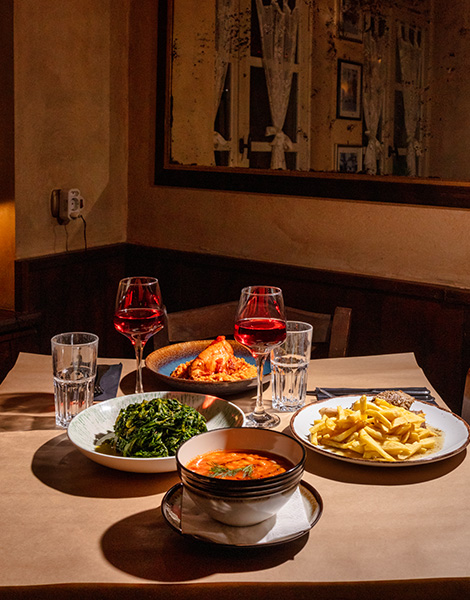
“The secret is to treat the restaurant like your home, to see every customer as a guest rather than a wallet,” says Eleni Tzifa, who, together with her sister Frosso and their mother Katerina, continues to cook at Klimataria, the taverna their grandparents founded in Vytina in 1931. Their grandfather, Dimosthenis, left the village as soon as he finished school and moved to Athens, where he trained as a cook in major hotels. When he returned a few years later, he married their grandmother Eleni and opened the taverna, bringing back what he had learned in the capital and developing it further. “Grandfather was a man with real passion. He loved cooking, brought in bands to play music, and had a dance floor and private booths for couples in the courtyard. There were no places like that around here back then,” recalls Eleni, who learned to cook from her parents, just as they had learned from him.
Today, Eleni and Frosso Tzifa continue to prepare traditional home-style dishes in Klimataria’s state-of-the-art kitchen, while the dining room, preserved as their grandfather designed it, has been entrusted to the restaurant’s fourth generation, Christos and Tasos Zambathas. “Times change. Expectations were different in the ’40s, the ’70s and the ’90s, and they are different again today. We keep up with the times while holding on to tradition –old-fashioned dishes and authentic flavors,” says Frosso, who grew up in the restaurant but also went on to attend university and pursue postgraduate studies so she could help develop the business.
Katerina, who has spent 50 years in the taverna’s kitchen, feels proud when she sees customers who once came with their parents returning with children of their own. They come back for rooster braised in tomato sauce, goat with olive oil and oregano, handmade tarhana and her savory pies filles with cheese, wild greens, or onions. “We try to maintain the quality by using local ingredients,” explains Eleni. “Eighty percent of our supplies come from Vytina and the surrounding area: local lamb and goat, hilopites, pappardelle and lazanaki pasta, homemade bread, manouromyzithra and anthotyro cheeses, and fir honey. They may cost more, but they’re what makes the difference.”
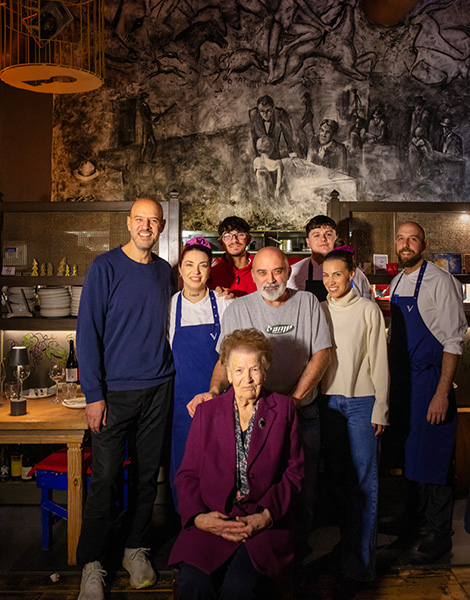
Sotiris Kouros with the extended “family” of Villa Incognito restaurant in Tripoli.
© Perikles Merakos

© Perikles Merakos
Although Villa Incognito appeared on Tripoli’s culinary map in 2012, Sotiris Kouros’ family has been in the restaurant business for much longer. The story began sometime in the 1920s, when his grandfather, also named Sotiris, returned from America and used his savings to open an inn in a central part of the city, along the route taken by horse-drawn carriages heading to the surrounding villages.
A few decades later, Sotiris’ father, Mimis, kept the inn’s wooden barrels to make his own wine from must brought in from Mesogeia and transformed the inn into a taverna. “The kitchen he had created was incredible. Working in just seven square meters, we could serve 200 people,” says Sotiris, who in 2002 opened his own restaurant in memory of Mimis Kouros, with his mother Athanasia and his father’s former waiter. “There were three different generations of us in the kitchen, and things worked with the classic kitchen-style arguments: ‘Let me do it the way I know how.’ And yet, somehow, the result was magical,” he recalls. Mageireio tou Kourou went on to make its own mark on the city, until another chapter came to an end and Sotiris decided to take the next step, this time with his partner, Yakinthi Tyrovola, who also comes from a family with a history in the restaurant business.
At Villa Incognito, inspired by the books of Tom Robbins, the old wooden barrels have been transformed into light fixtures. Athanasia, now in her 80s, may no longer run the kitchen, but she still makes sour tarhana, cooked with lamb and sheep’s butter, a dish that is hugely popular. Her influence can also be found in the cooking of both Sotiris and chef Giorgos Sougioultzis, who learned the art of traditional pot cooking at her side and now puts his own spin on old recipes. The menu includes local beef from Argos, slow cooked for six hours in a covered clay pot; prized Alonistaina beans with herring; wild greens with manouromyzithra cheese; eggplant pie with tarhana. There are also local wines from the vineyards of Mantineia, Yakinthi’s specialty, as well as handmade desserts such as yogurt ice cream with citrus sauce and crisp pastry rolls. This is a cuisine that does more than showcase the finest produce the region has to offer: it carries memories of an enduring connection to the Arcadian land, imbued with the nostalgic mood of Tom Robbins’ Jitterbug Perfume.

© Perikles Merakos

Taverna owner Kostas Paraskevopoulos with his mother and son, alongside Koumpouris’ signature dish, roast suckling pig.
© Perikles Merakos
Kostas Paraskevopoulos literally grew up in his family’s taverna, O Koumbouris, on the main square of Levidi, an almost obligatory stop for anyone passing through the village with a taste for roast suckling pig. He lost his father at the age of 14 and found himself helping his mother run the business. “I had no choice but to jump in, but I’ve never regretted it. I love my work,” says the eldest of the family’s children, who has now taken over the business and expanded it. The original, 15-square-meter taverna was founded in the 1970s by Giorgos Paraskevopoulos, nicknamed Koumbouris, and his wife Asimo. They ran it with the help of their children. Today, it occupies 200 square meters and employs a staff of 20.
Ever she eloped with her husband before leaving for his military service in Litochoro, where they opened their first establishment, Mrs Asimina has never left the kitchen. Now a grandmother, she still works 15 hours a day at the taverna, helping her son. She always prepares enough for both the family and the customers: liver with olive oil and oregano, chicken with hilopites pasta, baked eggplant, and a handmade pie. The taverna’s signature dish, however, remains the roast suckling pig. Regulars also come for the kontosouvli, orange-flavored sausage, kokoretsi and handmade beef patties. “It’s important to have good ingredients,” says Kostas, who carefully selects his suppliers from Arcadia and the neighboring regions. “The real challenge, though, is finding quality staff – people with a strong sense of pride and responsibility, who treat every customer as if they were family.”
A Thessaloniki expert selects 13 spots...
All the secrets to producing a...

My mind keeps tumbling back, bringing...
Just two and a half hours...