Nine Artists Shaping Contemporary Athens
Working across art, craft and design,...


Having made Hania her home five years ago, Japanese calligrapher Mizuki Imamura is working to introduce Greeks to the art of Japanese calligraphy, a tradition with deep historical roots that remains very much alive today. At this year’s Thessaloniki International Fair, she presented her art to the public, giving visitors the opportunity to discover a different form of expression and, as she explained to us, meditation. Imamura has been practicing calligraphy for 24 years and holds the title of shihan, a prestigious rank recognizing her expertise and ability to teach the art.
Having chosen Greece as her home and a place to pursue her creative work, she continues to share her knowledge and passion for calligraphy with those attending her workshops and seminars. She spoke to us about her journey, her life in Greece and the meeting of two distinct cultures through an art form that, despite relying on the simplest of tools – ink, paper, and the movement of a brush – encompasses a world of meaning and tradition.

When did you move to Greece, and what have your impressions been of the life and people here in Greece in general and in Hania in particular?
I came to Greece for the first time in 2017 and moved to Hania in 2021. My impression of life here is defined by a beautiful sense of warmth, generosity and a relaxed rhythm of time. The people of Greece, and particularly in Hania, have welcomed me with open arms. There is a deep appreciation for culture, family and nature that resonates strongly with my Japanese roots. Living in Hania, surrounded by the sea and rich history, provides a peaceful backdrop that constantly inspires my artistic work.
How long have you been practicing calligraphy, how did you achieve the title of shihan, and did you have a master? How important was the connection with your master?
I have been practicing Japanese calligraphy (shodo) for 24 years. Achieving the title of shihan (master instructor) required decades of rigorous practice, study of classical works and formal examination by traditional calligraphy associations in Japan.
The connection with my master was fundamental to my journey. In Japanese traditional arts, learning is not merely about technique. It is transmitted from master to student through ishin-denshin (heart-to-heart communication). My master taught me how to sit with the ink, hold the brush with presence and pour my character onto the paper. That spiritual lineage and guidance remain the core of everything I practice and teach today.

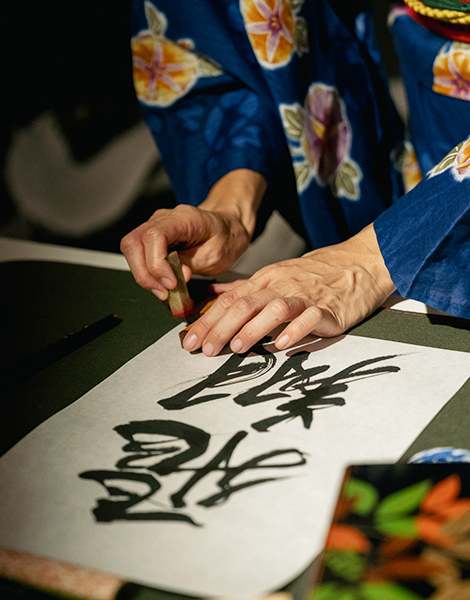
Is Japanese calligraphy an art that requires devotion and time to study and master it? Is the process as important as the result?
Absolutely. Japanese calligraphy is a lifelong path (道 – dou). It demands complete devotion, concentration and patience.
It is fundamentally an art of a single, decisive moment because there are no second chances or retouches. Unlike oil painting or drawing, you cannot erase, overwrite or edit a stroke once it touches the paper.
Because of this, the process is arguably even more important than the final result. Every single line captures an unrepeatable second of your breath, physical movement and state of mind. The final artwork is simply an honest, permanent reflection of the internal state that existed in that exact instant.
What led you to work as a calligrapher here, and how has the Greek audience engaged with your work?
When I relocated to Greece, I naturally brought my art and life’s work with me. I realized that shodo could serve as a unique bridge between Japanese and Greek cultures.
The response from Greek audiences has been deeply moving. People here are remarkably expressive, open-hearted and genuinely curious. Many who attend my performance or workshops express a profound curiosity about the philosophy behind the brushstrokes. They don’t just see letters; they feel the energy and emotion embedded in the ink.

Is calligraphy more than an art? Is it also a form of meditation? How would you explain this connection?
Yes, shodo is often described as “moving meditation.” The ritual begins before the brush even touches paper; grinding the ink stick on the inkstone creates a quiet, rhythmic focus that cleanses the mind.
When writing, you align your breath, body and mind. For that moment, all distractions dissolve, and you exist entirely in the present moment. The paper becomes a mirror of your inner state. If your mind is chaotic, the stroke shows it. If your mind is still, the line flows with strength and clarity.
How powerful and meaningful are the symbols you create, and how important is their meaning during the process? Do the letters/words resonate with you? Could you share a few examples?
Kanji characters are ideograms; each symbol carries a living history, visual energy and deep philosophy. When I write a character, its intrinsic meaning echoes within me, shaping the speed, pressure and energy of the brush.
For example:
無 (mu – emptiness/nothingness): A foundational concept in Zen philosophy. Writing “mu’ is not about drawing a void, but about clearing the mind of distraction and ego, allowing pure awareness to guide the brush.
静 (sei – stillness/tranquility): In writing “sei,” my movement becomes deep, grounded and deliberate. It is an exercise in cultivating inner peace, holding space for silence and calm within the flow of black ink.
匠 (takumi – master craftsmanship): This character holds special resonance, especially with Japan being the honored country at the Thessaloniki International Fair under the theme of Takumi. It embodies ultimate dedication, precision and the lifelong spirit of honoring one’s craft with reverence and passion.
I do not merely draw the shape of a character; I strive to embody its meaning through my breath as the ink touches the paper.

How significant is the tradition of calligraphy in Japan in the past and today?
Historically, calligraphy was an essential discipline for scholars, samurai and artists – in other words, a primary way to cultivate mind and character.
Today, while digital technology has changed daily writing habits, shodo remains a cherished pillar of Japanese identity. Children still learn it in school, and it is practiced at major life milestones, New Year rituals (kakizome) and through contemporary performance art. It serves as an essential anchor back to mindfulness, stillness and cultural heritage in a fast-paced modern world.
Do you travel to Athens monthly to conduct workshops? Where can someone attend workshops or watch you perform?
Yes, I travel to Athens regularly to host workshops and cultural events, which is always a wonderful way to connect with people there.
The easiest way to join a workshop, request custom artwork or see where I’ll be next is through my Instagram [@calligraphermizuki]. Since my live calligraphy performances usually happen during special events or festivals, I share all the details on social media whenever an occasion comes up.
Alongside open workshops, I also run team-bonding sessions for companies and groups, offering a creative, mindful space for people to slow down and connect together through ink and brush.
What do you hope Greek participants discover about themselves through practicing Japanese calligraphy?
I hope participants discover a quiet sanctuary within themselves. In our busy lives, we rarely give ourselves permission to sit in stillness and focus on a single breath.
Through shodo, I want them to realize that mistakes are not failures, but honest moments to be embraced, and that true beauty comes from authentic self-expression. I hope they leave the workshop feeling centered, connected and inspired by the quiet power of their own inner voice.
Working across art, craft and design,...
Over a decade ago, Dina Peratsakis...

How one of Athens’ most multicultural...
How did the Greek National Opera...