Why Monemvasia Is the Perfect Spring Escape
The new Yiannis Ritsos Museum and...

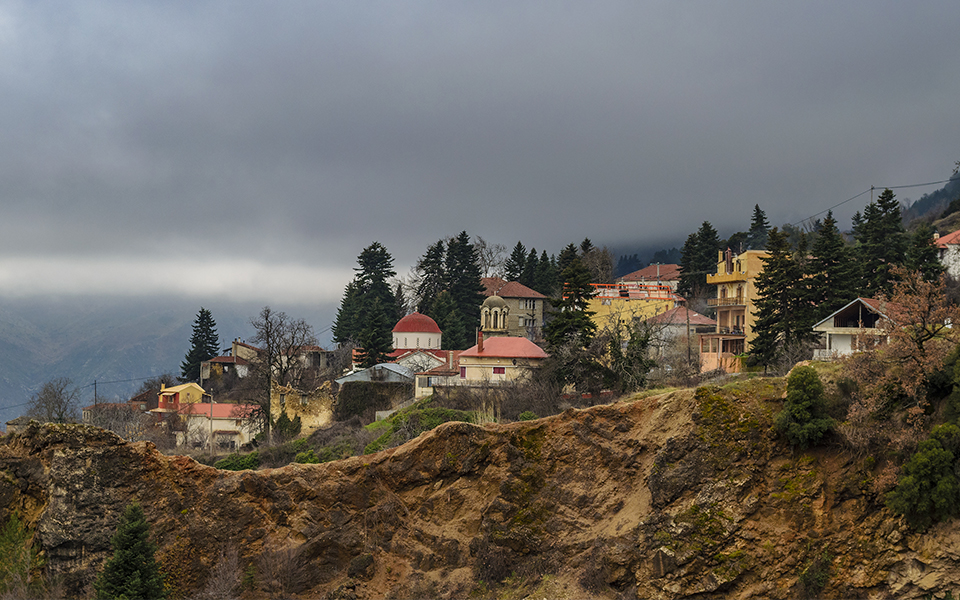
Mesaia Trikala is the region’s tourism hub, with charming guesthouses, traditional tavernas and small shops selling delicious local specialties.
© Shutterstock
Just over two hours from Athens, the villages on the slopes of Mount Ziria in Corinthia are a favorite destination for those seeking a mountain getaway. The scent of woodsmoke drifting from fireplaces, the crisp mountain air, the stone mansions and dense fir forests lend the region a distinctive charm. A weekend is all you need to explore the region’s villages and some of its most important attractions.
Trikala Corinthias is not a single village but a settlement that consists of three distinct neighborhoods, each with its own character.
The first you’ll encounter is Kato Trikala (Lower Trikala), with its lovely square and centuries-old plane trees providing welcome shade during the warmer months. A little farther uphill lies Mesaia Trikala (Middle Trikala), the area’s main tourist hub. Here, charming guesthouses sit alongside traditional tavernas serving locally sourced meats, and small shops selling delicious local products, from handmade pasta and honey to traditional spoon sweets.
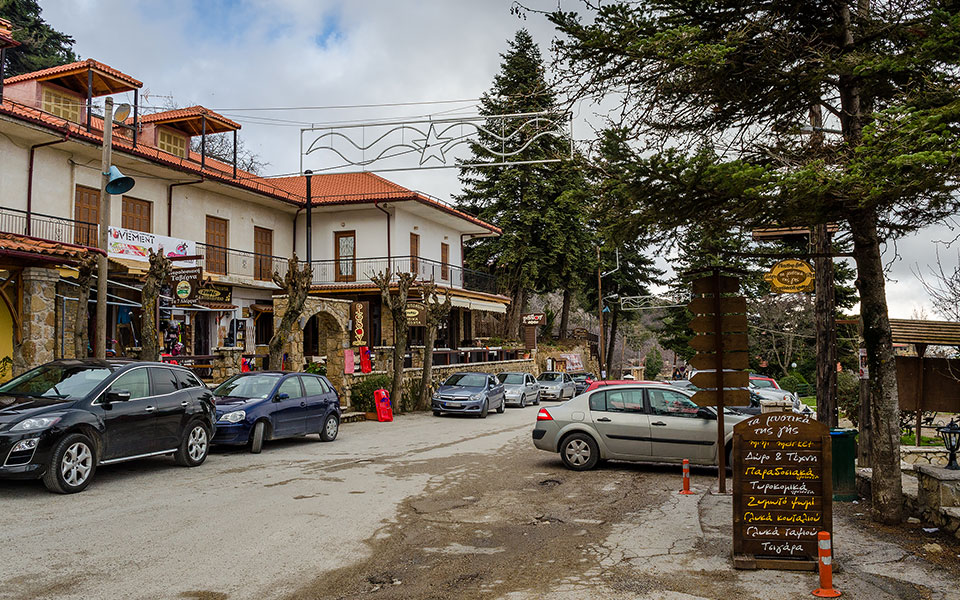
Mesaia Trikala Corinthia
© Shutterstock
The road continues to Ano Trikala (Upper Trikala), the highest of the three neighborhoods, at an elevation of around 1,100 meters. Its stone mansions and old cobbled lanes offer glimpses into the area’s past, while the Church of Aghios Nikolaos stands out for its remarkable frescoes. The surrounding mountains also offer plenty of opportunities for hiking, with trails of varying difficulty winding through the woodland on the slopes of Mount Ziria.

The historic Theoxenia Hotel
© Maria Anastasopoulou
As you arrive at the square in Ano Trikala, it is hard to miss the imposing stone building that once housed the historic Theoxenia Hotel. A celebrated retreat for Greece’s social elite in the 1950s, it recalls an era when mountain destinations, rather than the islands, were the preferred summer escapes of the country’s wealthy urban families.
Built in 1932-1933, the hotel remained in operation until 1980. Its guests included prominent businessmen, royalty and politicians, including King Farouk of Egypt, who stayed there in 1938. Although time and subsequent alterations have left their mark, the stone building, with its distinctive French-style roof tiles, still retains elements of its interwar architecture.

Ziria Ski Center
© Shutterstock
Leaving the villages behind, the road climbs through a dense fir forest toward the plateau and Ziria Ski Center, at an altitude of 1,500 meters. Even without snow, the alpine scenery is well worth the journey. The rugged peaks of Mount Ziria frame the plateau, creating a wonderful setting for leisurely walks and exploring the surrounding countryside. At the wooden chalet, you can enjoy a coffee beside the stove while taking in the mountain views.

© Maria Anastasopoulou
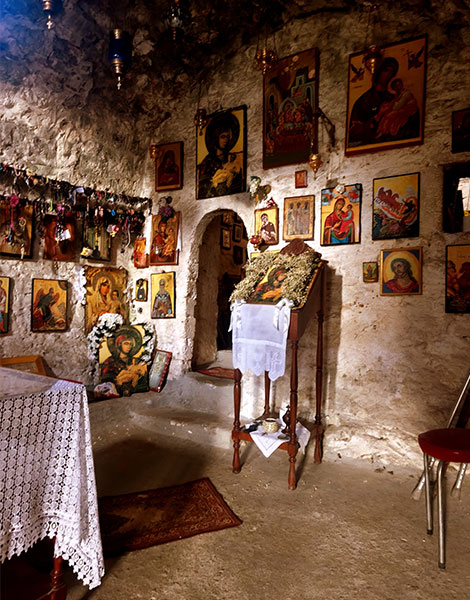
The interior of Panagia tou Vrachou Church.
© Maria Anastasopoulou
Near Tarsos, in the Feneos area, a winding mountain road leads to one of Greece’s most extraordinary hidden places of worship: Panagia tou Vrachou (Our Lady of the Rock). The tiny chapel is built into the face of a towering vertical cliff, seemingly suspended above the landscape. Inside, a spring of holy water emerges directly from the rock, adding to the site’s unusual atmosphere.
The cave extends over two levels. The lower level houses the chapel, while the upper level was once used for storage and as a refuge during times of unrest. Inside are several noteworthy icons, some more than 150 years old, as well as numerous votive offerings. The exploration continues through low doorways, a series of steps and a wooden staircase, eventually leading to a balcony with breathtaking views across the Olvios Valley.
The chapel’s origins are steeped in local legend. One account links its founding to the siege and capture of the Byzantine castle of Tarsos by Mehmed II in 1458. According to the story, a woman miraculously survived a fall from the sheer cliff and, in gratitude to the Virgin Mary, transformed a natural crevice in the rock into a place of worship. Today, the tranquillity of the setting is interrupted only by the rustle of the wind and the sound of flowing water, creating an atmosphere of profound serenity that transcends religious belief.

Goura, the traditional main village of Feneos.
© Maria Anastasopoulou
The journey continues to Goura, the traditional main village of Feneos. Its stone-paved square, dominated by the imposing Church of the Taxiarches (Archangels), built in 1877, is among the most beautiful in Greece. Surrounding the square are historic mansions, including homes belonging to families associated with the Greek War of Independence in 1821.
A little farther uphill, on the slopes of Mount Ziria, lies Karya, one of the highest villages in the Peloponnese at an altitude of around 1,300 meters. Surrounded by forests and walnut trees, it offers a quieter side of Corinthia, far from the bustle of the region’s more popular tourist mountain resorts. Take your time wandering through its peaceful lanes before stopping for a meal at one of its traditional tavernas.
The new Yiannis Ritsos Museum and...

Christopher Nolan's The Odyssey is already...
We spent a quiet weekend in...

For the shepherds, mountaineers, muleteers, and...