What to See, Sense, and Savor in Athens...
A curated journey through exhibitions, history,...


Below the Acropolis, the newly transformed Vasilissis Olgas Avenue completes Athens’ archaeological pathway, opening a nearly car-free walking route linking gardens, major antiquities and the Panathenaic Stadium.
© YIANNIS LIAKOS / IN TIME NEWS
Athens may be inseparable from the image of the Acropolis, but it’s also defined by something less tangible: its refusal to fit neatly into the familiar molds of European urban tradition. It has never been an easy city to read, but this unpredictability is part of what keeps it so compelling. Much of its appeal lies precisely in its capacity for reinvention. In the summer of 2026, that feeling seems stronger than ever.
The transformation of Vasilissis Olgas Avenue into a quieter, pedestrian-friendly thoroughfare marks the final step in a long effort to connect the city’s major archaeological sites. It also says something important about Athens today. For much of the postwar era, the city was designed around the car. That reality has not disappeared, but the old postwar model is slowly giving way, as more space is being returned to pedestrians, green areas and the monuments that define the cityscape.
The new Vasilissis Olgas Avenue offers a rare sense of expansiveness and a more serene experience for those visiting the gardens and antiquities there. It’s the latest chapter in a major effort to rethink the center of Athens – a process that began in the years before the 2004 Olympic Games – as a four-kilometer archaeological route stretching from the ancient cemetery of Kerameikos to the Panathenaic Stadium, where the first Olympic Games of the modern era were held in 1896.
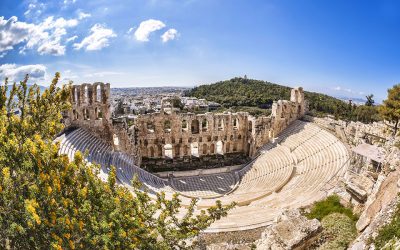
This is also a summer of farewells, albeit temporary ones. June 2026 marked the final month of performances at the Roman Odeon of Herodes Atticus before the monument closes for extensive conservation and restoration work, expected to last at least three years. For generations of Athenians and visitors alike, attending a concert or theatrical performance at this venue beneath the Acropolis has been one of the defining experiences of summer in the city.
Built in AD 161 by the Athenian benefactor Herodes Atticus in memory of his wife Regilla, the theatre is Athens’ most iconic Roman-era performance venue. The restoration aims not simply to preserve the structure, but also to make the monument more legible as an architectural whole, improve public access, strengthen its stability, and address problems caused by earlier interventions.
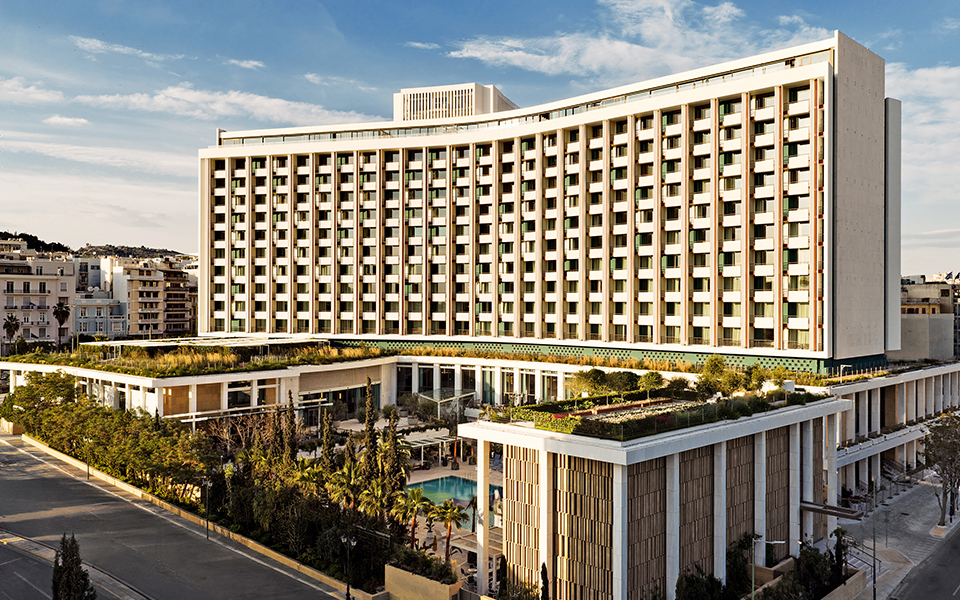
The former Hilton Athens has been reimagined as The Ilisian in a new phase of life for one of the capital’s best-known postwar landmarks.
A short walk away, at the entrance to pedestrianized Dionysiou Areopagitou Street, a new figure has joined the city’s public life. Beneath the shade of a plane tree, a sculptural bench depicts the poet C.P. Cavafy seated among passersby. The work follows a distinctly European tradition of bringing writers into the urban landscape: Fernando Pessoa in Lisbon, James Joyce in Trieste, and Hans Christian Andersen in Copenhagen. Every day, visitors stop for photographs beside one of the great figures of modern Greek literature, whether or not they have yet encountered his poetry.
Few projects have generated as much anticipation as the revival of Stoa Arsakeiou, the 19th-century covered arcade linking Stadiou and Panepistimiou streets. This historic passage is being reimagined as a major culinary destination, with restaurants, bars, specialty food retailers and a large grocery dedicated to products from across Greece. The project is expected to breathe new life into a commercial district that struggled through the years of economic crisis. The area between Omonia and Syntagma has changed dramatically over the past decade, and the adaptive reuse of one of the city’s landmark spaces reinforces a growing sense that central Athens is recovering both confidence and momentum.
Another landmark is entering a new phase as well. The former Hilton Athens – one of the most recognizable symbols of the capital’s postwar ambitions – has re-emerged as The Ilisian following an extensive redevelopment.
For generations, the Hilton was more than a hotel. It was a symbol of a city looking outward, eager to position itself on the international stage and embrace a more cosmopolitan identity. Reimagining such a charged landmark was never simply a technical or financial exercise. It raised a more difficult question: how do you reinvent an urban icon without erasing its meaning? And how do you move beyond a familiar hotel model to create something broader: a layered urban resort intended not just for visitors, but for Athenians, too?
Today, the building functions as a larger hospitality and lifestyle ecosystem, encompassing Conrad Athens The Ilisian, branded private residences by Conrad and Waldorf Astoria, the House of NYNN private members’ club, restaurants, bars, shops, wellness spaces, and other public-facing uses.
On a different scale, but with equal symbolic weight, another transformation is taking place in the northern suburb of Maroussi: the revival of the Olympic Athletic Center of Athens, known as OAKA. Twenty-two years after the 2004 Olympic Games, the complex is undergoing extensive upgrading and restoration works, with particular emphasis on reviving the architectural legacy of Spanish architect Santiago Calatrava.

Athens’ commercial center is gaining new energy through the revival of arcades, food destinations and street-level spaces overlooked during the crisis years.
© SPYROS CHAMALIS

At OAKA, the Olympic complex is being brought back into the city's daily life as restoration works revive Santiago Calatrava’s architectural legacy.
© VANGELIS ZAVOS
For years, OAKA stood as a reminder of the unrealized promises of Athens’ Olympic moment. The current works seek to reconnect the complex with everyday city life and transform it into a contemporary hub for sports, recreation and entertainment. By early fall, officials hope to deliver a fully renewed Olympic park to residents and visitors alike. Watching crews restore some of Calatrava’s most ambitious structures and seeing the freshly painted movable metal elements of the long-neglected Wall of Nations come back to life as children play in the shade of the wave-like canopies of the Agora, one cannot help but think that this is about more than an Olympic park. A new destination is taking shape.
In other parts of town, too, visitors can hardly miss the large construction sites shaping the Athens of 2030. The redevelopment of the former airport at Ellinikon – widely presented as the largest urban regeneration project currently underway in Europe – continues to transform the city’s coastal front. The construction of Metro Line 4 keeps opening new fronts across the Athens basin, while in Votanikos, a former industrial district located on the site of the ancient olive grove and just two kilometers from the Acropolis, work is advancing rapidly on the new stadium for the football club Panathinaikos.
The club is expected to move into its new home in 2027. After that, Athens will face another question: what should become of the old football stadium on Alexandras Avenue? That uncertainty feels appropriate. Athens today is not a city arriving at a finished vision of itself. It is a city in the midst of decisions, negotiations and reinventions. Its future remains unfinished. And that, perhaps, is what makes Athens so fascinating to watch.
A curated journey through exhibitions, history,...

Athens has always been graced with...

Just steps from Monastiraki Square, The...

A portrait of Dimitris Pikionis, the...