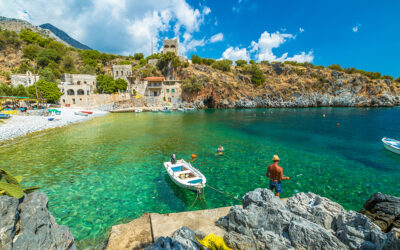
A Road Trip Through the Heart of East...
A road trip from Kotronas to...

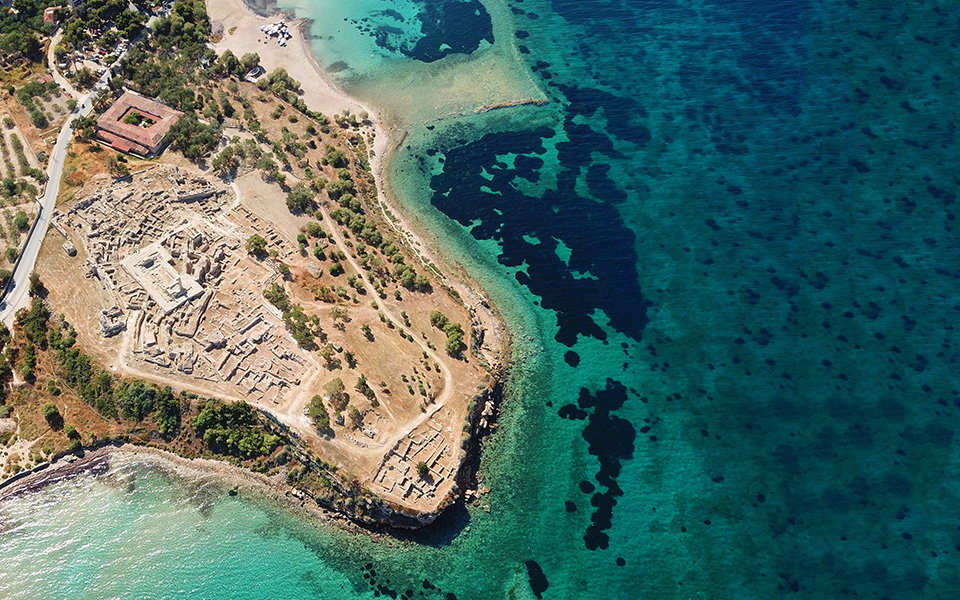
Kolona Hill and the Temple of Apollo, with the museum nestled discreetly beside the site, in the top left.
© Shutterstock
Most people picture Greek archaeology as a serious undertaking: clambering up steep hillsides in the midday heat, tramping rocky paths, and spending hours exploring sprawling, knee-high ruins. While some of Greece’s greatest monuments certainly reward the effort – yes, we’re looking at you, Delphi – many remarkable sites are far easier to visit than you might imagine, especially during the hot summer months.
Picture yourself wandering beneath the marble columns of an ancient temple before cooling off with an iced coffee by the sea. Or exploring a Bronze Age palace in the morning, then spending the afternoon swimming in crystal-clear water just a short drive away. Across Greece, you’ll find archaeological treasures that are easy to reach, enjoyable for children, and perfectly suited to travelers who’d rather pack flip-flops than a pair of hiking boots.
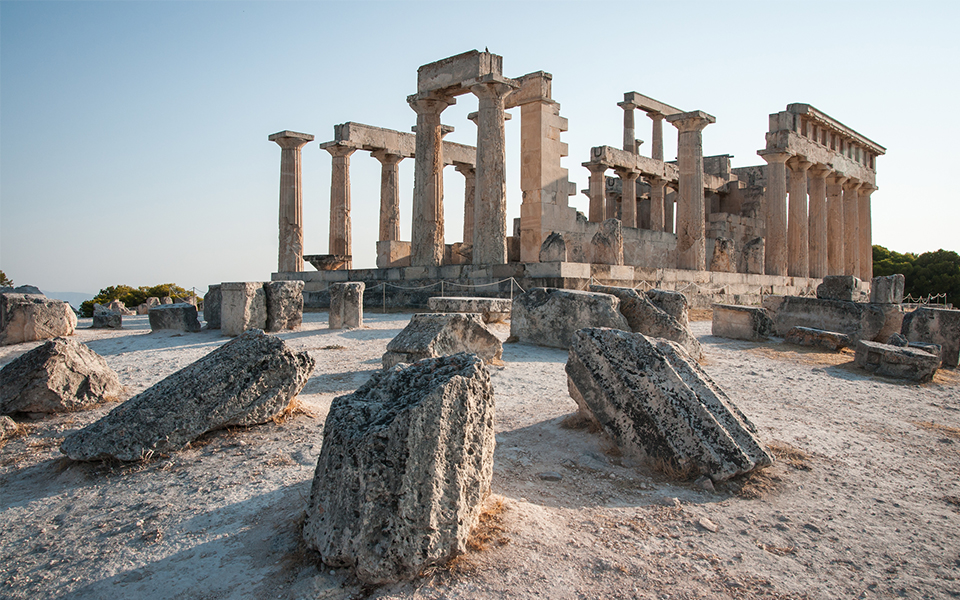
The Temple of Aphaia on Aegina.
© Shutterstock
If there were an award for Greece’s most effortless archaeological outing, the Temple of Aphaia would be a serious contender. After a short drive from Aegina Town, you can park almost at the entrance before strolling through fragrant pine trees to one of the country’s finest Doric temples. There’s no strenuous climb here and no sprawling site to navigate – just graceful limestone columns, birdsong, and sweeping views across the Saronic Gulf.
Built around 500 BC and dedicated to the local goddess Aphaia, the temple has another claim to fame. The temple is also associated with the much-debated “Sacred Triangle” linking Aphaia, the Parthenon and Cape Sounion. Don’t miss the small but excellent on-site museum before rewarding yourself with a coffee at the nearby café. Then it’s just a 15-minute drive to Aghia Marina, where a long sweep of golden sand, shallow turquoise water, and family-friendly tavernas provide the perfect excuse to spend the rest of the afternoon by the sea. Job done.

The Temple of Poseidon at Sounion, Attica.
© Shutterstock
Few archaeological sites can rival the sheer drama of Cape Sounion. Perched on a cliff high above the Aegean at the southernmost tip of the Attica peninsula, the Temple of Poseidon has been welcoming travelers for nearly 2,500 years – from ancient mariners navigating their way home to modern road-trippers following the spectacular coastal route down the Athens Riviera.
Despite its breathtaking setting, this is one of Greece’s easiest ancient sites to explore. Parking is next to the entrance, the sanctuary is compact and largely level, and a pleasant open-air café/eatery nearby provides the perfect place to linger over lunch, enjoy an ice cream, or stop for an evening drink.
The hardest decision comes afterwards: which beach to choose. Sounio Beach sits almost beneath the temple, while nearby Legrena, Harakas, and KAPE Beach all offer crystal-clear water and magnificent coastal scenery within a few minutes’ drive. Stay into the evening and you’ll be rewarded with one of Greece’s most celebrated sunsets, when the honey-colored columns glow against a backdrop of sea and sky.
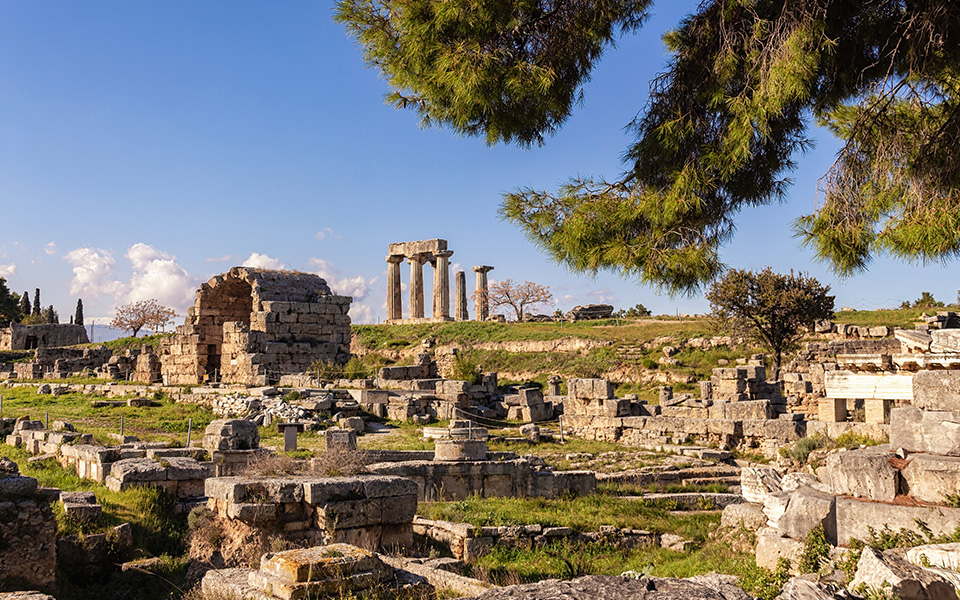
One of the best-preserved ancient cities in Greece, St. Paul the Apostle spent 18 months in Corinth in the 1st century.
© Shutterstock
Not every ancient Greek site comes with a sea view – but Ancient Corinth more than makes up for it with an extraordinary concentration of history, excellent on-site museum, and a wonderfully relaxed atmosphere. Just over an hour from Athens, the site is surprisingly easy to explore, making it an ideal stop on a road trip through the Peloponnese.
The ancient city stretches across a broad, open landscape beneath the dramatic slopes of Acrocorinth, but visitors don’t need hiking boots to appreciate its highlights. A short walk takes you past the iconic Temple of Apollo, as well as the well-preserved remains of ancient streets, fountains, shops, and public buildings that bring ancient Corinth vividly to life. The on-site museum adds another layer of discovery, while cafés and tavernas just outside the entrance make it easy to pause for a cold drink or a leisurely lunch.
After exploring, head to the coast for a swim at Loutraki or Kalamia Beach in Corinth, both around 15-20 minutes away. Before you leave, make time for one more ancient wonder: the nearby Isthmus of Corinth and the 7 to 9km-long Diolkos, the famous “haul across” trackway that allowed ships to be transported over land between the Saronic and Corinthian Gulfs from the early 6th century BC onwards.
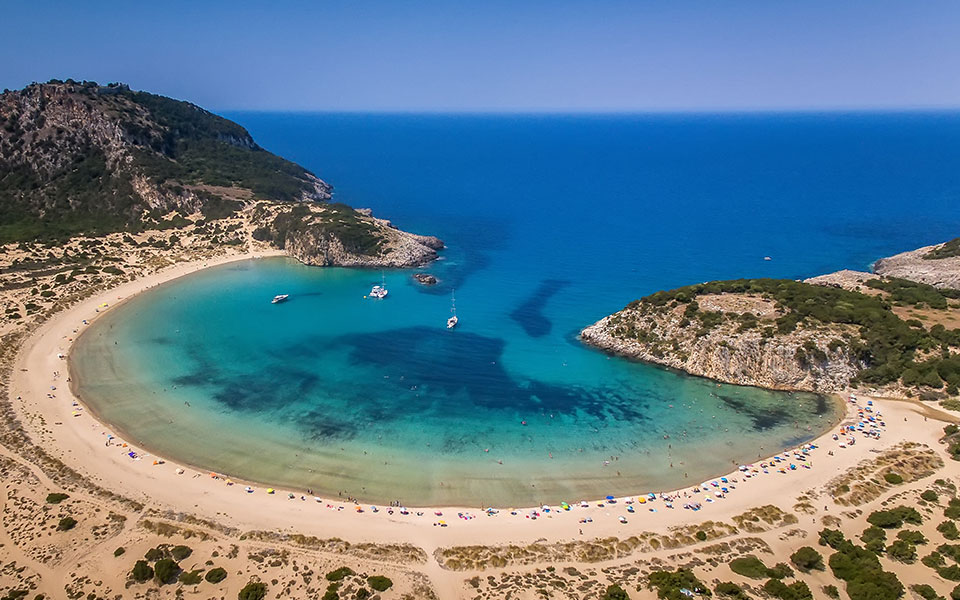
The famous omega-shaped Voidokilia Beach.
© Shutterstock
Few archaeological sites bring the world of Homer to life as vividly as Nestor’s Palace. Built around 1300 BC, this remarkable Mycenaean complex in the southwest Peloponnese was once the center of a powerful Bronze Age kingdom ruled by the legendary king Nestor, the wise old hero who appears in Homer’s “Iliad” and “Odyssey.” Today, it offers one of Greece’s most rewarding ancient experiences – without requiring a heroic effort to reach it.
Following recent improvements, including a modern protective shelter and raised walkways, exploring the palace is remarkably straightforward. Visitors can move comfortably around the remains of storerooms, courtyards, and royal apartments, while learning about the Linear B tablets that reveal details of everyday life over 3,000 years ago. There are no steep climbs or rocky paths here, making it an excellent choice for families traveling with younger children.
The setting is also part of the magic. Located among the gentle hills of western Messinia, the palace is just a short drive from the coast and the beautiful town of Pylos, where cafés and tavernas overlook the historic Navarino Bay. Best of all, the famous omega-shaped Voidokilia Beach is only around 20 minutes away – the perfect place for a swim after stepping into the world of Homer.
If you have more time, the spectacular archaeological park of Ancient Messene, one of Greece’s most impressive ancient cities, is another unforgettable stop in the region.

The temple of Athena on the acropolis of Lindos.
© Shutterstock
When most people hear the word “acropolis,” they immediately think of Athens. But Greece is home to many ancient citadels, and few are as spectacular as the Acropolis of Lindos. Rising above a maze of whitewashed houses on Rhodes’ sun-drenched east coast, this remarkable sanctuary dedicated to Athena Lindia combines dramatic history with some of the finest sea views in the Aegean.
Reaching the summit does involve a short uphill walk, around 300 steps, along a paved path, but don’t let that put you off. Take it at an easy pace – preferably during the cooler morning hours – and you’ll soon find yourself exploring an unexpectedly compact archaeological site where ancient Greek, Hellenistic, and medieval monuments share the same rocky plateau. The elegant Doric temple, monumental stairway, and fortifications tell the story of a place that has welcomed traders, knights, pilgrims, and travelers for more than 2,500 years.
Back in Lindos village, you’ll be spoiled for choice when it comes to cafés and tavernas tucked among its narrow lanes. Afterwards, cool off with a swim at nearby Megali Paralia, picturesque St Paul’s Bay or the quieter sands of Vlycha Beach, much favored by locals and just a short drive away.
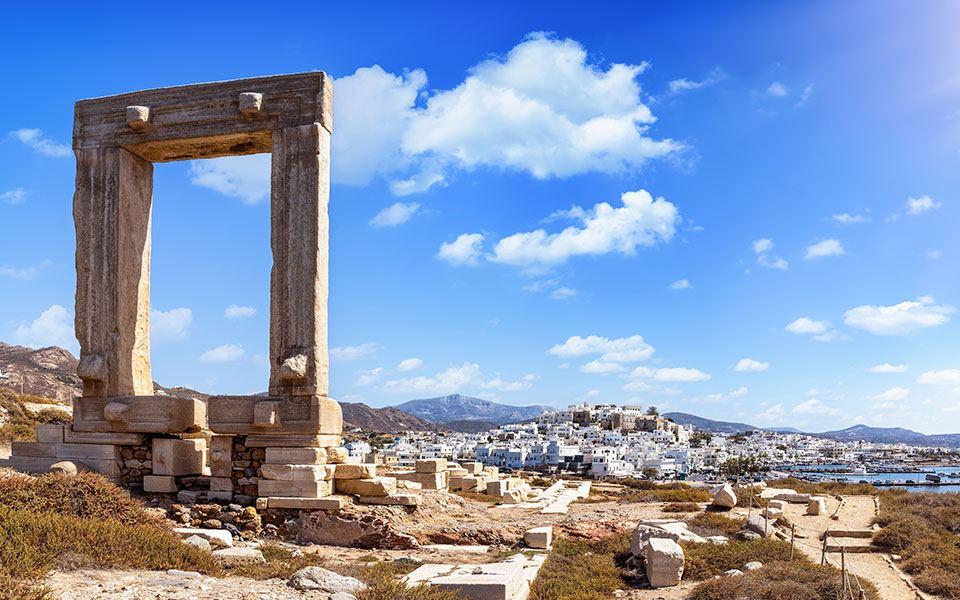
The Portara is located on the islet of Palatia, connected to the Old Town (Hora) of Naxos by a narrow causeway.
© Shutterstock
Who says archaeology has to come with an admission ticket? Standing proudly at the entrance to Naxos harbor, the Portara is one of Greece’s most iconic ancient monuments. This colossal marble doorway, marooned on the tiny islet of Palatia and connected to Naxos Town (Hora) by a narrow causeway, is all that remains of an ambitious temple that was never completed. Today, it stands as a monumental gateway to nowhere and one of the Cyclades’ most photographed landmarks.
Reaching the Portara couldn’t be easier. A gentle stroll from the waterfront brings you to the towering marble frame, where uninterrupted views stretch across the Aegean and back towards the whitewashed alleys of Hora. Archaeologists still debate whether the temple was intended to be a place of worship for Apollo, god of music, poetry, and the Sun, or Dionysus, god of wine and revelry – but that uncertainty is part of its appeal. Visit in late afternoon and you’ll understand why generations of travelers have gathered beneath its six-meter-high lintels to watch the sun sink into the sea.
When it’s time to cool off, Aghios Georgios Beach is just a short walk away, with calm, shallow water that’s ideal for families, while the quieter sands of Laguna Beach 2km further south. Finish the day with lunch or dinner overlooking the water, and you’ll have experienced one of the easiest – and most memorable – archaeological outings in Greece.

Schinias Beach is one of Attica’s finest family-friendly beaches.
© Shutterstock
Few places in Greece have a name as instantly recognizable as “Marathon.” The battle. The long-distance race. While most visitors come to see the famous burial mound (tumulus) of the 192 Athenian soldiers – along with the smaller Tomb of the Plataians – who fell during the famous battle against the Persians in 490 BC, there’s much more to discover in this historic corner of Attica than a single battlefield. Begin at the Archaeological Museum of Marathon, whose exhibits bring the area’s long history to life, from the prehistoric cemeteries of Vrana and Tsepi to the Classical world.
After a morning immersed in history, it’s time for the beach. Schinias (Marathon Beach), with its long ribbon of golden sand backed by fragrant pine forest, is one of Attica’s finest family-friendly beaches, offering shallow waters, watersports, and plenty of space to unwind. The beach sits inside the protected Schinias-Marathon National Park, which helps explain why the landscape feels so wonderfully pristine. Some fabulous seafront tavernas can be found in Nea Makri, offering fresh seafood and traditional Greek dishes at decent prices.
A road trip from Kotronas to...

Explore a landscape shaped by ancient...

Herodes Atticus was an important local...
Archaeology reveals powerful Iron Age women...