A Perfect Saronic Weekend: Exploring Aegina’s Ancient Highlights
A compact archaeological guide to the...

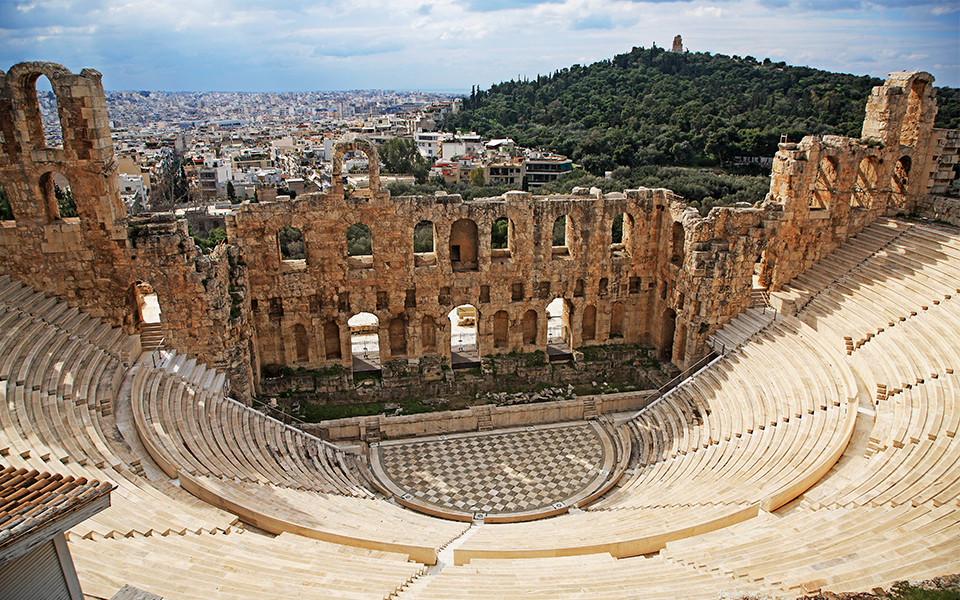
The interior of the Odeon of Herodes Atticus, built in AD 161
and dedicated to Herodes' wife Regilla. As of July 2026, the Odeon will remain closed for at least three years for essential restoration works.
© Getty Images/Ideal Image
Few figures in ancient Athens were such fascinating, complex personalities, or today as little-considered and misunderstood, as the wealthy 2nd-century AD benefactor who constructed the still-thriving music venue that bears his name, the Odeon of Herodes Atticus. Active in an era when Greece was no longer a dominant Mediterranean commercial power but merely a province of the Roman empire – itself strained by enormous military spending by emperors Domitian and Trajan – Herodes Atticus and his forebears, the Claudii of Marathon, were the “Rockefellers” of their time. Their vast wealth, sometimes fatefully begrudged among Rome’s elite, was generated not only from the agricultural production of the family estate in the hills around the illustrious Marathon battlefield but also from moneylending.
Born at Marathon in AD 101, Herodes Atticus was later called a “Son of Hellas” on an inscribed statue base at Eleusis. He was, according to historian Harry Rutledge, “a youth of famous family and great expectations” who went on to become “antiquity’s greatest private philanthropist.” He steadily rose on Rome’s public-service career ladder, with his posts, from 122 to 143, ranging from a lowly market official – which required him to oversee mercantile activities, regulate prices and prevent cheating in the agoras – to archon (chief magistrate) in Athens; financial officer; protector of the people’s interests/rights; chief judge/administrator; corrector (regulator, auditor, judicial overseer) of the Free Cities of Asia; and, ultimately, consul (head of state, military commander).
Herodes Atticus’ great-great-great-grandfather, Herodes of Marathon, and great-great-grandfather, Eucles, had also been archons in Athens. It was they who had cultivated ties with Julius Caesar and Augustus to secure funding for the new Roman Agora in Athens.
Atticus, Herodes’ father, had also held high positions and proved a generous benefactor, not only in Athens but also Corinth, Sparta and Gytheio. He and his wife, Vibullia Alcia Agrippina, were both honored with front-row “thrones” in the Theater of Dionysus. Under Trajan, Atticus had become a Roman senator and an alternate consul, with riches so legendary that the satirist Juvenal wrote “Atticus, the wealthy, dines well, he’s [considered] the height of elegance.” When young Herodes, as corrector in Asia, miscalculated the cost of building an aqueduct for the city of Alexandria Troas, allowing the project’s expenses to double, his father bailed him out, paying off the difference (4 million denarii) and preserving his reputation and career.
Herodes Atticus thus grew up an indulged, protected son of a senator, educated into his mid-30s in Athens and Rome, where he learned Latin and Italian ways in the home of future-emperor Marcus Aurelius’ grandfather. Herodes developed a passion for and great skill in oratory, becoming the top figure in the Second Sophistic movement, as later recounted by Philostratus. Unlike Classical sophists, who spoke to educate and persuade, the sophists of the 2nd century AD were concerned with demonstrating impressive oratorical ability and amusing audiences through their knowledge of history, literature and the art of rhetoric. With all Herodes’ education and “refined … yet eclectic literary taste,” Rutledge comments, it is “small wonder that in his late years [he] was the savant of the Mediterranean world, and that students came to him as to a shrine.” Spectators at the Olympic games were said to have hailed Herodes as “the equal of Demosthenes!”

A mosaic depicting Achilles and Penthesilea, Queen of the Amazons, from Herodes Atticus' villa at Eva/Loukou.
© Lala Aufsberg / DEUTSCHE FOTOTHEK
Life was not always smooth sailing for the Claudii of Marathon, as previous generations, and eventually Herodes himself, faced repeated calamities, public accusations and opposing political winds. Hipparchus, Herodes’ grandfather, having drawn Domitian’s attention through his inordinate wealth and perhaps unscrupulous official practices or political ambitions, had all his personal property confiscated. He was accused of seeking to become a tyrant in Athens, much as Herodes Atticus would be later, and was either executed or exiled, leaving his family ostensibly destitute.
Miraculously, however, soon after Nerva became emperor, Atticus suddenly “discovered” an immense treasure buried under the floor of a Claudii-owned house near the Theater of Dionysus. Clearly, his wily old father had taken steps to circumvent Domitian’s enforcers and secure the family’s survival. With this windfall, Atticus established himself as a great, beloved patron of the Athenian people. Philostratus writes: “He would often sacrifice a hundred oxen to the goddess [Athena] in a single day, and entertain at the sacrificial feast the whole population of Athens … And whenever the festival of Dionysus came round … he would furnish wine to drink for citizens and strangers alike, as they lay in the Kerameikos on couches of ivy leaves.” In the end, he also left an annual gift to every adult male citizen, which amounted to about 100 days’ wages.
After his father Atticus died in 137, Herodes Atticus’ esteem among Athens’ rank and file took a lasting hit. Although his inheritance permitted him to become a great benefactor in his own right, his extravagant tastes, perceived arrogance and ill-treatment of the Athenian people, including his own family members, compounded by his ambitious building schemes and political embroilments, would result in decades of public resentment and outright enmity among some segments of the population.
Facing a total annual payout of about 1.2 million denarii from Atticus’ bequest to the Athenians, Herodes stingily reneged on his father’s will, tried to strike a better, lump-sum bargain, and even stopped paying regular tribal endowments his father had provided the state, thus triggering the destabilization and sudden necessary reorganization of the Athenian financial system. Moreover, to collect their gift, many people had first to pay off existing debts owed to the Claudii family. Public anger seethed and Herodes was labeled a cheater.

A statue of Herodes Atticus, from his Sanctuary of the Egyptian Gods at Marathon (Louvre Museum), 2nd c. AD.
© 2011 Musee du Louvre Dist GrandPalaisRmn / Thierry Ollivier
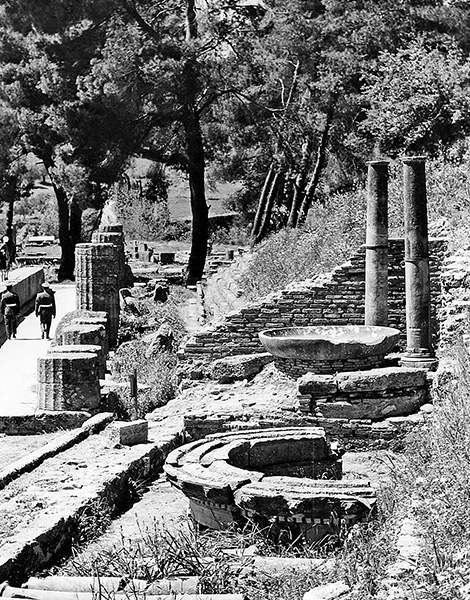
Remains of the once-ornate nymphaeum at Ancient Olympia, a gift from Regilla, wife of Herodes Atticus.
© Lala Aufsberg / DEUTSCHE FOTOTHEK
The AD 120s and 130s were a time of major infrastructural improvement in Athens, during which the Hellenophile Hadrian visited the city and left his mark by completing an all-important aqueduct, the massive temple of Olympian Zeus, an adjacent suburb (Hadrianopolis) with its ceremonial arched entranceway, and a new agora/library. He also founded the Panhellenion, a federation of Greek cities intended to provide cultural unity within the Romans’ Greek East.
Herodes Atticus admired these achievements and apparently looked to Hadrian as a role model, wishing also to be influential and remembered. Nevertheless, by 140 he’d become such a contentious figure that he chose to leave a tense Athenian atmosphere and relocate to Rome. There, he taught rhetoric to future emperors Marcus Aurelius and Lucius Verus, became a senator, and married an Italian noblewoman, Appia Annia Regilla. He only returned full-time to Athens in the 150s. He drew a following, many of them “freedmen” (skilled artisans, bankers, traders, entrepreneurs and domestic staff) like those who had backed his father, but he remained a controversial public personality.
With Regilla at his side, Herodes Atticus and his wife became a power couple, often well-received at games and other public events. Since his consulship in 143, Herodes had already begun making notable benefactions in Italy and Greece. During the last two decades prior to his death about 179, he renovated the odeon at Corinth, constructed luxurious baths at Isthmia and a nymphaeum in the forecourt of the Demeter sanctuary at Eleusis, renovated the stadium at Delphi, installed bathing pools at the hot springs of Thermopylae, and endowed other cities in Evia, the Peloponnese and Viotia with various gifts. Together, Herodes built the aqueduct at Olympia and Regilla its magnificent nymphaeum, decorated with juxtaposed sculptures of the Roman imperial and Herodes’ own families.
In Athens, Herodes placed a statue of Marcus Aurelius on the Acropolis, erected other statues of prominent Romans and Athenians around the city and supplied new white garments for the Athenian epheboi – by Roman times essentially an elite college for the sons of the wealthy. As a presiding official of the Panathenaia festival, he also aggrandized the parade. Most prominently, Herodes rebuilt the centuries-old Panathenaic stadium (140s) using white Pentelic marble. The traveler Pausanias records, “the greater part of the Pentelic quarry was exhausted in its construction.” On the adjacent Ardettos Hill, Herodes built a temple of Fortuna/Tyche, with Regilla as its head priestess.
His crown jewel was the Odeon of Herodes Atticus (161), also constructed of brilliant Pentelic marble and roofed with cedar wood, “though this wood [from Lebanon] is considered costly even for making statues,” as Philostratus said. Centrally located on the Acropolis’ South Slope, the music hall held about 5,000 people. Since its restoration in the 1950s, the Odeon has been a premier venue for top musicians and other performing artists from Greece and around the world. In June 2026, it will close for two years for structural restoration.
With all his benefactions, Herodes saw himself – or wished to be regarded – as a Hadrian-like figure, perhaps even a new Theseus, the Athenians’ legendary founding hero and mythical king. Although praised elsewhere, he was often criticized in Athens, where his successes played out against a persistent backdrop of mixed public sentiment.
Tragedy struck repeatedly for Herodes in the 160s and early 170s, when, having already lost an infant son 20 years before, he suffered the deaths of three more children and his beloved pupil Polydeukion. Regilla died in 160 (while eight months pregnant), reportedly after a brutal attack by Herodes’ freedman Alcimedon. Publicly accused of murder by Regilla’s brother, Herodes was acquitted in a trial in Rome. The suspicion has been advanced that his Odeon, dedicated to Regilla, was a gift meant to assuage guilt and placate the gods, but his grief was overwhelming and apparently sincere. Philostratus argues Herodes “never would have dedicated to her memory so fine a theater, nor would he have postponed for her sake the casting of lots for his second consulship, if he had not been innocent of the charge; nor again would he have made an offering of her apparel at the Temple of Eleusis …, for this was more likely to turn the goddesses into avengers of the murder than to win their pardon.” Privately, Herodes turned his villa in eastern Arcadia into a darkly decorated shrine-mausoleum with statues commemorating all those dear to him now gone.
The political scene in Athens during most of the 2nd century AD was dominated by four families, especially – by the 170s – the Claudii of Marathon and Claudii of Melite. Power struggles, daily bickering and more serious attacks were not unusual. As Herodes was a better sophist than politician, he appears time and again to have misread or underestimated how Athenians would react to his actions, and his political opponents welcomed chances to impugn him. Within this rancorous political climate, his much-resented interference with his father’s will, the death of his popular wife, and his highly visible, often self-promotional benefactions all brought controversy, rumor and accusation.
In 174, three of Herodes’ influential political opponents joined forces with two visiting imperial officials to formally charge him with tyranny. Popular ill-sentiment may have risen from Herodes trying to insert his freedmen into Athenian institutions, including the Areopagus court. His lavish building projects, however, including an expressed interest in completing the Corinth Canal previously attempted by Nero, had likely appeared too emperor-like and continued to fuel discontent.
Herodes defended himself eloquently before Emperor Marcus Aurelius, arguing his opponents wished to turn the Athenian people against him. The emperor recognized the political nature of the charges, letting Herodes off with only a light punishment for his freedmen. Herodes remained for several months in self-imposed exile, allowing the mood in Athens to cool, then returned to the city, where he was greeted by his supporters. Marcus Aurelius wrote a letter to the Athenians explaining his decision, remarking on the city’s factious politics and urging them to recognize all the good Herodes had done. This imperial communication was inscribed on marble steles, fragments of which have been found in the Athenian and Roman Agoras. Herodes himself had long stood at a crossroads of forces in Athens, caught between desires for fame, fortune, political influence and philanthropic immortality. Today, as scholar Estelle Strazdins suggests, he remains “one of the most charismatic and repellent figures of second-century Greece.”
A compact archaeological guide to the...
From the vineyards of Nemea to...
Here’s how to get better at...

The plain of Philippi is home...