Athens’ Ancient Cemetery Gets a New Look
Kerameikos, the potters’ quarter and great…


The restored Early Christian Basilica at Ancient Olympia, formerly the workshop of the renowned 5th century BC sculptor Phidias.
© Hellenic Ministry of Culture
For most visitors, Ancient Olympia exists firmly in the imagination as a place of Classical Greece: a sacred sanctuary of Zeus, the birthplace of the Olympic Games, and a landscape strewn with temples, stoas, training grounds, and a labyrinth of buildings connected to the sanctuary’s dual religious and athletic role. Yet for centuries after the height of the Classical world, Olympia remained very much alive – transformed, expanded, and enthusiastically embraced by the Roman empire.
Now, newly completed restoration works at the UNESCO World Heritage Site are bringing this lesser-known chapter of Olympia’s history into sharper focus.
Earlier this week, Minister of Culture Lina Mendoni inaugurated conservation and restoration projects at three important Roman-era monuments within the archaeological site: the Early Christian Basilica, identified with the workshop of the 5th-century BC sculptor Phidias, renowned for his work on the Parthenon in Athens; the South Baths complex; and the Baths of the Leonidaion.
The 3.6-million-euro project was funded through Greece’s Recovery and Resilience Fund and expands the accessible core of the site by roughly ten “stremmata” – around one hectare.

The restored South Baths complex is now fully accessible to visitors following conservation works.
© Hellenic Ministry of Culture
The ambitious interventions do more than preserve vulnerable ruins. They reshape how visitors experience Olympia itself, extending the story beyond the familiar world of Classical antiquity into the Roman and early Byzantine eras.
“Ancient Olympia is known for its famous Archaic sculptures, its temples, the Classical period, and above all for the sanctuary where the Olympic Games were held,” Mendoni said during the inauguration ceremony. “However, it was also an important place for the Roman emperors, one of the most distinguished landmarks of the Roman Empire in its eastern territories.”
Indeed, Roman Olympia was far from a historical afterthought. After Greece became part of the Roman world following the destruction of Corinth in 146 BC, statesmen, wealthy elites, and emperors continued to patronize the sanctuary, funding monumental building programs and transforming the site into one of the eastern Mediterranean’s most prestigious cultural destinations.
Even the notoriously theatrical emperor Nero left his mark here. In AD 67, according to the Roman writer Suetonius, Nero famously competed in the Olympic Games – or rather, a specially rescheduled edition of them – reportedly taking part in musical contests and chariot racing. In one famous episode, he entered the four-horse chariot race with a team of ten horses, crashed during the competition, yet still claimed victory. He is also believed to have built a lavish villa near the eastern edge of the sanctuary, close to the Stadium, the remains of which can still be seen today.
The newly restored monuments belong to this later phase of Olympia’s long life.
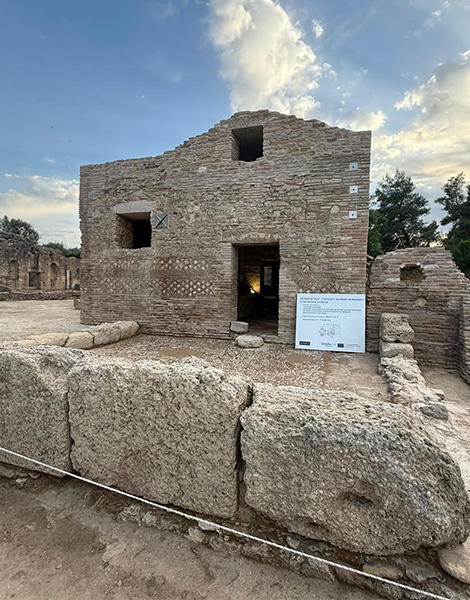
Exterior of the Baths (“Thermae”) of the Leonidaion.
© Hellenic Ministry of Culture
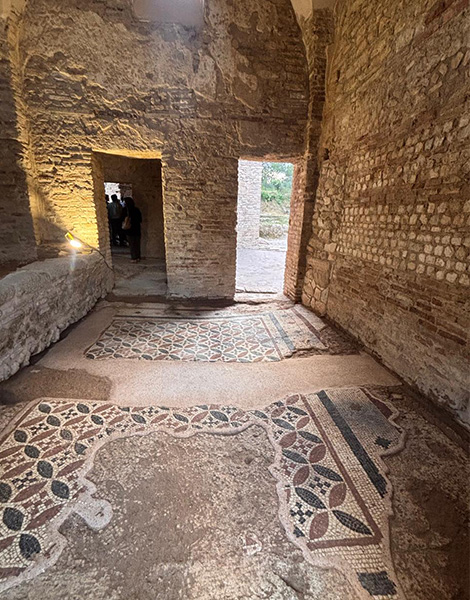
Interior of the bathhouse, featuring well-preserved mosaic floors.
© Hellenic Ministry of Culture
Among the most significant is the Early Christian Basilica, one of the site’s most historically layered buildings. Archaeological research has identified the structure as the workshop of Phidias, the legendary sculptor who created the colossal Statue of Zeus, one of the Seven Wonders of the Ancient World. In later centuries, the building was converted into a Christian basilica, making it one of the few monuments at Olympia to preserve evidence of continuous use from the Classical through the Byzantine period.
Restoration works here focused on conserving and reconstructing key architectural features while highlighting the monument’s multiple historical phases.
Elsewhere, the South Baths complex – located outside the sacred enclosure of the Altis – offers a glimpse into the social and urban life of Roman Olympia. The project included structural stabilization, flood-protection measures, and the creation of new visitor pathways, making the complex fully accessible and easier to interpret.
The Baths of the Leonidaion, dating to the 3rd century AD, are perhaps the most visually striking of the restored monuments. Remarkably well preserved, the structure retains sections of its roof, mosaic floors, heating system, and hydraulic network – rare survivals that vividly illustrate the sophistication of Roman engineering and the integral role of bathhouses in Roman social life.
Together, the restored monuments expand the archaeological site’s accessible core, encouraging visitors to explore beyond Olympia’s better-known Classical and Hellenistic remains.
The restoration projects also form part of a broader effort to modernize the visitor experience at Olympia. New infrastructure unveiled this week includes an upgraded ticket office, renovated retail spaces, modern restroom facilities, and digital tools such as the Hellenic Heritage Guide, virtual reality applications, and enhanced digital signage.
According to the Ministry of Culture, Ancient Olympia will also become one of the first archaeological sites in Greece to incorporate artificial intelligence technologies into its interpretation and presentation.
For Mendoni, the project reflects a wider shift in how Olympia is understood and presented to the public.
“Ancient Olympia and the values it represents extend far beyond the narrow boundaries of our homeland and Europe,” she said. “They speak to the entire world.”
Kerameikos, the potters’ quarter and great…
Newly restored, the historic fortress offers…

New discoveries near the Olympieion reveal…

The permanent removal of scaffolding from…