In the Dark Places: Limnos’ Mysterious Sanctuary of…
New restoration works will open more…

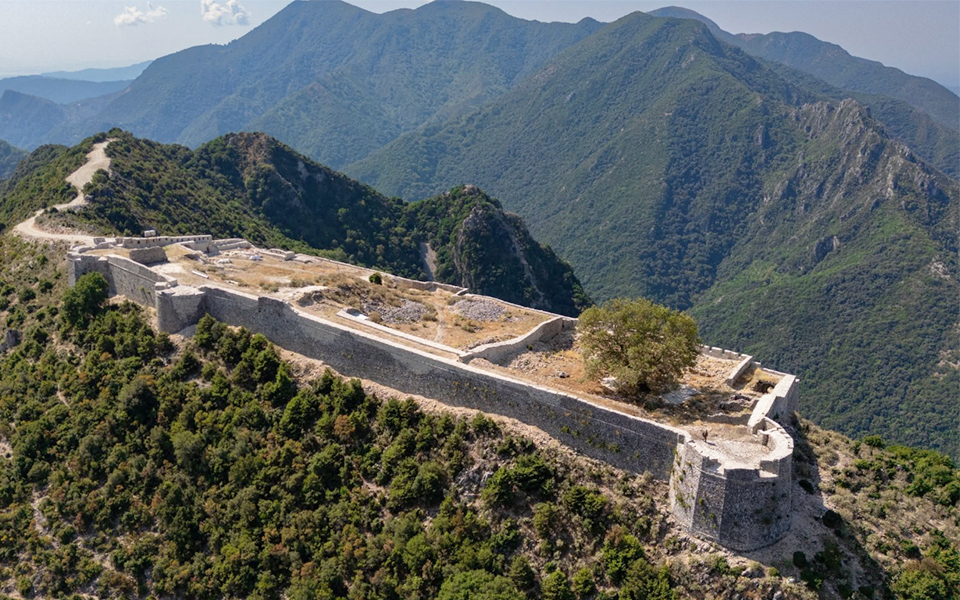
The promotion of the Kiafa Castle is part of the plan to upgrade the historical site of Souli.
© Hellenic Ministry of Culture
High in the mountains of Souli in northwest Greece, overlooking the spectacular Archeron Gorge and, in the distance, the Ionian Sea, Kiafa Castle has entered a new chapter in its long and turbulent history. The historic fortress has recently been restored and officially inaugurated by the President of the Hellenic Republic, Kostas Tasoulas, in the presence of Culture Minister Lina Mendoni and local officials.
For anyone exploring this majestic of corner of Epirus, Kiafa Castle is more than a battle-scarred mountain stronghold. It belongs to a landscape steeped in the history of the Souliotes, the fiercely independent highland clans whose resistance to Ottoman rule during the 18th century became legendary and remains one of the enduring stories of modern Greek history.
Nearby are other landmarks associated with their struggle, including Kougki, the Bouleuterion where decisions were made, the famous wells and the fortified houses, or “koulés,” of local captains.
President Tasoulas described Kiafa as a “symbol of resistance, autonomy and high ideals, a place where the Souliotes organized their defense and made history.” For Mendoni, meanwhile, restoring the castle was “a debt to the future of Souli and the wider region, and to the people who continue stubbornly to live here, with self-sacrifice and perseverance.”
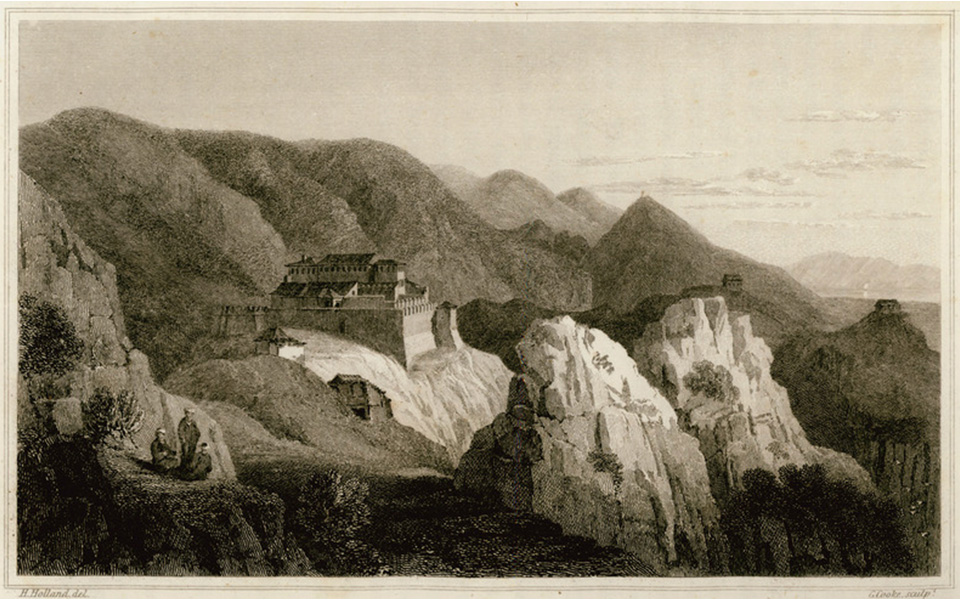
The Kiafa Castle, also known as the “Serai of Souli.” Engraving from Henry Holland's travel chronicle, published in 1815.
The castle itself dates to the aftermath of the Souliotes’ defeat. Following a four-year siege, they were forced to abandon their ancestral lands in 1803. Ali Pasha, the powerful and often ruthless ruler of Ioannina, subsequently built Kiafa Castle as a means of consolidating his control. “The castle was his way of demonstrating his control over the wider area,” says Giannis Houliaras, head of the Ephorate of Antiquities of Thesprotia, which oversaw the archaeological aspects of the restoration.
But Kiafa’s story extends beyond Souli. According to historians, Ali Pasha had another reason for strengthening the area: control of the strategic maritime corridor linking the Adriatic and Ionian seas through the Straits of Corfu. The route was an important artery for trade between Central Europe and the wider eastern Mediterranean and beyond.
Kiafa therefore formed part of a wider chain of coastal and inland fortifications stretching from Himara and Butrint in Albania to Corfu, Parga, Preveza, Lefkada, and Vonitsa. Together, these strongholds helped control movement between the Adriatic and Ionian seas – a strategic prize that attracted Venetians, French, British, Ottomans and Russians over the centuries, as well as earlier Greeks and Byzantines.
After Ali Pasha’s death in 1822, a year into the Greek Revolution, the Souliotes successfully besieged the castle, forcing its Ottoman garrison to surrender and finally reclaiming their homeland.
Today, the battles and rivalries have passed into history, but the landscape remains remarkably rich in reminders of them. The restoration of Kiafa forms part of the Ministry of Culture’s wider program for Souli and its network of historic sites.
“The protection and promotion of castles is a priority,” Mendoni says, noting that the ministry is developing cultural routes linking monuments across wider regions. Among them is the “Network of Castles, from Byzantium to Ottoman Rule,” encompassing 48 castles in the Peloponnese, Western Greece, the Ionian Islands and Epirus.
“Castles tell the history of local communities,” she adds, “while also providing evidence of the changing geostrategic importance of the areas to which they belonged.”
With information in Greek from kathimerini.gr
New restoration works will open more…

Kerameikos, the potters’ quarter and great…

Excavations at ancient Mieza reveal colorful…

New discoveries near the Olympieion reveal…