Athens’ Ancient Cemetery Gets a New Look
Kerameikos, the potters’ quarter and great…


The archaeological site of the Sanctuary of the Kabeiroi, Lemnos. The Kabeiroi were mysterious, chthonic deities whose worship long predated the Olympian gods.
© Hellenic Ministry of Culture
On the northern shores of Limnos, overlooking Pournias Bay, the ruins of an ancient sanctuary occupy two rocky terraces above the sea. This was no ordinary place of worship. For centuries, the Sanctuary of the Kabeiroi was a center of the “Kabeirian Mysteries,” where initiates gathered for rituals dedicated to mysterious, chthonic deities associated with fire and metallurgy.
Now, the Ministry of Culture is moving ahead with a major new phase of work at the site, including the excavation and conservation of its ancient enclosure and, for the first time, the incorporation of its southern section into the visitor route.
The Kabeiroi were shadowy figures, their origins and identities already obscure to the ancient world, although some described them as the offspring of Hephaistos. Their cult on Limnos was closely associated with fire, the earth and the forces believed to stir beneath it, while their sanctuary was among the most important mystery sanctuaries of the ancient Greek world.
Worship here continued from the 8th century BC until the 3rd century AD, with the cult later spreading more widely under Macedonian influence.
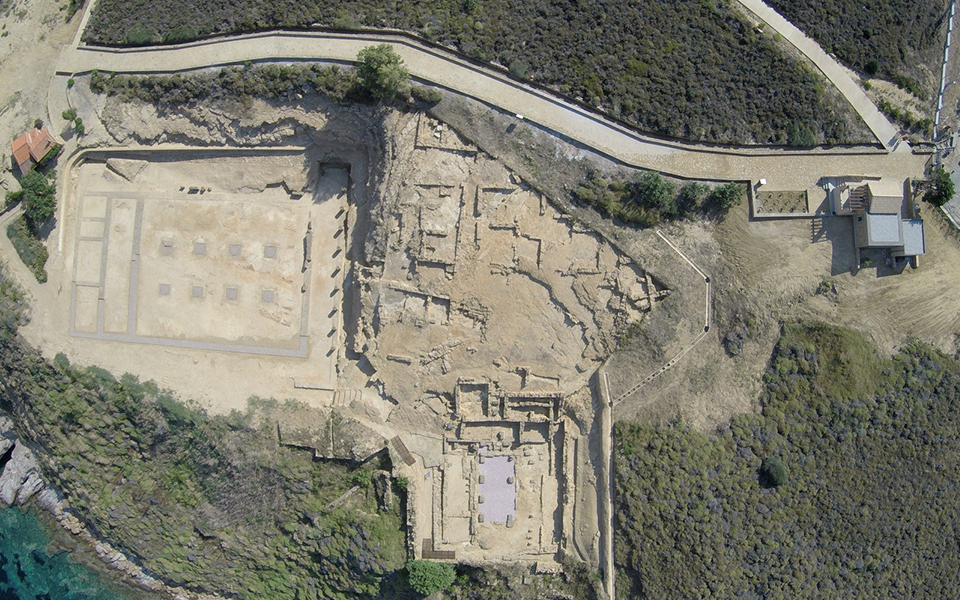
The ruins of the Sanctuary, preserved on two plateaus overlooking the sea, include a tall fortification wall that may have helped shield the ceremonies and initiation rites from view.
© Hellenic Ministry of Culture
The sanctuary is arranged across two terraces. On the southern plateau stands an Archaic “telesterion,” or ceremonial building, dating to the 7th century BC, while the northern plateau contains a Hellenistic “telesterion” that was later looted and destroyed during the Roman period. Today, visitors can also see auxiliary buildings and the cave traditionally associated with the hero Philoctetes, abandoned on Limnos by the Greek forces on their way to Troy.
Much about the rituals remains hidden, which is precisely what makes the place so compelling. The ceremonies were held once a year after sunset and are believed to have lasted nine days, involving animal sacrifices, libations and offerings. Like other ancient mystery cults, the Kabeirian rites were deliberately shielded from outsiders, leaving archaeologists with tantalizing fragments rather than a complete picture of what took place here.
The sanctuary was excavated by the Italian Archaeological School between 1937 and 1991. More recent archaeological investigations have revealed new evidence about its ancient enclosure, shedding light on the organization of the sanctuary and its development over the centuries.

The works included the stabilization of slopes, the creation of visitor paths and rest areas, and the installation of new visitor facilities.
© Hellenic Ministry of Culture
The new 270-meter visitor route will follow the natural contours of the landscape, incorporating steps, gentle ramps and accessible sections for wheelchair users. It will also create new views toward the sanctuary and Pournias Bay.
“The new route allows safe access to the ancient enclosure, creates new views toward the Sanctuary and the bay, and ensures full accessibility for all visitors,” Culture Minister Lina Mendoni said.
The project forms part of a wider €4-million program of works at the Sanctuary, which has already included conservation, visitor facilities, walking routes and accessibility improvements.
For travelers willing to look beyond Greece’s better-known islands, the timing is particularly appealing. Limnos remains one of the North Aegean’s quieter destinations, with archaeological sites such as Poliochni and nearby Hephaistia, the otherworldly dunes and desert-like landscape of the “Pachies Ammoudies,” traditional villages and long stretches of coastline far removed from the crowds of the Cyclades.
And at the Kabeiroi, the island offers something rarer still: the chance to stand among the remains of a sanctuary whose mysterious rituals were deliberately designed to remain hidden.
Kerameikos, the potters’ quarter and great…
Newly restored, the historic fortress offers…

New discoveries near the Olympieion reveal…

The permanent removal of scaffolding from…