Athens’ Zappeion Gardens to Reveal Their Ancient Past
An ambitious restoration plan aims to…

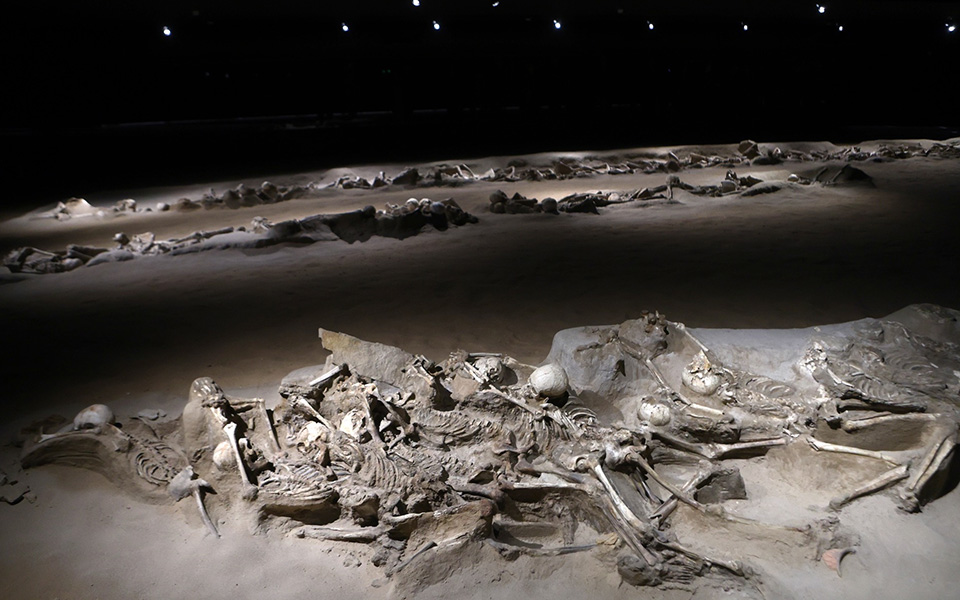
The remains have been tentatively linked to the so-called Cylonian Affair, an attempted coup by Athenian nobleman and former Olympic champion Cylon around 632 BC.
© Intime News/Dimitris Peristeris
One of the most remarkable archaeological discoveries of recent decades has finally received the protection and recognition it deserves. Ten years after their discovery, the so-called “Shackled Men of Phaleron” are now at the heart of a purpose-built underground memorial at the Stavros Niarchos Foundation Cultural Center (SNFCC), where visitors can encounter the remains in the very place they were buried more than 2,700 years ago.
Culture Minister Lina Mendoni inaugurated the new facility on November 25, bringing to a close a lengthy project involving conservation challenges and an exceptionally delicate archaeological operation. The museum has now officially opened to the public.

The illuminated museum structure housing the “Faliro Shackled Prisoners” on the Esplanade of the Stavros Niarchos Foundation Cultural Center during yesterday’s inauguration.
© Intime News/Dimitris Peristeris
Designed to blend discreetly into the SNFCC’s Esplanade, the approximately 930-square-meter structure is as much a protective enclosure as an exhibition space. Visitors gradually descend along a spiral route, passing historical images, interactive displays and a large model illustrating the development of ancient Athens. The journey culminates in a dimly lit underground viewing corridor, where large glass panels offer a close view of the 79 skeletons, still arranged in the positions in which they were buried.
The remains are kept behind the glass under carefully controlled environmental conditions. As Mendoni explained at the inauguration, “Here, architecture and exhibition design do not seek to impress. They serve to highlight historical evidence,” reminding visitors that they are looking at the remains of people who suffered violent and tragic deaths. The presentation deliberately makes room for silence and reflection rather than spectacle.
The men were discovered in 2016 by archaeologist Stella Chrysoulaki during excavations at the ancient cemetery of Phaleron, which extended across the area now occupied by the cultural center. Dating to the second half of the 7th century BC, the mass burial consists of three parallel groups of men, many still wearing iron shackles or with their hands bound behind their backs. Examination of their skeletons revealed fatal injuries to the head, evidence of a brutal execution.
The wider necropolis, in use from the 8th to the 4th centuries BC, yielded 2,132 burials and provides an unusually rich record of life, death and social inequalities in early Athens. Chrysoulaki has described it as the largest Archaic-period cemetery in Attica.
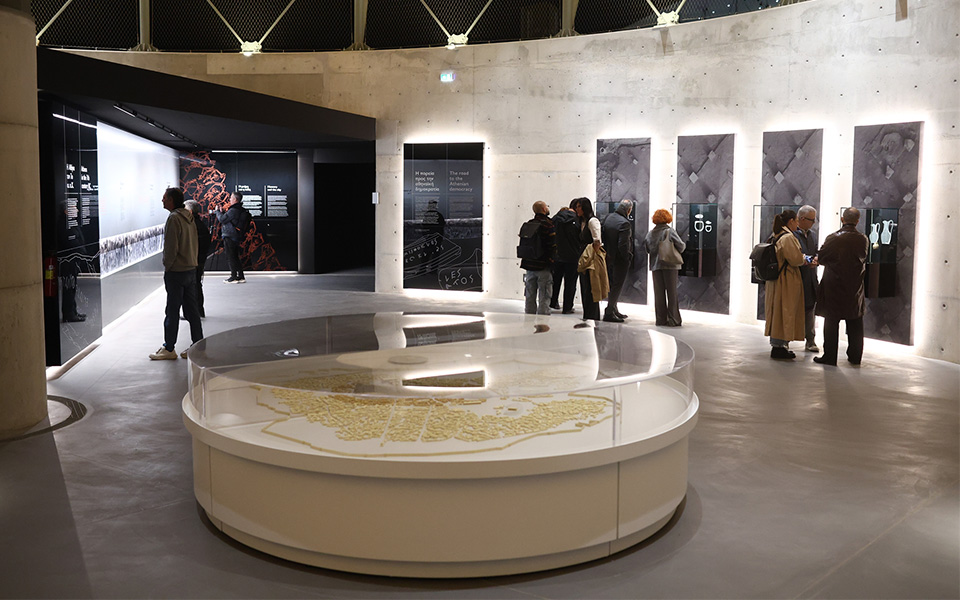
A scale model illustrating the urban development of Athens and Faliro (510-404 BC), displayed in a specially designed space within the structure.
© Intime News/Dimitris Peristeris
The identity of the 79 men remains unknown. One intriguing theory connects their deaths with the attempted coup by the Athenian nobleman Cylon around 632 BC, and the subsequent massacre of his supporters, an episode remembered as the Cylonian Affair. However, as Mendoni acknowledged, this remains an attractive but unproven hypothesis. Whatever their precise circumstances, the burial offers a rare and unsettling glimpse of the political violence that marked Athens before the emergence of its democratic institutions.
The project also represents an important conservation achievement. After the condition of the underlying ground threatened the remains, they were carefully removed in 2020, transferred to temporary accommodation and eventually returned to their original location in March 2023. Anna Karapanagiotou, head of the Ephorate of Antiquities of Piraeus and the Islands, described the completed museum as an international first, presenting such an extensive collection of human remains authentically at the place where it was excavated.
The Shackled Men of Phaleron exhibition is located on the Esplanade of the SNFCC in Faliro, southern Athens.
Admission is free, and the museum is open daily from 9:00-17:90, except Tuesdays.
The facility is fully accessible to visitors with disabilities.
An ambitious restoration plan aims to…
A new seven-day pass brings together…
After 111 years in Exarchia, the…
The renovation of Ernst Ziller’s richly…