Did the Ancient Greeks Really Play Football?
Ancient Greece had its own team...

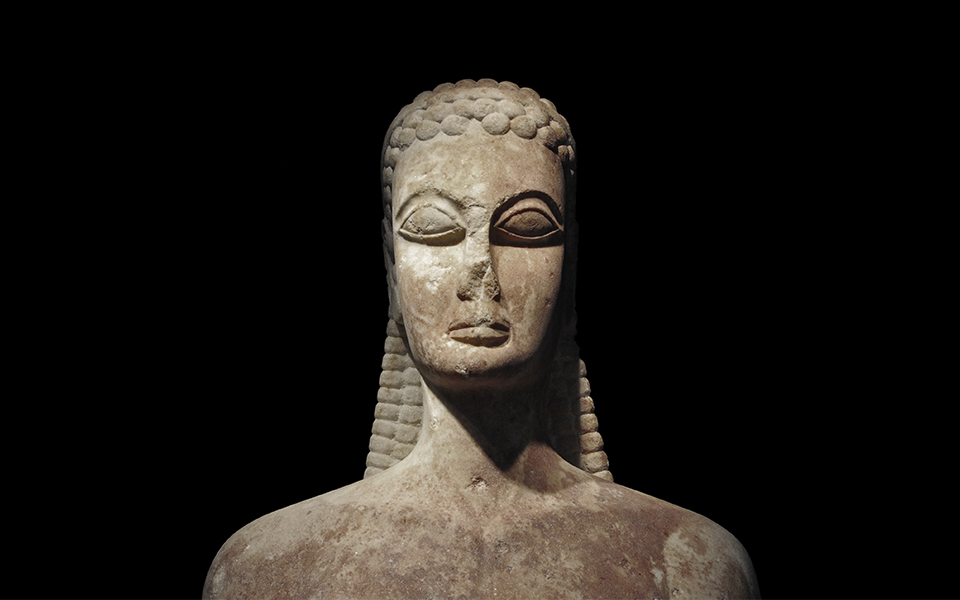
The Kouros of the Sacred Gate at the Kerameikos Archaeological Museum in Athens.
© Shutterstock
When Alexander I of Macedon (c 498/497-454 BC) wished to compete in the Olympic Games, his fellow athletes objected, claiming he was not Greek and therefore ineligible to participate. It was the early 5th century BC, and the King of Macedon, an ancestor of Alexander the Great, was seeking a place in the stadion footrace. According to Greek historian Herodotus, he had to prove to the Hellanodikai (the Olympic judges) that his family hailed from the city of Argos before he was permitted to compete, as recounted by Dr Jonathan Hall, professor of classics at the University of Chicago.
Herodotus’ account raises a question that might seem strange to us today: What made someone Greek in the eyes of other Greeks? Was it language, lineage, the gods one worshipped, or the way one lived?
Dr Hall has been studying how Greek identity was shaped for decades. In his new book, “Being Greek in the Greek World,” published by Cambridge University Press, he returns to the subject nearly 25 years after his previous study. “I would like to think that many of my hypotheses have stood the test of time. That said, there are some areas where I believe my thinking has evolved,” he tells Kathimerini.
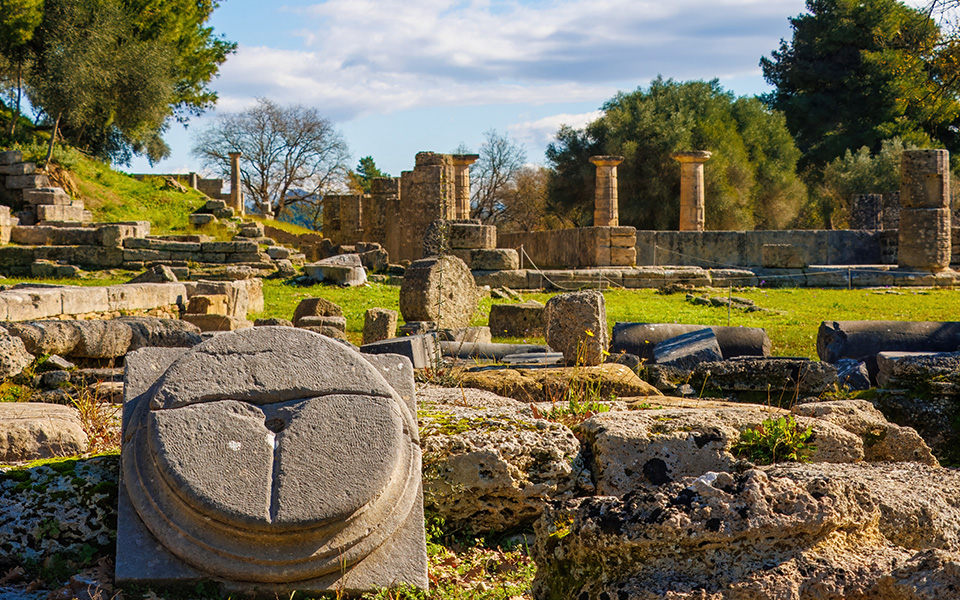
The ancient Olympia Stadium
© Shutterstock
In his book, Hall examines the various groups to which an individual could belong, ranging from the family and the city-state to communities extending beyond them. “The ancient Greeks – like anyone else – could identify with a multitude of different affiliations. The polis is the most obvious, along with civic subdivisions, religious associations, and especially among elites, families,” he explains.
The professor focuses primarily on ties that transcended the city-state without encompassing the entire Greek world: “In my new book, I consider a series of seven ‘vignettes,’ drawn from different places in different periods, to explore identities that transcended the polis but fell short of an overarching Hellenic identity – for example, groups that identified themselves as Achaeans, Dorians, Ionians, and Graikoi,” Dr Hall says.
When, then, did these individual identities give way to the shared self-definition of “Hellenes”? “Against the background of these multiple affiliations, self-identification as Hellenes was probably comparatively rare and only arose in a narrow range of situations, such as when there was an existential threat to multiple Greek communities from external enemies like the Persians or the Romans,” he explains.
The name Hellenes, after all, did not always have the scope we attribute to it today. “In the literary evidence that has survived down to our own day, the Greeks do not employ Hellenes as a collective term to describe themselves until the early decades of the 6th century BCE, so after the time of Homer and Hesiod,” Dr Hall says.
In “The Iliad,” the term Hellenes is employed only to denote the contingent led by Achilles. “I don’t think it’s self-evident that the society depicted in the Homeric epics necessarily thought of itself as Greek,” the professor says.
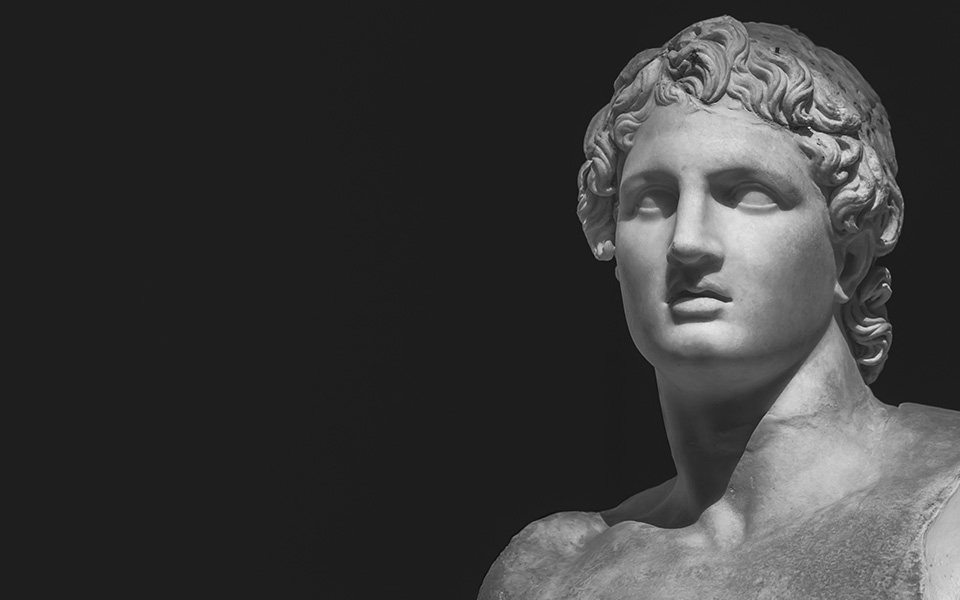
Alexander the Great
© Shutterstock
The epics themselves, however, would later contribute to the shaping of this consciousness. “There is no doubt that, in the subsequent centuries, the epics came to serve as a vehicle for the expression of Hellenicity. Herodotus goes so far as to say that Hesiod and Homer ‘created’ the origins of the gods for the Greeks. The fact that the epics were composed in an artificial dialect that was spoken by none, but apparently intelligible to all, ensured their widespread dissemination and the Greeks who heard them – especially, I think, Greek-speaking elites – would no doubt have identified with many of the beliefs and values expressed in the poems,” he explains.
However, the fact that they recognized they belonged to a broader whole did not mean they would all fight on the same side. “It’s a sobering thought that, of the literally hundreds of Greek poleis that existed throughout the Mediterranean, a mere 31 united to attempt to repel the Persian invasion of 480 BCE. Furthermore, such unity as was achieved was short-lived: A mere 50 years later, the Greek world imploded when the coalitions that Athens and Sparta had built up came to confront one another in the Peloponnesian War.”
The Persian Wars had, however, left their mark on the way the Greeks viewed themselves. “I have argued that the Persian Wars served as a catalyst for a new mechanism of defining Greek identity that was grounded less in seeking commonalities between groups of Greek-speakers and more in staking out oppositional differences from ‘barbarian’ out-groups,” Dr Hall continues. “This is most clear at Athens, especially in the works of the tragedians, and the Athenians had a particular reason to demonize ‘barbarian’ easterners because their whole imperial system was predicated on defense against future Persian invasions. How far this attitude spread beyond Athens is difficult to determine, because we have considerably less literary evidence from other regions.”
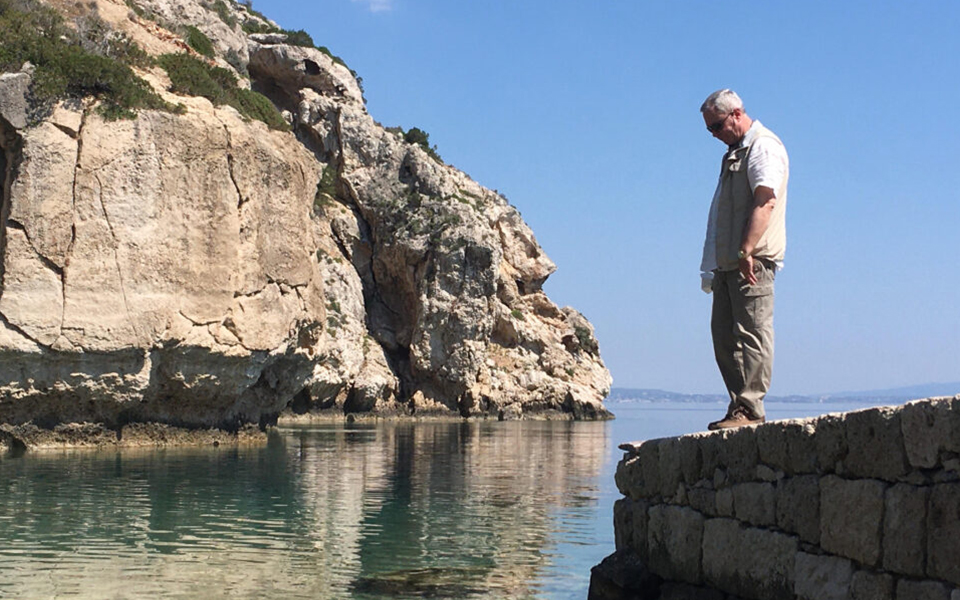
Professor Hall visits Greece every spring as the head of a University of Chicago educational program.
© Yiota Vouzna
Similarly, life in the mixed communities of the Mediterranean demonstrates how people of diverse origins could gradually acquire a shared identity. Dr Hall examines precisely this kind of coexistence in Metapontum in Italy and Naukratis in Egypt. Earlier Greek narratives portrayed Greek colonists in southern Italy and Sicily as settling in uninhabited areas or driving out the local populations. Archaeological findings and modern methods, such as the study of ancient DNA, present a different picture.
“In many cases, Greek speakers cohabited with indigenous populations in these new settlements and they didn’t always even constitute the majority. Yet, over several generations, these communities emerge in the historical record as unmistakably Greek poleis, which means that indigenous residents eventually came to identify as Greeks and to adopt the Greek language. Perhaps they regarded Greek as a ‘prestige language,’ which would suggest that the factors involved in this accommodation were as much social as they were ethnic,” he says.
A glimpse of this coexistence is also preserved in the Greek inscription carved in 591 BC on the leg of a colossal statue of Ramses II at Abu Simbel, Egypt. It mentions Greek mercenaries in the service of the then-Pharaoh Psamtik II. “There are several points of interest. One is that some of the names recorded appear to be Egyptian – or Greek adaptations of Egyptian names – even though their fathers have standard Greek names. This might suggest that their mothers were Egyptian. At the very least, it hints at a multiethnic and multilinguistic environment,” he observes.
Material remains, of course, do not always provide such clear indications regarding people’s identities. Dr Hall suggests we keep this in mind when visiting a museum. “I think it is helpful here to distinguish between ‘emic’ and ‘etic’ perspectives. Etic describes the perceptions of outsiders, while emic denotes the viewpoint of insiders.”
When a statue is labeled “Greek,” it is important to be aware that this is an etic category that has been determined by art historians based on its origin and form. “It is far from evident that an ancient viewer would necessarily have read such objects ‘emically’ as Greek. To offer an example from the book: The late Lord Colin Renfrew once argued that the expression of Greek identity could be gauged by examining the distribution of male kouroi statues. Now, it is true that kouroi are rarely found outside areas where Greek speakers formed the majority, but their distribution is not uniform and, to an ancient viewer, they are more likely to have communicated a distinctiveness that revolves around gender or class, rather than ethnicity.”
Originally published in Greek at kathimerini.gr
Ancient Greece had its own team...

From Bronze Age highways to sacred...

The ancient Greeks may not have...
Ancient Athens’ benefactors came from far...