Who Was Homer? The Man Behind the Epic
Before the “Iliad” and “Odyssey” took...


© Shutterstock
Homer’s second epic, the “Odyssey,” is filled with fantastical monsters, enchantresses, and meddling gods, yet beneath the swell of high adventure runs a single, persistent idea: homecoming. As you’d expect, the ancient Greeks had a pithy word for it: “nostos.” And for our hero Odysseus, king of Ithaca, it becomes an obsession that shapes every choice, however agonizing, he makes.
Ithaca, his small, rugged, and distinctly unremarkable island in the Ionian Sea, is more than a destination. It is a fixed point in a shifting world, a place that exists as much in memory and imagination as in geography. Over the course of the “Odyssey,” it becomes something larger still: a symbol of identity, endurance, and the fragile hope that one can return not only to a place, but to oneself.
It is this emotional gravity – rather than the spectacle of monsters or treacherous seas – that any modern retelling must ultimately reckon with. As anticipation builds for Christopher Nolan’s forthcoming “The Odyssey” this summer, the challenge will not simply be visualizing Homer’s strange and perilous world, but capturing the quieter, more persistent force that drives the narrative forward: the idea of home, and the cost of reclaiming it.

Head of Odysseus, probably 1st century AD. From the villa of Tiberius at Sperlonga, Italy.
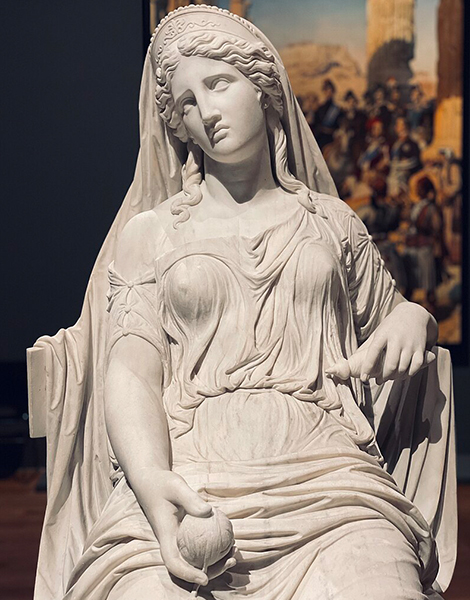
Penelope by Leonidas Drosis, National Glyptotheque of Greece.
Although much of the “Odyssey” recounts Odysseus’ wanderings after the Trojan War, the poem is ultimately structured around absence and return. From the opening lines of Book 5, where he famously declares, “I long for home, long for the sight of home,” the direction of travel is clear – even if the route is anything but…
The Greek word “nostos” carries a gravitas that’s difficult to translate fully into modern English. It signifies not just physical homecoming, but restoration: of identity, of order, of belonging. Combine it with “algos” (pain), and it gives us the modern word “nostalgia” – though for the Greeks, this was not a sentimental longing for the past, but something sharper, closer to gut-wrenching homesickness.
In early Greek epic tradition, the returns of heroes from the decade-long Trojan War – the “Nostoi” (plural) – formed an entire narrative cycle. Some, like the famed king Agamemnon, leader of the Greek forces at Troy, never truly made it home in any meaningful sense, murdered by his wife Clytemnestra and her lover Aegisthus upon his return – Odysseus famously encounters his shade in the Underworld in Book 11. Others were less violently fated, but no less troubled. Agamemnon’s brother, Menelaus, for example, wanders for years across the eastern Mediterranean with his wife Helen – the catalyst for the war – before finally reaching Sparta, his journey marked by shipwreck, delay, and uneasy encounters with the divine (Book 4). The war, it seems, does not end at Troy; its consequences follow the heroes home.
Of course, Odysseus’ journey is the most elaborate of them all, and the most psychologically complex. What Homer suggests, with quiet insistence, is that “nostos” is not guaranteed. It must be earned, endured, and, perhaps most importantly, desired above all else.

The archaeological site of Aghios Athanasios – the so-called “School of Homer” in northern Ithaki is a possible candidate for the site of the Odysseus’ palace.
© Shutterstock
And yet, when we take a step back, Ithaca itself is an unlikely object of such longing. What’s so special about it?
Unlike the grand cities of Homer’s epics – “well-built” Troy, “golden,” “broad-streeted” Mycenae, or even Sparta – Ithaca is rocky and remote. “Low-lying,” Odysseus calls it, “furthest out to sea” (Odyssey 9.25–26). It is not a place of fabulous wealth or splendor, but of rustic simplicity. Olive trees, rough terrain, flocks of sheep, a humble but well-stocked household: these are the coordinates of home.
And that’s precisely the point.
In a world where heroes win fame (“kleos”) through conquest and spectacle, Ithaca represents something quieter, more low-key. It’s not where Odysseus becomes famous – it is where he belongs. The contrast is deliberate, and it creates one of the central tensions of the epic: the pull between glory and the quiet persistence of ordinary life.
Achilles, the greatest of the Greek warriors in the “Iliad,” chooses glory over a long life at home. He knows his fate – to die young at Troy – but accepts it in exchange for immortal fame. Odysseus chooses differently. His story begins where Achilles’ ends. Through stealth and guile, he masterminds the Trojan Horse and the operation that brings Troy down – history’s first special forces raid. In the aftermath, he spends ten years trying to undo the consequences of war, to find his way back, to reclaim a life defined not by legend, but by continuity.
Even when offered something greater – immortality itself – he hesitates, but ultimately refuses. On the remote island of Ogygia, the nymph Calypso promises him eternal youth and divine companionship. For seven years, he remains there, suspended between worlds. And yet, the pull of Ithaca – of home – endures. Odysseus knows that what awaits him is not glory or triumph but aging and the humdrum of ordinary life. In many ways, this captures the essence of nostalgia: a sense of belonging to a place, even over comfort and pleasure.
Home, in Homer’s telling, is not the best possible world. It is not dazzling or heroic. It is simply the one that is yours – and that, somehow, is enough.

Achilles was, in many ways, the mirror opposite of Odysseus. Prone to fits of rage, passion, and grief, he chose fame and glory (“kleos”) and an early death over a long, obscure life.
© Shutterstock
To understand the pull of Ithaca fully, we have to see it not just as a place, but as a process. Odysseus does not return home unchanged. The man who leaves Troy is not the man who arrives in Ithaca twenty years later. The journey – marked by shipwrecks, losses, temptations, and divine interference – reshapes him. In the language of later scholarship, “nostos” is inseparable from “ponos”: toil, suffering, ordeal.
These ideas are inextricably linked to “kleos” – glory. Together, they form a kind of moral triangle within Greek epic. While Achilles is the ultimate embodiment of “kleos,” choosing eternal fame, Odysseus personifies “nostos,” but only through “ponos.” His return is hard-won and shadowed by near-constant loss. Of the twelve fully manned ships with which he left Troy, he returns the lone survivor.
This is what gives the “Odyssey” its emotional depth. The “Iliad” is all blood and thunder – feuds (the “wrath of Achilles”), battles, moments of honor won and lost, and heroic “aristeia,” those dazzling displays of martial prowess. Odysseus’ long journey home, by contrast, is a journey inward. Our long-suffering hero must learn patience, restraint, and endurance. He must survive not only external dangers, but the slow erosion of identity that comes with prolonged absence.
Again and again, he is tested. On Circe’s island, he risks forgetting his purpose, lulled into a life of ease. Among the Lotus-Eaters, his men literally lose the desire to return (Book 9), surrendering memory itself. Each episode becomes a quiet struggle against forgetting. To return home, one must first remember that home exists.
It’s a theme that still resonates. Think of Bilbo Baggins in Tolkien’s “The Hobbit”: a reluctant traveler who, despite dragons, orcs, and treasure, longs above all for the familiar comforts of the Shire. Like Odysseus, he is changed by the journey but defined by the desire to return.
And beneath it all runs something even more enduring: Odysseus’ devotion to his wife Penelope, and to Telemachus, the son he left behind as an infant. Their absence is not just a narrative device – it is an emotional anchor. It reminds us that beyond monsters and gods, the “Odyssey” speaks to something deeply human: the ache of separation, and the hope of reunion.

“Ulysses and the Sirens” (c. 1909) by Herbert James Draper.
When Odysseus finally reaches Ithaca in Book 13, the moment is strangely disorienting. He does not recognize the island at first. Athena has cloaked it in mist, and he stands on its shores as a stranger in his own land.
That detail matters. Ithaca is not simply waiting for him, unchanged. It must be rediscovered and reclaimed.
What follows is not an immediate homecoming, but a process of recognition. Disguised as a beggar, Odysseus re-enters his household (Book 17), witnessing the chaos and disorder that has taken root in his absence. The famous contest of the bow in Book 21 becomes a test not just of strength, but of identity. Only Odysseus can string the bow; only he can pass the arrow through the twelve axes and thus defeat Penelope’s suitors.
And even after the violence that restores order, the reunion with his long-suffering wife in Book 22 is cautious, measured, hard-won. Only when he reveals the secret of their olive-wood marriage bed does she accept him. The bed is powerfully symbolic, too: he has quite literally returned to his roots.
Home, Homer suggests, is not simply regained. It must be recognized – on both sides.
It is perhaps for this reason that Ithaca has endured so powerfully in the Greek imagination. In Constantine Cavafy’s celebrated poem “Ithaca” (1911), the island becomes something more than a destination:
“Ithaca gave you the marvelous journey.
Without her you would not have set out.”
Here, as in Homer, Ithaca is both real and symbolic – a place you can sail to, and an idea you carry with you. Even today, among the Ionian islands, with their olive groves, quiet coves, and shifting light, it is not hard to see why.
And while there is ongoing debate over whether modern-day Ithaki is truly Homer’s Ithaca, it remains the place where the journey ends. But it is also what makes the journey necessary.
Before the “Iliad” and “Odyssey” took...

Kefalonia reveals itself through the people,...

How one retired American teacher helped...

Ride the wind at Laguna, wander...