Ithaca’s ‘School of Homer’ to Become Archaeological Park
Plans to transform Ithaca’s “School of…


General layout of the archaeological site of the Lyceum of Aristotle.
© Hellenic Ministry of Culture
The archaeological site of the Lyceum of Aristotle in central Athens is set to receive a significant upgrade, as Greece’s Ministry of Culture moves forward with plans to enhance visitor facilities and introduce new digital experiences at one of the most important places in the history of philosophy – and perhaps one of the least noticed archaeological sites in the Greek capital.
Two complementary projects – currently being prepared for inclusion in the 2021–2027 national funding framework – will combine infrastructure improvements with new ways of interpreting the life and work of Aristotle. The initiatives form part of the Integrated Spatial Investment program “Lavrio–Athens–Elefsina,” which supports cultural and urban development projects across the Attica region.
According to Culture Minister Lina Mendoni, the goal is to reposition the site as a vibrant and dynamic cultural destination in the heart of the Greek capital.
“In this place, in 335 BC, Aristotle founded his school and taught his students during the most creative period of his life,” Mendoni said in a statement. “Through these interventions, the archaeological site is transformed from a static monument into a living place of thought and knowledge, where philosophy meets technology.”
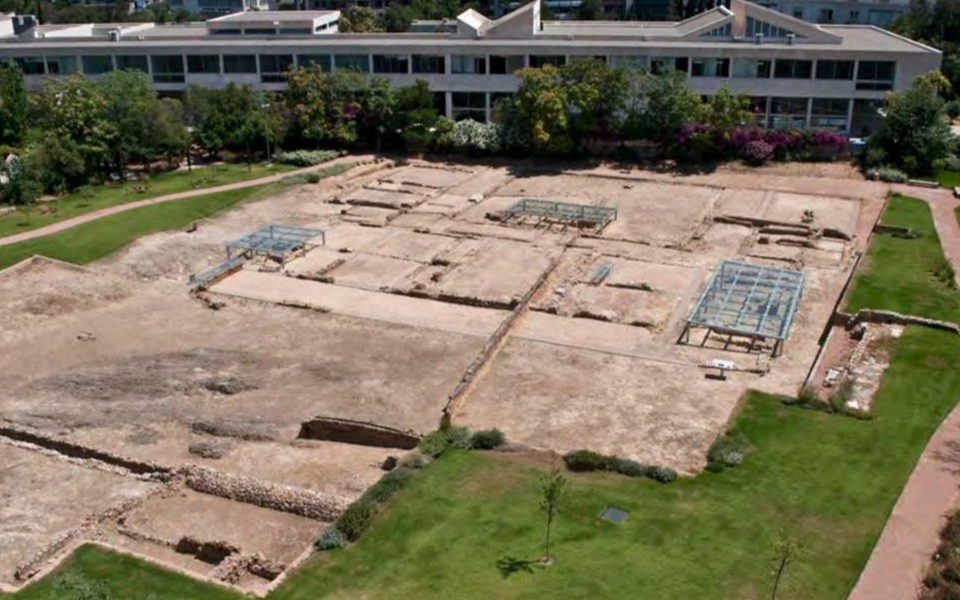
The archaeological site of the Lyceum of Aristotle in its current state.
© Hellenic Ministry of Culture
Just a few minutes’ walk from Syntagma Square, tucked between Rigillis Street, the Athens Conservatoire and the Byzantine and Christian Museum, Aristotle’s Lyceum occupies a peaceful green space in the heart of the modern city. Yet many Athenians – let alone visitors – pass by without realizing it is there.
The organized archaeological site, covering roughly ten acres, opened to the public in 2014 and remains accessible free of charge. Visitors can stroll along landscaped paths lined with rosemary, lavender, oregano and thyme while exploring the remains of an ancient gymnasium complex.
The most prominent structure uncovered here is the “palaestra,” an athletic training ground dating to the second half of the 4th century BC. Excavated in 1996 during rescue excavations, the complex once served athletes training in wrestling, boxing, and “pankration” – ancient Greece’s answer to mixed martial arts. It consisted of a central courtyard surrounded by porticoes and a series of symmetrical rooms used for exercise, bathing and instruction.
Yet the Lyceum’s significance extends far beyond athletics.
In 335 BC, Aristotle established his philosophical school here, teaching students as they walked through the shaded groves of the gymnasium. This habit of lecturing while strolling gave rise to the name “Peripatetic School,” derived from the Greek word “peripatein,” meaning “to walk.”
Alongside Plato’s Academy and the gymnasium of Kynosarges, the Lyceum formed part of a network of intellectual centers that helped shape the development of Western philosophy and education.
Over the centuries, Aristotle’s ideas – from logic and metaphysics to biology and ethics – would influence disciplines across the ancient world and far beyond.

: Walking with Aristotle: an augmented-reality walk offering a vivid digital reconstruction of the ancient Lyceum.
© Hellenic Ministry of Culture
One of the central components of the upgrade is the creation of a digital information pavilion dedicated to Aristotle’s life, philosophy, and enduring influence.
The project will be implemented by the National Centre for Scientific Research “Demokritos” and will take the form of a lightweight pavilion in the southern part of the archaeological site. Inside, visitors will find four interactive touchscreens presenting a range of multimedia content – including texts, historical images, videos, and digital reconstructions of what the ancient complex would have looked like in its prime.
Designed as a reversible and non-invasive structure, the pavilion will consist of four rectangular units covered by a corrugated canopy and accessible via ramps. The installation will also allow digital content to be regularly updated and expanded as new research emerges.
Beyond the pavilion itself, the digital experience will include storytelling elements and interpretive displays designed to help visitors understand how the Lyceum evolved over time and how it related to the wider city of Athens. These features aim to create a multisensory learning environment using AR (augmented reality), including digital walks – particularly appealing to younger audiences – while highlighting Aristotle’s global intellectual legacy.
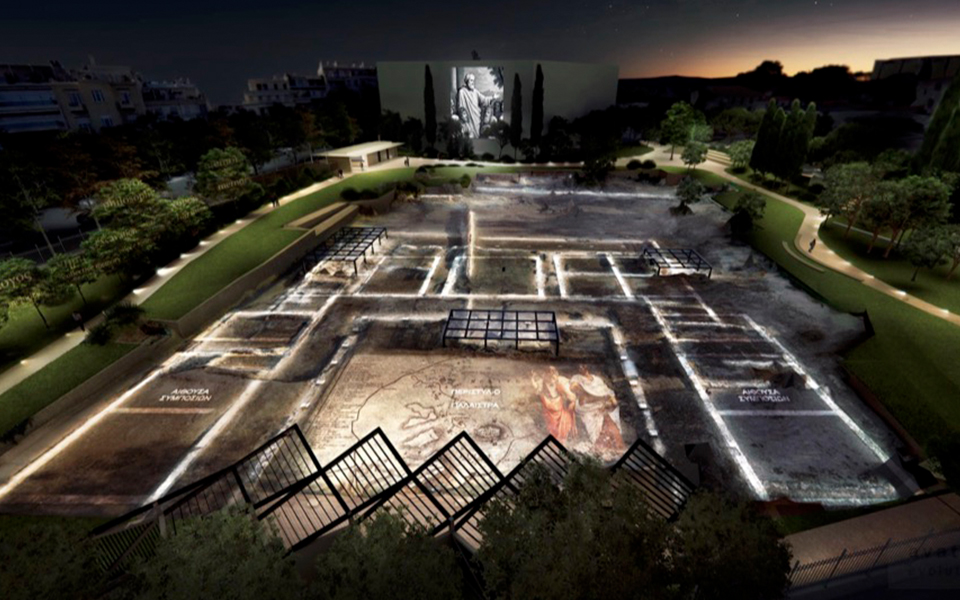
A proposed nighttime storytelling experience bringing the site to life after dark.
© Hellenic Ministry of Culture
A second project, developed by the Ministry of Culture in cooperation with the University of Crete’s School of Architecture, focuses on improving the site’s accessibility and visitor infrastructure.
Plans call for a new main entrance along Rigillis Street, accompanied by an elongated reception building housing ticketing services, visitor information and sanitary facilities. The building will run parallel to the street, replacing part of the existing fence and creating a clearer connection between the archaeological site and its surroundings.
Before the design process began, the area underwent extensive three-dimensional documentation – including aerial photogrammetry, static laser scanning, and mobile photogrammetry – to ensure precise scientific recording of the remains.
Plans also include a secondary entrance near the Athens Conservatoire, improving circulation between the two neighboring sites. Along the same axis, a small semicircular seating area for around 60 people will be created to host educational activities, lectures, and cultural events.
Plans to transform Ithaca’s “School of…
The renovation of Ernst Ziller’s richly…
Freshly conserved and reunited with its…

Ten new entries in Greece’s National…