Seven Ancient Roads You Can Still Walk in...
From Bronze Age highways to sacred...


© Shutterstock
Sometime towards the end of the 6th century BC, a woman made her way up the rocky west slope of the Athenian Acropolis, clutching in her hand a miniature bronze shield. The tiny object, just over 10cm in diameter, bore the “Gorgoneion” in its center, a stylized image of the decapitated head of Medusa, the snake-haired monster of Greek mythology; a popular apotropaic symbol that had long been associated with the goddess Athena. A dedicatory inscription had also been carefully etched around the shield’s circumference: ΦΡΥΓΙΑ ⋮ ΑΝΕΘΕΚΕ ΜΕ ΤΑΘΕΝΑΙΑΙ ΗΕ ΑΡΤΟΠΟΛΙ[Σ] (“Phrygia the bread-seller dedicated me to Athena”).
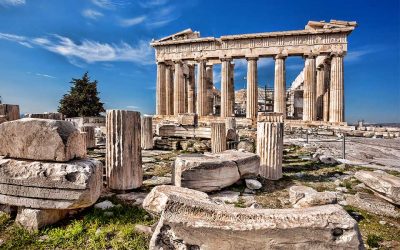
As the woman reached the top of the citadel and made her way to the limestone-built Temple of Athena Polias, “Protectress of the City,” the forerunner of the Erechtheion, she paused for a moment to survey the scene. Her eyes wandered across the multitude of marble statues and brightly painted ceramic vessels on bronze tripod bases, cluttering the spaces between the buildings and shrines, each one a dedication to the goddess by various aristocrats or wealthy citizens of the city.
Approaching the temple, she looked up and fixed her gaze on the central figure in its triangular west pediment, a huge marble statue of the goddess herself, arms outstretched and shrouded in her protective aegis, a magical cloak of unspeakable power. With disheveled, windswept hair, Phrygia the bread-seller bowed her head in reverence. Upon reaching the temple’s east-facing entrance, she presented her votive offering to the attendant priest and quietly withdrew.
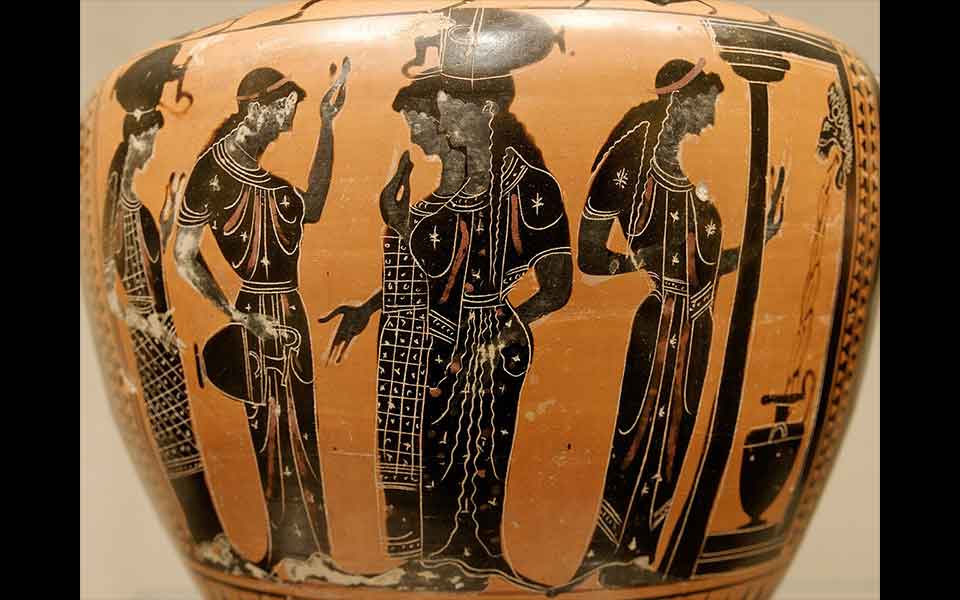
Women drawing water at the fountain house. Belly of an Attic black-figure hydria (water jug), c. 530 BC. On display at the Metropolitan Museum of Art, New York.
Phyrgia’s humble dedication to the goddess Athena, perhaps as a tithe amounting to one-tenth of her annual income (“dekate”), is one of a vast number of votive offerings found on the Sacred Rock, many dated to the 6th and early 5th centuries BC; a period when Athens was undergoing profound political reform as the world’s first known democracy. Currently on display in the Archaic Gallery of the Acropolis Museum in Athens alongside other such dedications, the miniature bronze shield is nevertheless quite unusual, as it’s one of only a handful of offerings known to have been made by a woman.
Close inspection of the artifact offers us a tantalizing glimpse into the life of its dedicant, a woman who lived and worked in the city over 2,500 years ago. We know nothing of her age or appearance, but her name “Phyrgia” denotes that she originally came from the region of Phrygia in central Asia Minor (modern-day Türkiye), then part of the vast Persian empire. As such, she was a non-Greek “metic,” or resident foreigner, and part of small but rapidly growing number of migrants coming to the city from the east. She was also a bread-seller, among the city’s poorest inhabitants.
Comic and literary sources often portray bread-sellers as noisy, aggressive, and socially coarse, pushing small carts around the city’s densely populated neighborhoods or attending stalls in the “agora,” or marketplace, certainly not the kind of work for a woman from a respectable Athenian household. And yet Phrygia was clearly not ashamed of her role and lowly status in her adopted city. On the contrary, she was proud of her contribution to its economy, and chose to spend a portion of her meager earnings to purchase and have inscribed her name and occupation on a simple yet beautiful bronze offering to the city’s patron goddess; a conspicuous display of her success, her faith, and how far she had come in life.

Symposium scene: banqueters playing the kottabos game while a girl plays the aulos. A wreath hanging on the wall. Laurel wreaths on the heads. Attic red-figure bell-krater.
If we relied only on the most famous male writers of ancient Greece, we might imagine Greek women as silent figures hidden behind household walls – quietly weaving, raising children, and rarely stepping into public life. Xenophon’s “Oeconomicus” (“Household Management,” c. 350 BC), for instance, offers a glimpse of the idealized Athenian wife managing the home from indoors. In it, the husband tells his wife: “your duty will be to remain indoors and send out those servants whose work is outside…” (7.35-36). Likewise, the speech “Against Neaira” (mid-4th century BC), delivered by Apollodorus in the name of Demosthenes, famously divides women into three categories: “mistresses [hetairai] we keep for the sake of pleasure, concubines for the daily care of our persons, but wives to bear us legitimate children…”
These male-authored stereotypes present us with an image that has stubbornly endured, presenting ancient Greek women as invisible, voiceless, and powerless. Yet the reality was far more complex.
Over the last fifty years, historians and archaeologists have radically reshaped our understanding of women in the ancient Greek world. What emerges is not a single story, but many. A wealthy Athenian woman lived very differently from a Spartan landowner – women in Sparta, for example, enjoyed unusually extensive property rights. The experiences of an immigrant bread-seller like Phrygia were worlds apart from those of a priestess at Delphi or a poet on Lesbos. Some women managed estates, others toiled in workshops and taverns. Some led sacred rituals attended by entire cities. A few became renowned intellectuals or even rulers. Most, however, lived lives that survive only in fragments: inscriptions, grave markers, courtroom speeches, household objects, and the occasional line of poetry.
As the historian Sarah Pomeroy observed in her groundbreaking Goddesses, Whores, Wives, and Slaves (1975), the challenge is that “the literary testimony presents grave problems… [because] the extant formal literature of classical antiquity was all written by men,” often shaped by deeply misogynistic assumptions. Ancient Greek women therefore reach us filtered through male voices – admired, feared, mocked, idealized, or controlled.
But when we look beyond the myths, a richer and more human picture emerges.
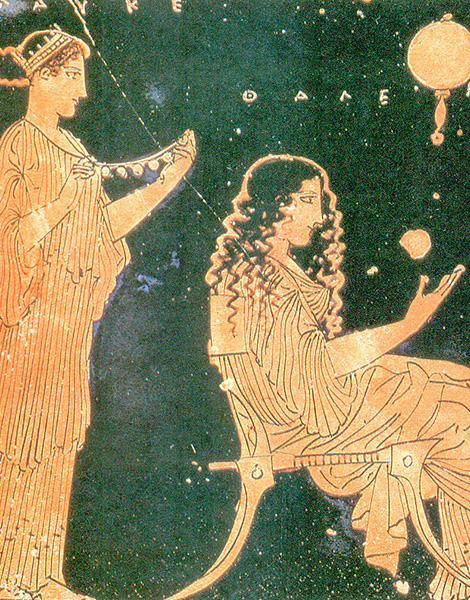
Athenian women preparing for a wedding (ceramic painting, 5th century BC).
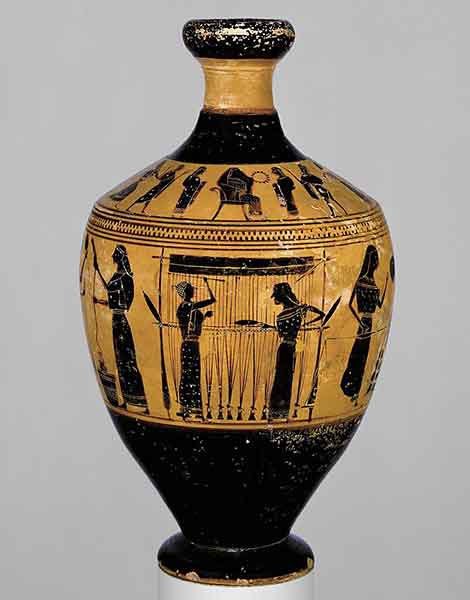
Black-Figure vase painting of women engaged in wool-working.
For many women, daily life revolved primarily around the household. In Classical Athens, respectable women were expected to oversee domestic management: weaving cloth, supervising enslaved workers, preparing food, and raising children. Xenophon’s “Oeconomicus” presents the household almost as a business enterprise, with the wife acting as its internal manager. “There is no greater blessing,” he writes, “than a good and capable wife” (7.42).
Yet even this supposedly secluded domestic sphere gave women considerable economic responsibility. Grain had to be stored, textiles produced, finances monitored, and servants directed. In House and Society in the Ancient Greek World (1999), archaeologist Lisa Nevett argues that the traditional image of women confined to isolated “women’s quarters” has often been exaggerated. Archaeological evidence from Greek houses suggests that domestic spaces were shared, flexible, and frequently reorganized according to season or circumstance. Women were not literally imprisoned away from men. And not all women could afford seclusion in the first place.
Poor women worked constantly. They sold ribbons, vegetables, bread, and perfume in markets. Others worked as nurses, midwives, wet nurses, tavern-keepers, textile workers, or agricultural laborers. Courtroom speeches occasionally reveal these realities almost by accident. In Demosthenes 57 (“Against Eubulides”), for example, a man’s mother is described earning a living by “selling ribbons in the agora and working as a wet nurse” to support her family.
Comedies like Aristophanes’ “Lysistrata” likewise depict women juggling errands, buying goods, and drinking wine together – comic exaggerations, perhaps, but rooted in recognizable social behavior. Textile production was especially important. Weaving was not merely symbolic “women’s work”; it was economically essential. Cloth production consumed enormous amounts of time and labor, and in many households women’s textile work contributed directly to family survival. The loom itself became a powerful cultural symbol, immortalized in Homer’s Penelope, Odysseus’ long-suffering wife, patiently weaving and unweaving her tapestry in the “Odyssey.”
Many households also depended heavily on the labor of enslaved women, whose experiences – from domestic service to sexual exploitation – remain among the most difficult to reconstruct from surviving sources.
But perhaps the greatest misconception about ancient Greek women is that they had no public role at all.
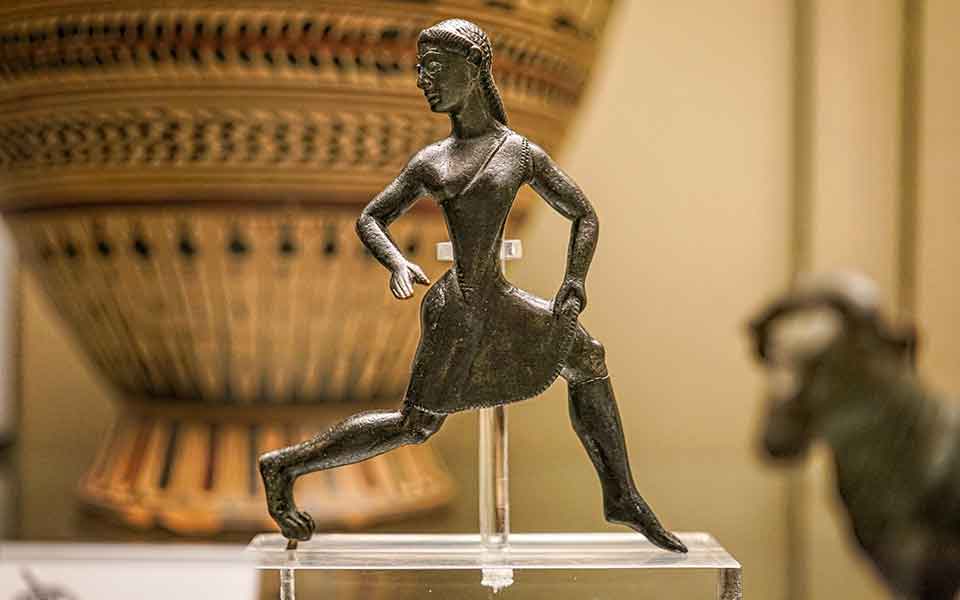
Spartan bronze figure of a running girl, wearing a single-shouldered chiton (c. 520-500 BC). On display at the British Museum, London.
Athens and Sparta have long been portrayed as polar opposites, and in some respects they were. Renowned for their warrior-based society, Spartan women enjoyed far greater economic freedom and public visibility than their Athenian counterparts, particularly in matters of property ownership and physical education.
While Athenian girls were typically educated within the confines of the “oikos” (household), Spartan girls exercised publicly, competed in athletics, and were expected to become physically strong – primarily to produce healthy sons for military service. Plutarch reports that the lawgiver Lycurgus, a semi-mythological statesman of the late 9th century BC, ordered girls “to exercise their bodies in running, wrestling, throwing the discus, and casting the javelin” (“Life of Lycurgus” 14).
Other Greeks often regarded Spartan women with suspicion or outright shock. Aristotle complained that they possessed too much luxury and influence. Yet Spartan women also benefited from unusually extensive property rights. By the 4th century BC, they reportedly owned a substantial proportion of Spartan land, with some modern scholars estimating as much as 40 percent.
Elsewhere in the Greek world, legal and social customs could differ significantly. In Gortyn on Crete, for instance, women’s inheritance rights were notably more liberal than those in Athens. Even so, historians caution against romanticizing Sparta as a “proto-feminist” society. As Pomeroy notes in Spartan Women (2002), Spartan freedoms existed within a rigid militarized system ultimately designed to serve the state.
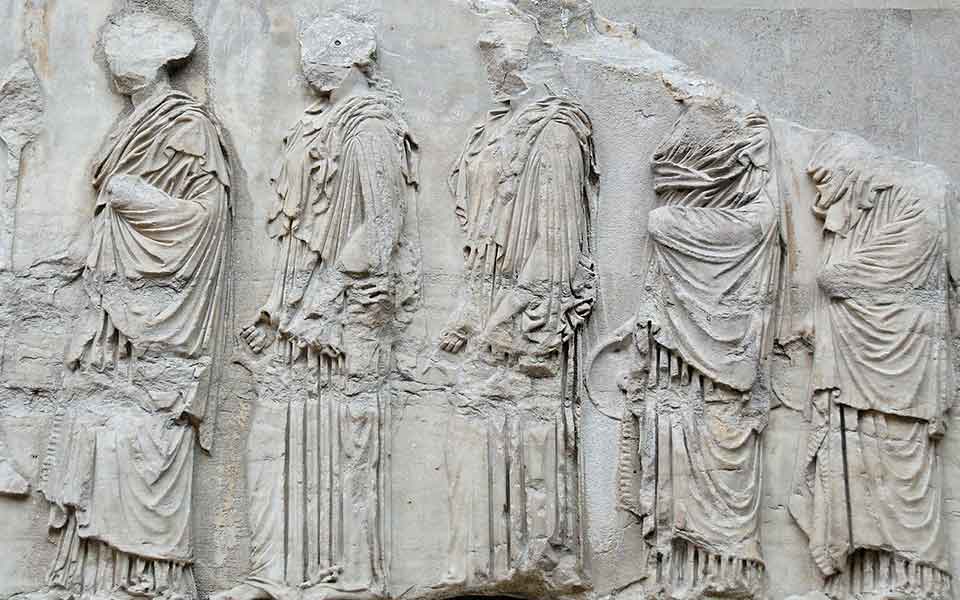
The Panathenaic Procession, honoring the patron goddess Athena, was Athens’ most important religious festival, in which women played a vitally important role. In this section of the Parthenon frieze, the leading maiden carries an incense burner, while those behind her carry vessels for pouring libations.
In the sacred sphere, women could occupy positions of remarkable visibility and authority. “Greek religion,” writes archaeologist Joan Breton Connelly in Portrait of a Priestess (2007), “gave women a voice, a presence, and an authority denied them in other areas of civic life.” Priestesses presided over sacrifices, festivals, and temple rituals attended by entire communities. Some offices were prestigious enough to bring wealth, public honor, and significant political influence.
The priestess of Athena Polias in Athens was among the city’s most important religious figures. At Delphi, the Pythia – Apollo’s priestess – delivered prophecies consulted by kings and city-states across the Greek world. Women also held senior positions at sanctuaries such as Eleusis (Demeter) and Brauron (Artemis). Young girls participated in sacred rites as “arrephoroi” (“basket-bearers”), as seen on the Parthenon frieze, while married women dominated festivals such as the “Thesmophoria,” a major fertility celebration held in honor of Demeter. Men were excluded from many of these rituals.
Aristophanes’ comedy “Thesmophoriazusae” (“The Women at the Thesmophoria,” 411 BC) playfully imagines the chaos that follows when a man infiltrates the women-only religious festival in disguise. Beneath the humor lies an important truth: religion created female-controlled spaces within Greek civic life.
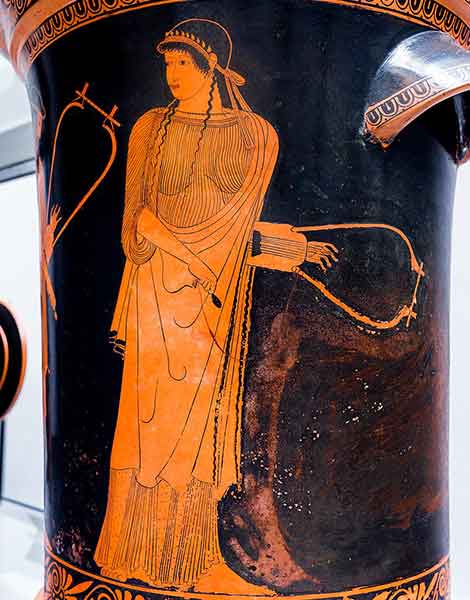
One of the earliest surviving images of the poet Sappho. Attic red figure krater, c. 470 BC.

Since respectable Athenian women could not attend symposia, prostitutes entertained guests. A red-figure kylix (drinking cup) with a woman playing a game, Athens, c. 500 BC.
Of course, some women transcended conventional expectations altogether.
The poet Sappho, writing on Lesbos around 600 BC, remains one of the most extraordinary female voices to survive from antiquity. Although much of her poetry survives only in fragments, her work reveals an intensely personal and emotional world rarely heard elsewhere in Greek literature. In one famous lyric poem, Fragment 31, she describes the physical shock of desire:
“… a subtle fire has run over my skin;
I cannot see anything with my eyes,
And my ears are buzzing.”
To ancient readers, Sappho was simply known as “the Poetess,” while Plato later dubbed her the “Tenth Muse.”
Other women became famous through intellect or political influence. Aspasia of Miletus (c. 470 – after 428 BC), a foreign-born consort of Pericles, was celebrated for her wit and intelligence and was said to have influenced leading Athenian thinkers, including Socrates. In Plato’s “Menexenus,” Socrates jokingly claims she taught him rhetoric.
Ancient Greek society also distinguished between different categories of sex workers. “Pornai” – from which the word “pornography” derives – were common prostitutes who generally worked in brothels and served men from across the social spectrum. “Hetairai,” by contrast, were elite companions associated with educated male social circles. Some were evidently trained in music, literature, and conversation, participating in “symposia,” the famous all-male drinking parties of the Greek elite. Modern scholars continue to debate the precise social role of hetairai, whose status likely varied considerably.
Among the most famous was Phryne (c. 371 – after 316 BC), originally from Thespiae in Boeotia. A semi-legendary story claims that during her trial for impiety, she bared her breasts before the all-male jury, which – awestruck by her beauty – immediately acquitted her. Despite her humble origins, she became one of the wealthiest women of her age. According to later tradition, she even offered to finance the rebuilding of Thebes after its destruction by Alexander the Great in 335 BC, on the condition that the inscription read: “Destroyed by Alexander, restored by Phryne the courtesan.”
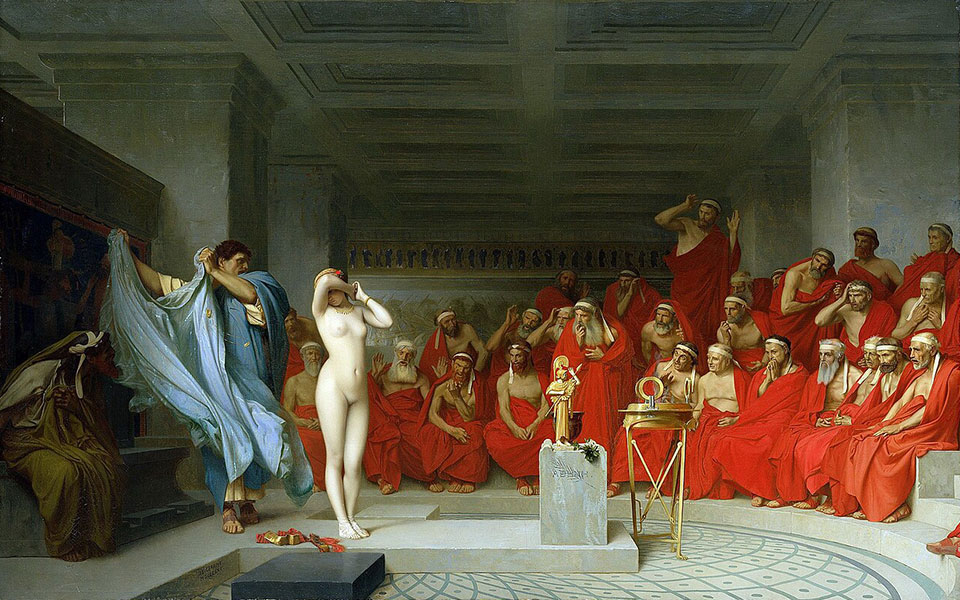
Phryne Before the Areopagus by Jean-Léon Gérôme, c. 1861
By the Hellenistic era, following the conquests of Alexander the Great, elite women appeared even more visibly in public life. Queens such as Arsinoë II (c. 316 – c. 270-268 BC) and Cleopatra VII (70/69 – 30 BC) – both of Greek Macedonian stock – wielded extraordinary political power in Ptolemaic Egypt. Wealthy women sponsored temples, financed public buildings, and issued decrees in their own names. Inscriptions from across the eastern Mediterranean reveal women acting as civic benefactors and religious patrons.
Yet for all these exceptional figures, most ancient Greek women lived ordinary lives beyond the notice of historians. Their traces survive in quieter forms: grave “stelai” showing women holding jewelry boxes or clasping hands with family members; loom weights worn smooth by years of use; perfume jars buried with the dead; inscriptions recording dedications to goddesses. These fragments matter because they complicate the old stereotypes.
Ancient Greek society was undeniably patriarchal. Women in many cities lacked political rights, formal education, and legal independence, and in the earlier Archaic and Classical periods, scholars have argued that veiling in public may have been a common practice among married Athenian women. Marriage was often arranged young, typically around 14 or 15 (20 in Sparta). Childbirth was dangerous. Respectable women were expected to uphold ideals of modesty and domesticity. According to classicist Paul Cartledge, “the richer you were, broadly speaking, the more confined you were.”
But ancient Greek women were never merely passive figures in the background of history. They worked. They worshipped. They managed households and estates. They composed poetry, sold goods, mourned the dead, participated in festivals, raised families, and preserved religious traditions central to civic life.
And perhaps that is the most important lesson of all: there was no single experience of being a woman in ancient Greece. The women of Athens, Sparta, Lesbos, Delphi, Alexandria, and countless smaller communities inhabited very different worlds, and to speak of “the ancient Greek woman” is almost as misleading as speaking of “the modern European woman” as though centuries, cultures, and class differences did not matter.
The marble statues may seem silent today. But through archaeology, literature, inscriptions, and poetry, ancient Greek women are slowly speaking again – like Phrygia, the bread-seller – not as myths, but as people.
From Bronze Age highways to sacred...
Here’s how to get better at...

Ancient Greece had its own team...
Archaeology reveals powerful Iron Age women...